







Question: A pump operates at a constant speed of 1500 rpm and delivers water through a 300 m long pipeline to an elevated tank 20
![QUESTION 4 [25] 3- You are presented with pump characteristic charts with five different types of pumps as shown in Appendix](https://dsd5zvtm8ll6.cloudfront.net/si.experts.images/questions/2021/05/608fd2844010e_1620038270982.jpg)
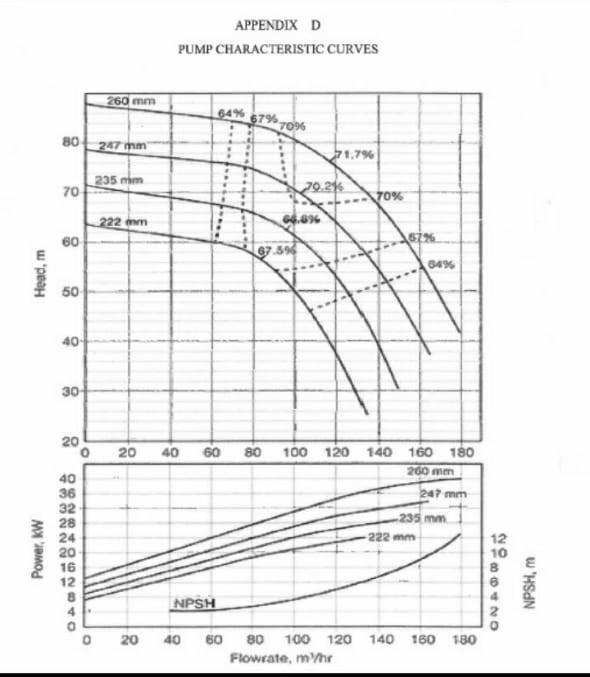
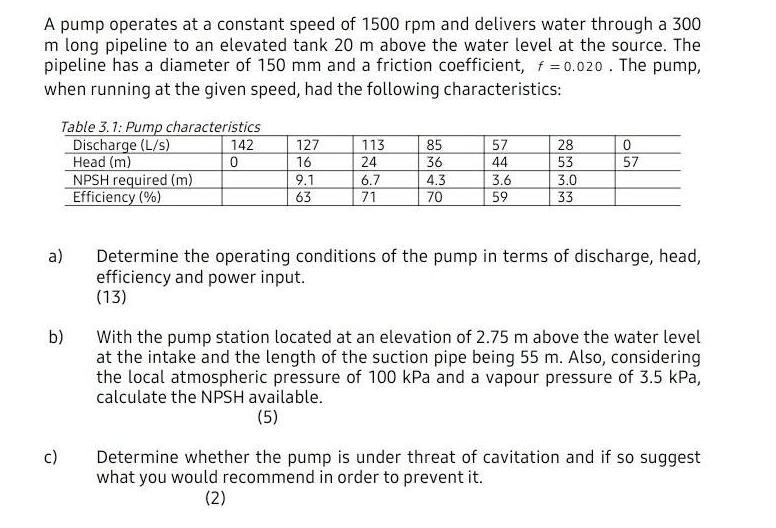
A pump operates at a constant speed of 1500 rpm and delivers water through a 300 m long pipeline to an elevated tank 20 m above the water level at the source. The pipeline has a diameter of 150 mm and a friction coefficient, f = 0.020. The pump, when running at the given speed, had the following characteristics: Table 3.1: Pump characteristics Discharge (L/s) Head (m) NPSH required (m) Efficiency (%) 142 127 113 85 57 28 16 24 36 44 57 9.1 63 6.7 71 4.3 70 3.6 59 3.0 33 a) Determine the operating conditions of the pump in terms of discharge, head, efficiency and power input. (13) b) With the pump station located at an elevation of 2.75 m above the water level at the intake and the length of the suction pipe being 55 m. Also, considering the local atmospheric pressure of 100 kPa and a vapour pressure of 3.5 kPa, calculate the NPSH available. (5) c) Determine whether the pump is under threat of cavitation and if so suggest what you would recommend in order to prevent it. (2) N533 QUESTION 4 [25] You are presented with pump characteristic charts with five different types of pumps as shown in Appendix D. These pumps are classified in terms of their impeller sizes, with the smallest pump having an impeller size of 222 mm and the largest pump having impeller size of 260 mm. Now, the job at hand is to pump water from a lake to a reservoir through a 150 mm galvanized iron pipe (k = 0.15 mm). The total length of the pipeline between the lake and the reservoir is 500 m. If the difference in elevation between the lake and the reservoir is 26 m, determine the pumping head, discharge, NPSHR, efficiency and power input to the pump when the following pumps are selected: 4.1 a) 235-mm impeller pump. (8) b) 260-mm impeller pump. (5) If the local atmospheric pressure is 101.1 kPa and the vapour pressure in the water is 3.5 kPa, determine whether cavitation would be a problem in the system when working under the following conditions: - Suction length, L = 60 m. - Static suction head, hs = 3.5 m above water level - Pump selected: 247 mm diameter impeller. 4.2 (5) It is expected that over a period of 20 years, the roughness size of the pipe will increase quite considerably. For some reasons, this pipe will then have to be replaced with a commercial steel pipe (k = 0.045 mm), but smaller with a diameter of 100 mm. Considering this change, determine the percentage increase or decrease of pumping discharge if the smallest pump is selected. (7) 4.3 APPENDIX D PUMP CHARACTERISTIC CURVES 260 mm 64% 67% 70% 80 247 mm 71,7% 235 mm 70 70.26 70% 222 m 60 67% 7.5% 64% 50 40 30 20 20 40 60 80 100 120 140 160 180 260 mm 40 36 32 28 24 20 16 12 247 mm 235 mm 222 mm 12 10 NPSH 4 80 100 120 140 160 180 Flowrate, m'hr 20 40 60 Power, kW Head, m NPSH, m
Step by Step Solution
3.42 Rating (161 Votes )
There are 3 Steps involved in it
Solution 3 We are plotting a graph with the valu... View full answer

Get step-by-step solutions from verified subject matter experts
Document Format (2 attachments)

60915c5db1c02_209855.pdf
180 KBs PDF File

60915c5db1c02_209855.docx
120 KBs Word File
 Study Help