







Question: https://www.compadre.org/Physlets/optics/ex35_5.cfm Open the simulation Lens Maker's Equation There are sliders on the bottom of the simulation, radius of curvature of right and left sies of
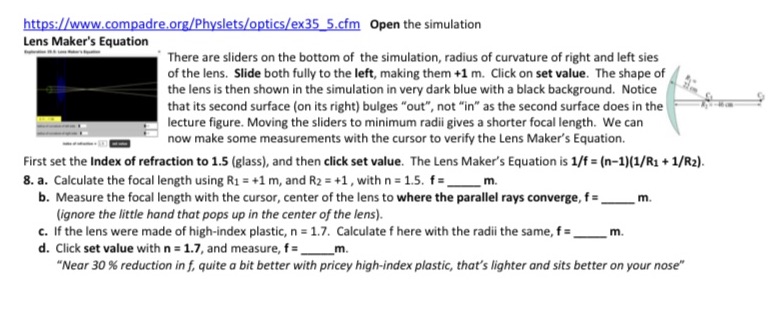
https://www.compadre.org/Physlets/optics/ex35_5.cfm Open the simulation Lens Maker's Equation There are sliders on the bottom of the simulation, radius of curvature of right and left sies of the lens. Slide both fully to the left, making them +1 m. Click on set value. The shape of the lens is then shown in the simulation in very dark blue with a black background. Notice that its second surface (on its right) bulges "out", not "in" as the second surface does in the lecture figure. Moving the sliders to minimum radii gives a shorter focal length. We can now make some measurements with the cursor to verify the Lens Maker's Equation. First set the Index of refraction to 1.5 (glass), and then click set value. The Lens Maker's Equation is 1/f = (n-1)(1/R1 + 1/R2). 8. a. Calculate the focal length using R1 = +1 m, and R2 = +1 , with n = 1.5. f= m. b. Measure the focal length with the cursor, center of the lens to where the parallel rays converge, f = m (ignore the little hand that pops up in the center of the lens). c. If the lens were made of high-index plastic, n = 1.7. Calculate f here with the radii the same, f = m. d. Click set value with n = 1.7, and measure, f= m. "Near 30 % reduction in f, quite a bit better with pricey high-index plastic, that's lighter and sits better on your nose"
Step by Step Solution
There are 3 Steps involved in it

Get step-by-step solutions from verified subject matter experts
 Study Help