







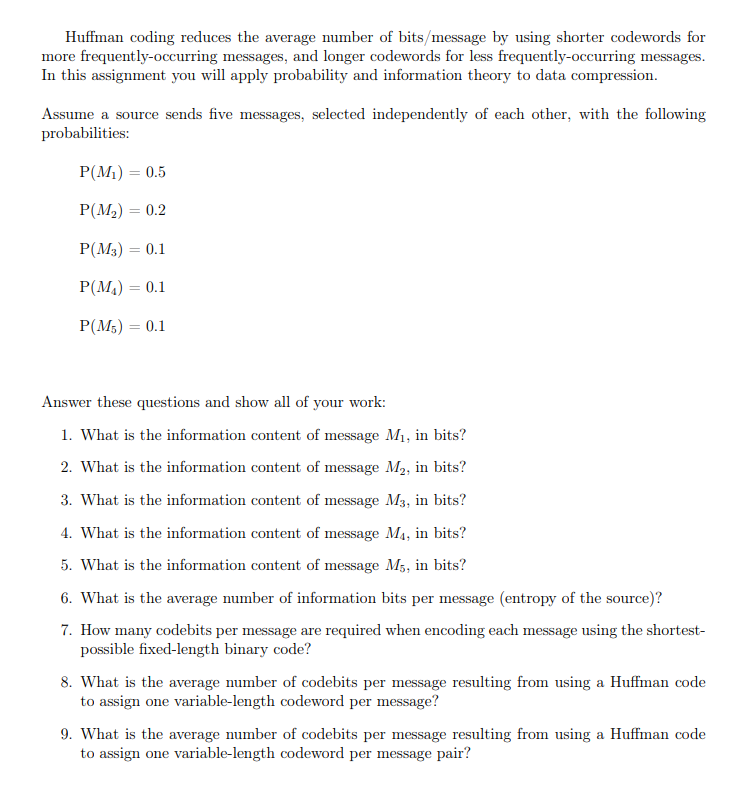
Question: Huffman coding reduces the average number of bits / message by using shorter codewords for more frequently - occurring messages, and longer codewords for less
Huffman coding reduces the average number of bitsmessage by using shorter codewords for
more frequentlyoccurring messages, and longer codewords for less frequentlyoccurring messages.
In this assignment you will apply probability and information theory to data compression.
Assume a source sends five messages, selected independently of each other, with the following
probabilities:
Answer these questions and show all of your work:
What is the information content of message in bits?
What is the information content of message in bits?
What is the information content of message in bits?
What is the information content of message in bits?
What is the information content of message in bits?
What is the average number of information bits per message entropy of the source
How many codebits per message are required when encoding each message using the shortest
possible fixedlength binary code?
What is the average number of codebits per message resulting from using a Huffman code
to assign one variablelength codeword per message?
What is the average number of codebits per message resulting from using a Huffman code
to assign one variablelength codeword per message pair?
Step by Step Solution
There are 3 Steps involved in it
1 Expert Approved Answer
Step: 1 Unlock

Question Has Been Solved by an Expert!
Get step-by-step solutions from verified subject matter experts
Step: 2 Unlock
Step: 3 Unlock
 Study Help