







Question: Human Knee Joint ( 2 2 pts ) In the human knee joint, synovial fluid is provided by a thin layer that separates the cartilage
Human Knee Joint pts
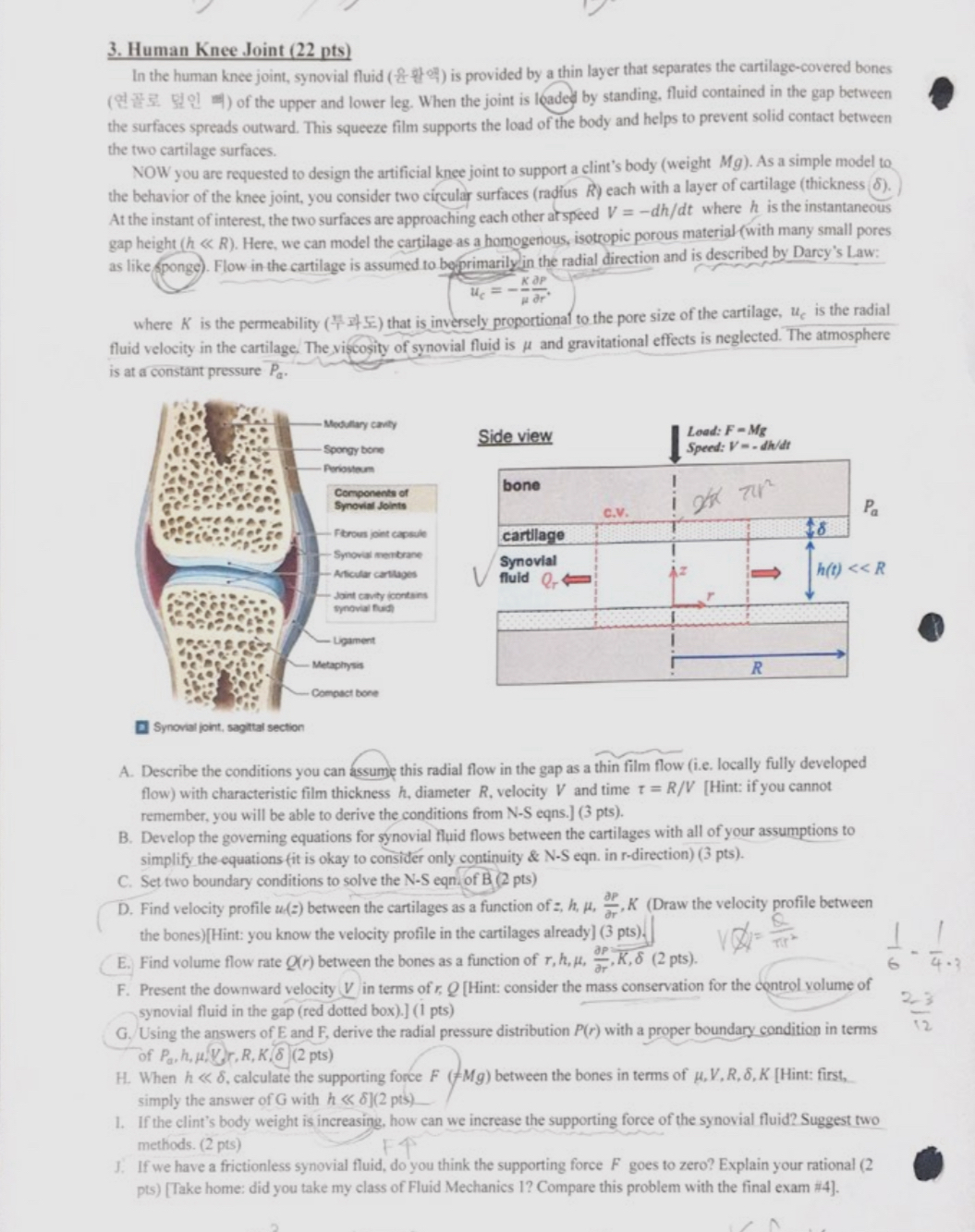
In the human knee joint, synovial fluid is provided by a thin layer that separates the cartilagecovered bones of the upper and lower leg. When the joint is leaded by standing, fluid contained in the gap between the surfaces spreads outward. This squeeze film supports the load of the body and helps to prevent solid contact between the two cartilage surfaces.
NOW you are requested to design the artificial knee joint to support a clint's body weight Mg As a simple model to the behavior of the knee joint, you consider two circular surfaces radius each with a layer of cartilage thickness At the instant of interest, the two surfaces are approaching each other atspeed where is the instantaneous gap height Here, we can model the cartilage as a homogenous, isotropic porous material with many small pores as like ponge Flow in the cartilage is assumed to borprimarity in the radial direction and is described by Darcy's Law:
where is the permeability that is inversely proportional to the pore size of the cartilage, is the radial fluid velocity in the cartilage. The vigcogity of synovial fluid is and gravitational effects is neglected. The atmosphere is at a constant pressure
Synovial joint, sagitulal section
A Describe the conditions you can assume this radial flow in the gap as a thin film flow ie locally fully developed flow with characteristic film thickness diameter velocity and time Hint: if you cannot remember, you will be able to derive the conditions from eqns. pts
B Develop the goveming equations for synovial fluid flows between the cartifages with all of your assumptions to simplify the equations it is okay to consider only continuity & NS eqn. in rdirection pts
C Set two boundary conditions to solve the NS eqn. of B pts
D Find velocity profile between the cartilages as a function of Draw the velocity profile between the bonesHint: you know the velocity profile in the cartilages already pts
E Find volume flow rate between the bones as a function of pts
F Present the downward velocity in terms of Hint: consider the mass conservation for the control volume of synovial fluid in the gap red dotted box pts
G Using the answers of E and F derive the radial pressure distribution with a proper boundary condition in terms of pts
H When calculate the supporting force
Step by Step Solution
There are 3 Steps involved in it
1 Expert Approved Answer
Step: 1 Unlock

Question Has Been Solved by an Expert!
Get step-by-step solutions from verified subject matter experts
Step: 2 Unlock
Step: 3 Unlock
 Study Help