



Question: Human Relations in Business Chapter 1 answer on these questions after reading this text. CASE / / / W. L. Gore & Associates: How Employees
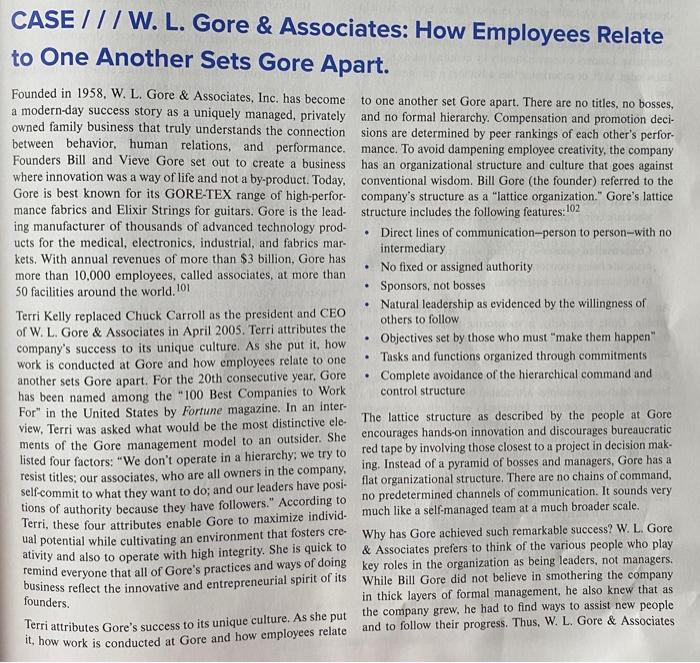
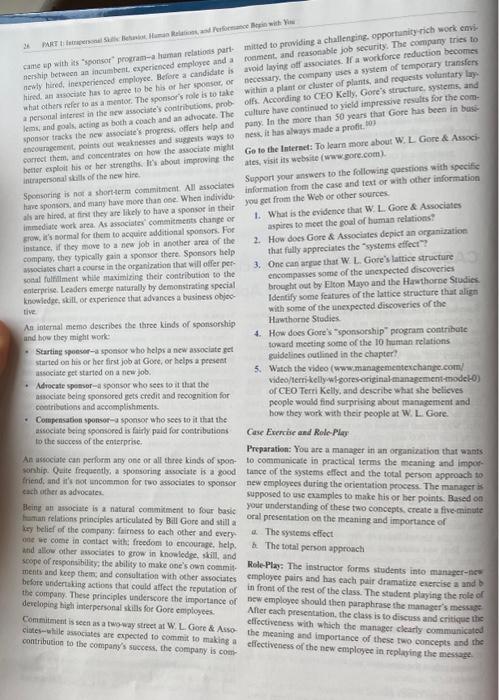
CASE / / / W. L. Gore \& Associates: How Employees Relate to One Another Sets Gore Apart. Founded in 1958, W. L. Gore \& Associates, Inc. has become a modern-day success story as a uniquely managed, privately owned family business that truly understands the connection between behavior, human relations, and performance. Founders Bill and Vieve Gore set out to create a business where innovation was a way of life and not a by-product. Today, Gore is best known for its GORE-TEX range of high-performance fabrics and Elixir Strings for guitars. Gore is the leading manufacturer of thousands of advanced technology products for the medical, electronics, industrial, and fabrics markets. With annual revenues of more than $3 billion, Gore has more than 10,000 employees, called associates, at more than 50 facilities around the world. 101 Terri Kelly replaced Chuck Carroll as the president and CEO of W. L. Gore \& Associates in April 2005. Terri attributes the company's success to its unique culture. As she put it, how work is conducted at Gore and how employees relate to one another sets Gore apart. For the 20th consecutive year, Gore has been named among the " 100 Best Companies to Work For" in the United States by Fortune magazine. In an interview, Terri was asked what would be the most distinctive elements of the Gore management model to an outsider. She listed four factors: "We don't operate in a hierarchy; we try to resist titles; our associates, who are all owners in the company, self-commit to what they want to do; and our leaders have positions of authority because they have followers." According to Terri, these four attributes enable Gore to maximize individual potential while cultivating an environment that fosters creativity and also to operate with high integrity. She is quick to remind everyone that all of Gore's practices and ways of doing business reflect the innovative and entrepreneurial spirit of its founders. Terri attributes Gore's success to its unique culture. As she put it, how work is conducted at Gore and how employees relate to one another set Gore apart. There are no titles, no bosses, and no formal hierarchy. Compensation and promotion decisions are determined by peer rankings of each other's performance. To avoid dampening employee creativity, the company has an organizational structure and culture that goes against conventional wisdom. Bill Gore (the founder) referred to the company's structure as a "lattice organization." Gore's lattice structure includes the following features: 102 - Direct lines of communication-person to person-with no intermediary - No fixed or assigned authority - Sponsors, not bosses - Natural leadership as evidenced by the willingness of others to follow - Objectives set by those who must "make them happen" - Tasks and functions organized through commitments - Complete avoidance of the hierarchical command and control structure The lattice structure as described by the people at Gore encourages hands-on innovation and discourages bureaucratic red tape by involving those closest to a project in decision making. Instead of a pyramid of bosses and managers, Gore has a flat organizational structure. There are no chains of command, no predetermined channels of communication. It sounds very much like a self-managed team at a much broader scale. Why has Gore achieved such remarkable success? W. L. Gore \& Associates prefers to think of the various people who play key roles in the organization as being leaders, not managers. While Bill Gore did not believe in smothering the company in thick layers of formal management, he also knew that as the company grew, he had to find ways to assist new people and to follow their progress. Thus, W. L. Gore \& Associates came ap with its "sponsof' propram-a luman relatiods partnership between an incumbent experienced employec and a newly hired, inevpericneed employce. Before a candidate is hired. an associate has to aprec to be his of her spossor, or what others refer to is a meator. The sponsor's role is to tale a personal interest in the new associate's contributions; probkems, and pools, acting as both a coach and as achocase. The sponsor tracks the ned associate's progress. offer help and etocouragencit. points out meaknesses and sugecits ways to sorrost them, and concentrates on hore the asociate might betaer exploif his ef her strengths. Its about improwine the intrapersonal walls of the new hite. Sponsoritg is not a shortterm commitmeat. All associate have sponion, and many bave moce than oee. When individuals are hired, at first they are likcly to have a sponsor in their imetdiate woek area. As associates' comenitments change or grow, li's sormal for ibem to acquice additional spotsen. Foe inutance, if they move to a new job in another area of the company, they typically gail a sponsoe thete. Sponsors belp avoctates chart z cocrse in the organiration that will ofler persodal folfillment whise maximizing their contribution to the enterprise. Leaders emerge naturally by demonstrating special knowiedze, skill, or experience that advances a business objoctive An internal memo describes the throo kinds of sponsonhip and tow they mipht work: - Starting spoesor-a speesor who helps a new associate get started on his or her first job at Goce, of Aelps a peesect associate get started on a new job. - Nhocate spotser-a sponsor who sees to it that the asacciate being sponsored gets eredit and recognition for cootributions and accomplishments. - Cotnpensation sponsor-a spoensor who sees to it that the asseciate being sponoered is fairly paid for contributioas to the success of the enierprise. An ussociate can perform any onc or all three kiads of spon*orhip. Qeite frequently, a sponsoring associate is a good friend, and if's bot uncommon for two associales to sponsor each other as advocater. Geing an associale is a natural commitrinent to four basic heman relations principles articulated by Bill Gore and still a ky belief of the companys faimess to each other-and every whd allow other associstes to grow in knowledge, sill, and scope of responvibilisy, the abilify to make one's own coamit. ments and ketp them; and consultation with ofher-associates before undertaking actions that could affect the repatation of the company. These principles underscote the importance of deteloping high interperional skills for Gore cmiployees. Commitment is seen as a two way street at W. L. Goec \& Associofes-while aswociates are copected fo commit to making a contribution to the company's success, the company is coin. Initted to providing a challenging- opportanity-rich work cevirogment. and reasonable job security. The company tries to woid laying otf associates. If a workforte teduction becomis necebsary, the company wes a system of temporary transfers. offs. According to CFO Kelly, Gore's structure, systems, and culture have continued to yicld impressive thalts for the company. In the more than 50 years that Gore has been in bussness, it has always made a profit. 603 Go to the Interect: To kam more about W, L Core \& Assceiates, visit its website (wma gore.cotn). Support your answers to the following questions with specife information from the case and teat of with other information you get fram the Wob or other sources: 1. What is the evidence that W. L. Gore \& Associates aspires to meet the posi of humas relations? 2. How doss Gore \& Associates depict an organization that fully appreciates the "systems etfect"? 3. One can afpoe that W: L. Gore's lattice structure escoenpasses some of the unexpected discoveries brocklat out by Elton Mayo and the Harwhorne Siudies. Identify some features of the lattice structure that align with some of the unexpected discoveries of the Hawthorne Srodies. 4. How does Gore's "sponsorship" program contribate torard mecting some of the 10 humtan relations guidelines outlined in the chapter? 5. Watcl the video (wwwimanagemeatexchangecom) video/ierrikellywtgotes-originalmanagement-model.0) or CEO Terri Kelly, and describe what she beticves people wovild find surprising about management and bow they work with their people at W. L. Gote. Case Exerrice and Role-Play Preparation: You are a manacer it an organization that wants to communicate in practical terms the meaning and importance of the systems effect and the total person approach to new employec during the orientation peocess. The manuet is supposed to ase caamples to make his or her points: Based on your understanding of these two concepts. create a frve-minute oral presentation on the meaniag and importance of a. The systems elfect b. The total persoe approach Role-Play; The instructor forms students into munaper-ace employec pairs and has each pair dramatize evercise a and b in front of the rest of the class. The stedent playing the role of Dew employes should then paraphrase the manager's messuge Niter each presentation, the class is to discuss and critique the eflectiveness with which the manager clearly communicated the meaning and importance of these two concepts and the effectiveness of the new emplogee in replaving the mesuage
Step by Step Solution
There are 3 Steps involved in it

Get step-by-step solutions from verified subject matter experts