







Question: Human Resource management chapters 9 and 10 1. Define total compensation. 2. Compensation serves as a signaling function. What does this mean? 3. in compensation
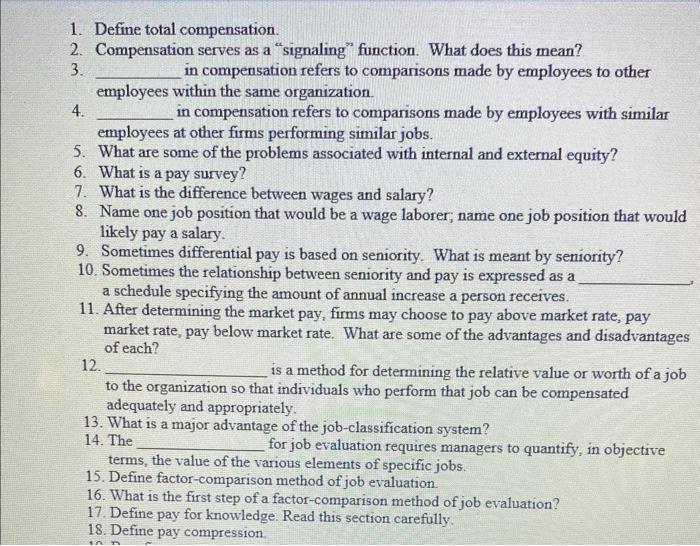
1. Define total compensation. 2. Compensation serves as a "signaling" function. What does this mean? 3. in compensation refers to comparisons made by employees to other employees within the same organization. 4. in compensation refers to comparisons made by employees with similar employees at other firms performing similar jobs. 5. What are some of the problems associated with internal and external equity? 6. What is a pay survey? 7. What is the difference between wages and salary? 8. Name one job position that would be a wage laborer; name one job position that would likely pay a salary. 9. Sometimes differential pay is based on seniority. What is meant by seniority? 10. Sometimes the relationship between seniority and pay is expressed as a a schedule specifying the amount of annual increase a person receives. 11. After determining the market pay, firms may choose to pay above market rate, pay market rate, pay below market rate. What are some of the advantages and disadvantages of each? 12. is a method for determining the relative value or worth of a job to the organization so that individuals who perform that job can be compensated adequately and appropriately. 13. What is a major advantage of the job-classification system? 14. The for job evaluation requires managers to quantify, in objective terms, the value of the various elements of specific jobs. 15. Define factor-comparison method of job evaluation. 16. What is the first step of a factor-comparison method of job evaluation? 17. Define pay for knowledge. Read this section carefully. 18. Define pay compression
Step by Step Solution
There are 3 Steps involved in it

Get step-by-step solutions from verified subject matter experts
 Study Help