







Question: Hurte-Paroxysm (B) Hurte-Paroxysm Products, Inc. (B). Hurte-Paroxysm Products, Inc. (HP) of the United States, exports computer printers to Brazil, whose currency, the reais (BRL) has
Hurte-Paroxysm (B)
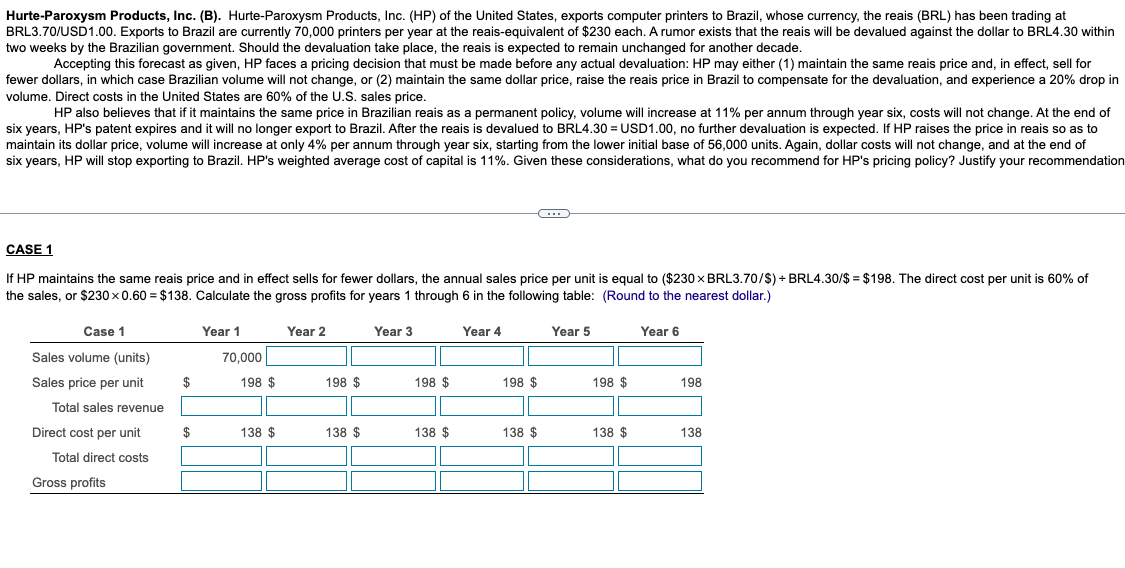
Hurte-Paroxysm Products, Inc. (B). Hurte-Paroxysm Products, Inc. (HP) of the United States, exports computer printers to Brazil, whose currency, the reais (BRL) has been trading at BRL3.70/USD1.00. Exports to Brazil are currently 70,000 printers per year at the reais-equivalent of $230 each. A rumor exists that the reais will be devalued against the dollar to BRL4.30 within two weeks by the Brazilian government. Should the devaluation take place, the reais is expected to remain unchanged for another decade. Accepting this forecast as given, HP faces a pricing decision that must be made before any actual devaluation: HP may either (1) maintain the same reais price and, in effect, sell for fewer dollars, in which case Brazilian volume will not change, or (2) maintain the same dollar price, raise the reais price in Brazil to compensate for the devaluation, and experience a 20% drop in volume. Direct costs in the United States are 60% of the U.S. sales price. HP also believes that if it maintains the same price in Brazilian reais as a permanent policy, volume will increase at 11% per annum through year six, costs will not change. At the end of six years, HP's patent expires and it will no longer export to Brazil. After the reais is devalued to BRL4.30 = USD1.00, no further devaluation is expected. If HP raises the price in reais so as to maintain its dollar price, volume will increase at only 4% per annum through year six, starting from the lower initial base of 56,000 units. Again, dollar costs will not change, and at the end of six years, HP will stop exporting to Brazil. HP's weighted average cost of capital is 11%. Given these considerations, what do you recommend for HP's pricing policy? Justify your recommendatior CASE 1 If HP maintains the same reais price and in effect sells for fewer dollars, the annual sales price per unit is equal to ($230BRL3.70/$)BRL4.30/$=$198. The direct cost per unit is 60% of the sales, or $2300.60=$138. Calculate the gross profits for years 1 through 6 in the following table: (Round to the nearest dollar.) Hurte-Paroxysm Products, Inc. (B). Hurte-Paroxysm Products, Inc. (HP) of the United States, exports computer printers to Brazil, whose currency, the reais (BRL) has been trading at BRL3.70/USD1.00. Exports to Brazil are currently 70,000 printers per year at the reais-equivalent of $230 each. A rumor exists that the reais will be devalued against the dollar to BRL4.30 within two weeks by the Brazilian government. Should the devaluation take place, the reais is expected to remain unchanged for another decade. Accepting this forecast as given, HP faces a pricing decision that must be made before any actual devaluation: HP may either (1) maintain the same reais price and, in effect, sell for fewer dollars, in which case Brazilian volume will not change, or (2) maintain the same dollar price, raise the reais price in Brazil to compensate for the devaluation, and experience a 20% drop in volume. Direct costs in the United States are 60% of the U.S. sales price. HP also believes that if it maintains the same price in Brazilian reais as a permanent policy, volume will increase at 11% per annum through year six, costs will not change. At the end of six years, HP's patent expires and it will no longer export to Brazil. After the reais is devalued to BRL4.30 = USD1.00, no further devaluation is expected. If HP raises the price in reais so as to maintain its dollar price, volume will increase at only 4% per annum through year six, starting from the lower initial base of 56,000 units. Again, dollar costs will not change, and at the end of six years, HP will stop exporting to Brazil. HP's weighted average cost of capital is 11%. Given these considerations, what do you recommend for HP's pricing policy? Justify your recommendatior CASE 1 If HP maintains the same reais price and in effect sells for fewer dollars, the annual sales price per unit is equal to ($230BRL3.70/$)BRL4.30/$=$198. The direct cost per unit is 60% of the sales, or $2300.60=$138. Calculate the gross profits for years 1 through 6 in the following table: (Round to the nearest dollar.)
Step by Step Solution
There are 3 Steps involved in it

Get step-by-step solutions from verified subject matter experts
 Study Help