







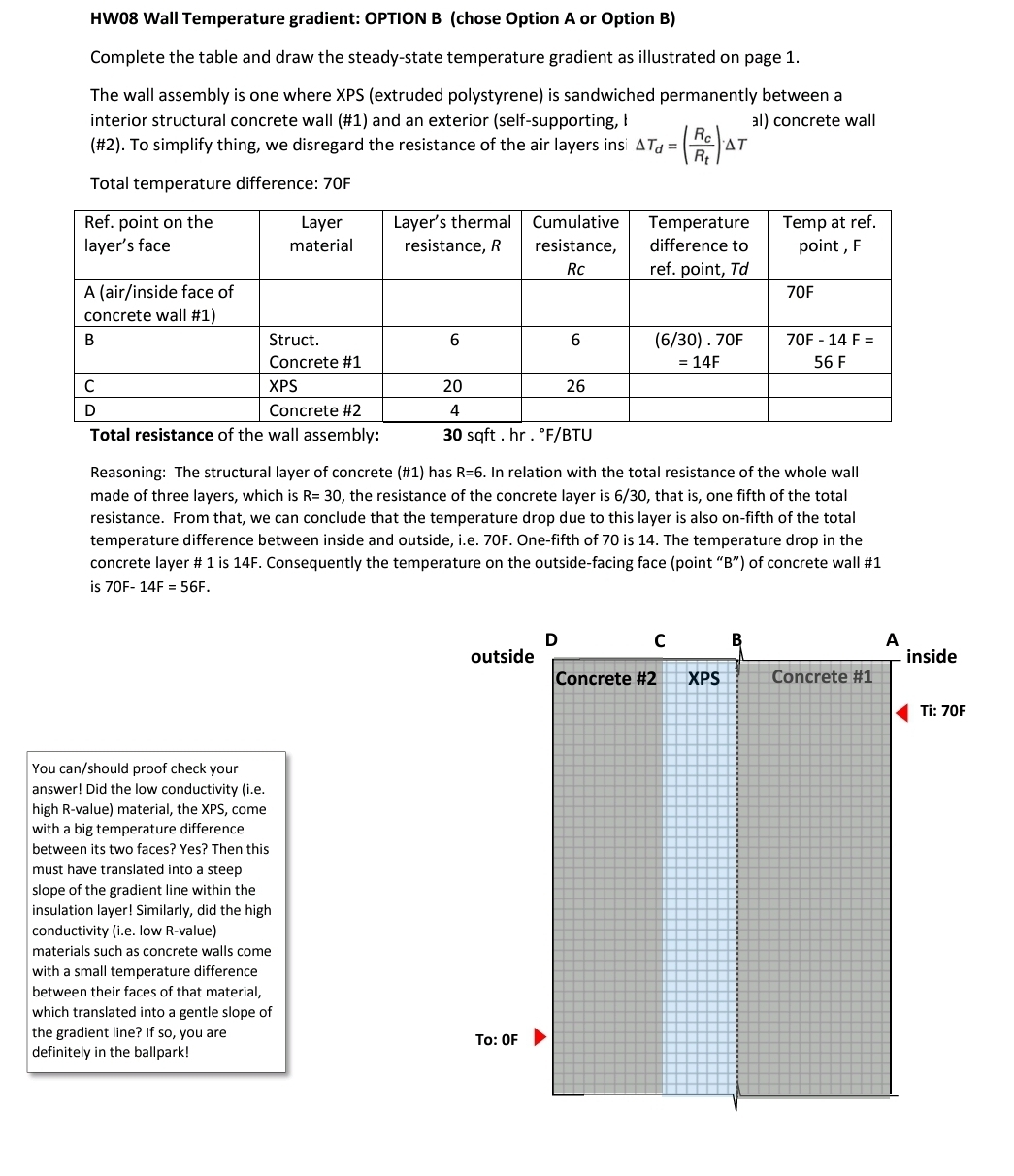
Question: HW 0 8 Wall Temperature gradient: OPTION B ( chose Option A or Option B ) Complete the table and draw the steady - state
HW Wall Temperature gradient: OPTION B chose Option A or Option B
Complete the table and draw the steadystate temperature gradient as illustrated on page
The wall assembly is one where XPS extruded polystyrene is sandwiched permanently between a
interior structural concrete wall # and an exterior selfsupporting,
# To simplify thing, we disregard the resistance of the air layers insi :
al concrete wall
Total temperature difference: F
Reasoning: The structural layer of concrete # has In relation with the total resistance of the whole wall
made of three layers, which is the resistance of the concrete layer is that is one fifth of the total
resistance. From that, we can conclude that the temperature drop due to this layer is also onfifth of the total
temperature difference between inside and outside, ie F Onefifth of is The temperature drop in the
concrete layer # is F Consequently the temperature on the outsidefacing face point B of concrete wall #
is
You canshould proof check your
answer! Did the low conductivity ie
high Rvalue material, the XPS come
with a big temperature difference
between its two faces? Yes? Then this
must have translated into a steep
slope of the gradient line within the
insulation layer! Similarly, did the high
conductivity ie low Rvalue
materials such as concrete walls come
with a small temperature difference
between their faces of that material,
which translated into a gentle slope of
the gradient line? If so you are
definitely in the ballpark!
Step by Step Solution
There are 3 Steps involved in it
1 Expert Approved Answer
Step: 1 Unlock

Question Has Been Solved by an Expert!
Get step-by-step solutions from verified subject matter experts
Step: 2 Unlock
Step: 3 Unlock
 Study Help