







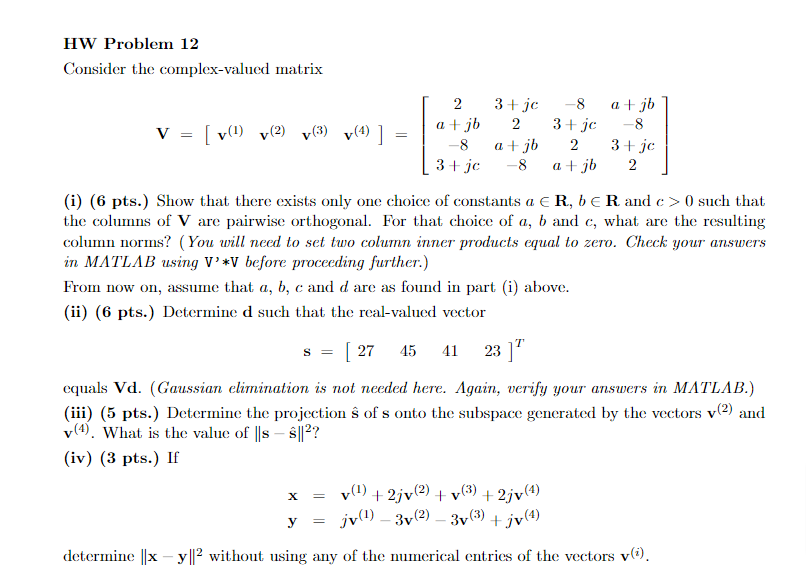
Question: HW Problem 12 Consider the complex-valued matrix 2 3+ jc -8 a+ jb] V = [v(1) v(2) v(3) v(4) ] = a + jb 2
![a+ jb] V = [v(1) v(2) v(3) v(4) ] = a +](https://dsd5zvtm8ll6.cloudfront.net/si.experts.images/questions/2024/10/6703ef678ecf1_1436703ef67631b3.jpg)
HW Problem 12 Consider the complex-valued matrix 2 3+ jc -8 a+ jb] V = [v(1) v(2) v(3) v(4) ] = a + jb 2 3+ jc -8 -8 at jb 2 3+ jc 3+ jc -8 a + jb 2 (i) (6 pts.) Show that there exists only one choice of constants a E R., be R and c > 0 such that the columns of V are pairwise orthogonal. For that choice of a, b and c, what are the resulting column norms? ( You will need to set two column inner products equal to zero. Check your answers in MATLAB using V'*V before proceeding further.) From now on, assume that a, b, c and d are as found in part (i) above. (ii) (6 pts.) Determine d such that the real-valued vector 8 = 27 45 41 23 equals Vd. (Gaussian elimination is not needed here. Again, verify your answers in MATLAB.) (iii) (5 pts.) Determine the projection s of s onto the subspace generated by the vectors v(2) and v(4). What is the value of Is - s| |?? (iv) (3 pts.) If X = v() +2iv(2) + v(3) + 2jv(4) y = jv(1) -3v(2) - 3v(3) + iv(4) determine |/x - y||2 without using any of the numerical entries of the vectors v().HW Problem 13 Let V = [v(0) v(1) v(2) (3) v (4 ) v (5) v() v(?) ] be the matrix of Fourier sinusoids of length N = 8. (i) (6 pts.) If x= 3 1 -5 3 3 1 -5 3 use projections to represent x in the form x = Ve. Verify that x is a linear combination of four columns of V (only). (ii) (6 pts.) Repeat for y = 0 0 2 0 0 0 -2 0 7 , expressing it as y = Vd. Verify that y is a linear combination of four columns of V. (iii) (2 pts.) Verify your results in (i) and (ii) using the FFT command in MATLAB (which will generate the vectors 8c and 8d). (iv) (2 pts.) Verify that the vectors x and y are orthogonal by computing their inner product. Do your answers to (i) and (ii) above also support this conclusion? (v) (4 pts.) If s = x + y, use your results from (i) and (ii) above to obtain the least squares approximation s of s in terms of v), v() and v("). Display the entries of s. Also, compute the squared error norm s - s| |2
Step by Step Solution
There are 3 Steps involved in it

Get step-by-step solutions from verified subject matter experts
 Study Help