







Question: HW#2 RIl. Why do HTTP, FTP, SMTP, and POP3 run on top of TCP rather than on UDP? R13. Describe how Web caching can reduce
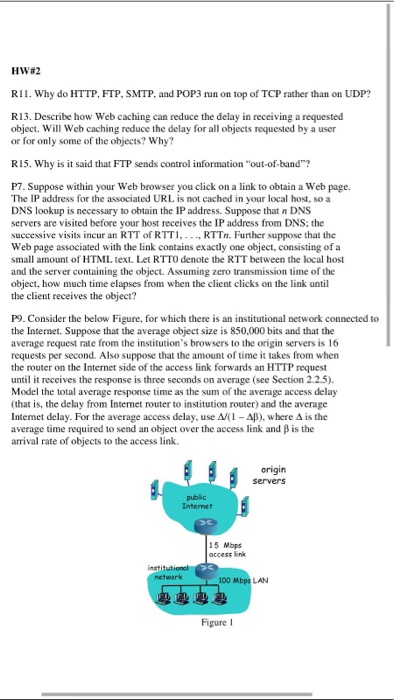
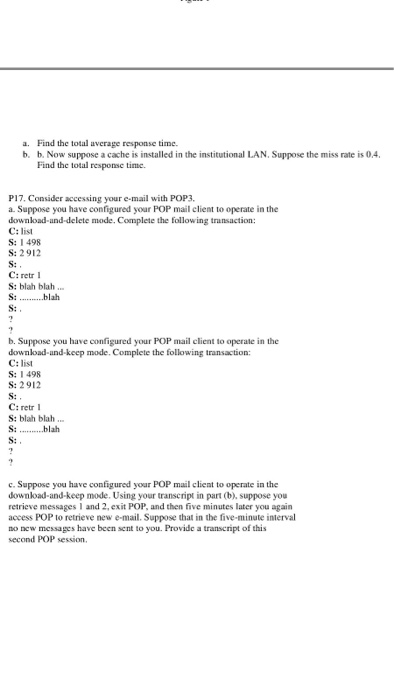
HW#2 RIl. Why do HTTP, FTP, SMTP, and POP3 run on top of TCP rather than on UDP? R13. Describe how Web caching can reduce the delay in receiving a requested object. Will Web caching reduce the delay for all objects requested by a user or for only some of the objects? Why? R15. Why is it said that FTP sends control information "out-of-band P7. Suppose within your Web browser you click on a link to obtain a Web page The IP address for the associated URL is not cached in your local host, so a DNS lookup is necessary to obtain the IP address. Suppose that n DNS servers are visited before your host receives the IP address from DNS; the successive visits incur an RTT of RTTI Web page associated with the link contains exactly one object, consisting of a small amount of HTML text. Let RTTO denote the RTT between the local host and the server containing the object. Assuming zero transmission time of the object, how much time elapses from when the client clicks on the link until the client receives the object? RTTn. Further suppose that the P9. Consider the below Figure, for which there is an institutional network connected to the Internet. Suppose that the average object size is 850,000 bits and that the average request rate from the institution's browsers to the origin servers is 16 requests per second. Also suppose that the amount of time it takes from when the router on the Internet side of the access link forwards an HTTP request until it receives the response is three seconds on average (see Section 2.2.5) Model the total average response time as the sum of the average access delay (that is, the delay from Intemet router to institution router) and the average Intemet delay. For the average access delay, use MI-), where is the average time required to send an object over the access link and is the arrival rate of objects to the access link gure, for w origin public 15 Mbps occess ink 100 Mbps LAN Figure 1
Step by Step Solution
There are 3 Steps involved in it

Get step-by-step solutions from verified subject matter experts
 Study Help