





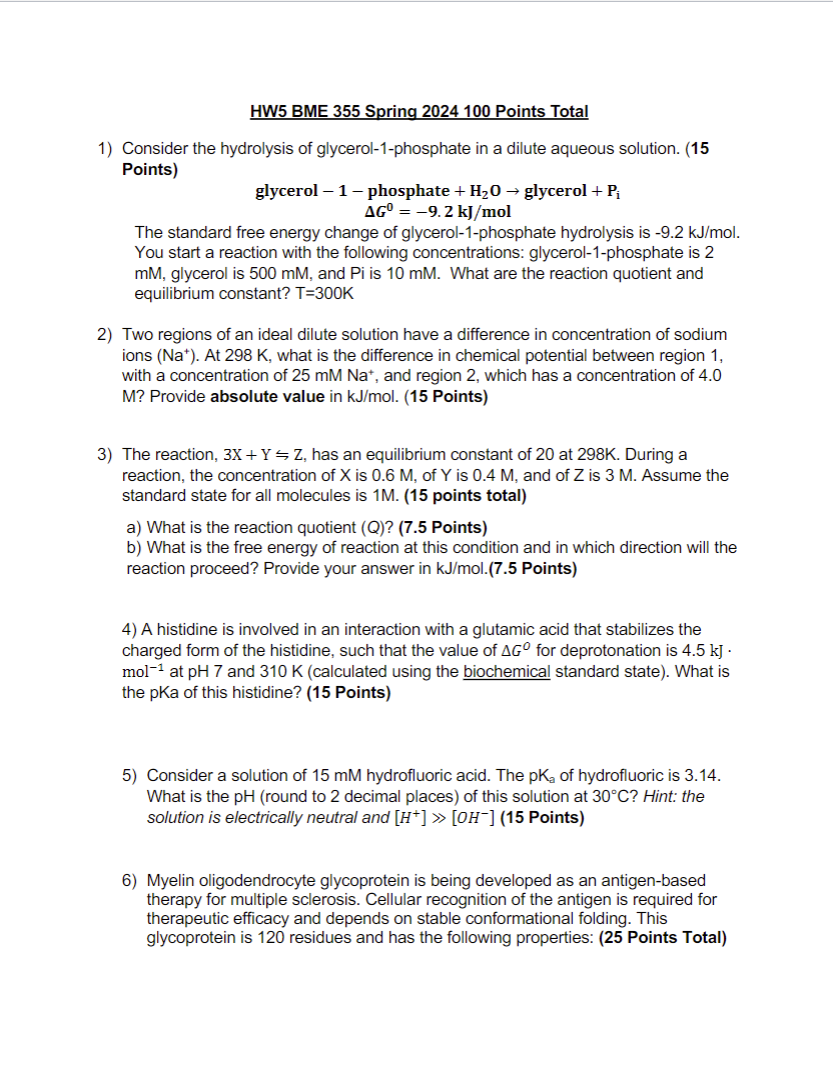
Question: HW5 BME 355 Spring 2024 100 Points Total 1) Consider the hydrolysis of glycerol-1-phosphate in a dilute aqueous solution. (15 Points) glycerol - 1 -
HW5 BME 355 Spring 2024 100 Points Total 1)HW5 BME 355 Spring 2024 100 Points Total 1)
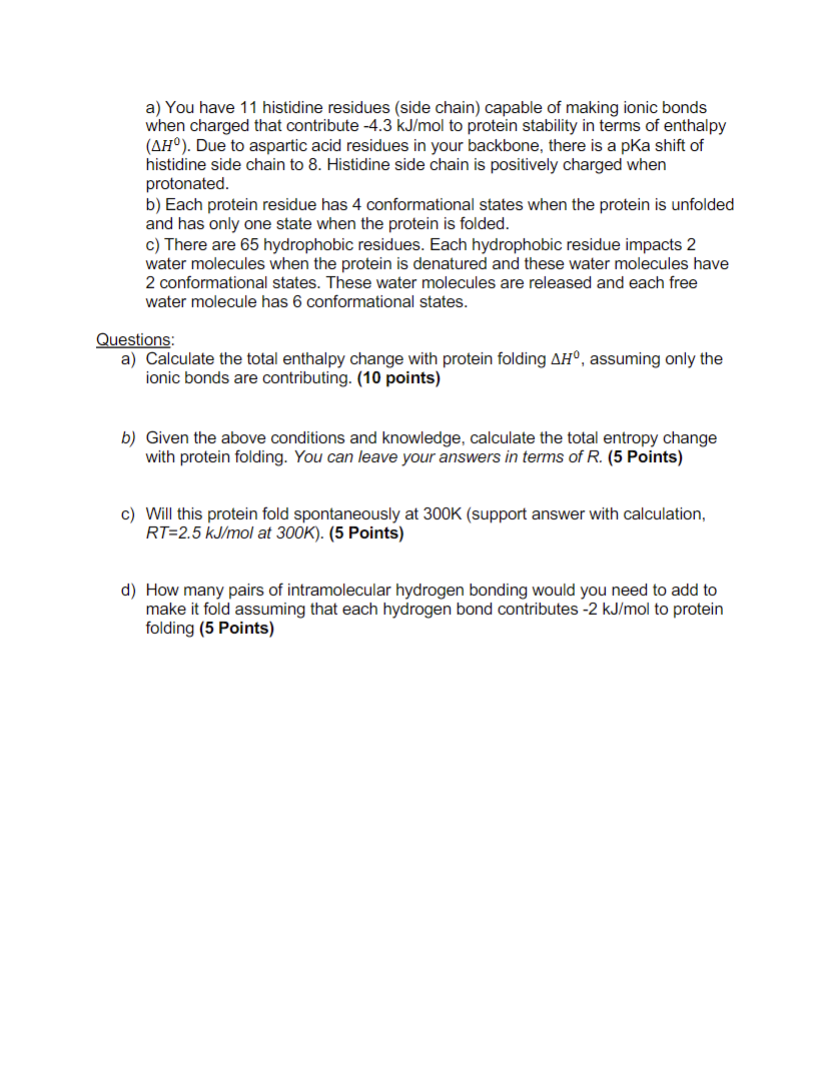
HW5 BME 355 Spring 2024 100 Points Total 1) Consider the hydrolysis of glycerol-1-phosphate in a dilute aqueous solution. (15 Points) glycerol - 1 - phosphate + H20 - glycerol + Pi AGO = -9.2 kJ/mol The standard free energy change of glycerol-1-phosphate hydrolysis is -9.2 kJ/mol. You start a reaction with the following concentrations: glycerol-1-phosphate is 2 mM, glycerol is 500 mM, and Pi is 10 mM. What are the reaction quotient and equilibrium constant? T=300K 2) Two regions of an ideal dilute solution have a difference in concentration of sodium ions (Na*). At 298 K, what is the difference in chemical potential between region 1, with a concentration of 25 mM Na*, and region 2, which has a concentration of 4.0 M? Provide absolute value in KJ/mol. (15 Points) 3) The reaction, 3X + Y > [OH-] (15 Points) 6) Myelin oligodendrocyte glycoprotein is being developed as an antigen-based therapy for multiple sclerosis. Cellular recognition of the antigen is required for therapeutic efficacy and depends on stable conformational folding. This glycoprotein is 120 residues and has the following properties: (25 Points Total)a) You have 11 histidine residues (side chain) capable of making ionic bonds when charged that contribute -4.3 kJ/mol to protein stability in terms of enthalpy (AH"). Due to aspartic acid residues in your backbone, there is a pKa shift of histidine side chain to 8. Histidine side chain is positively charged when protonated. b) Each protein residue has 4 conformational states when the protein is unfolded and has only one state when the protein is folded. c) There are 65 hydrophobic residues. Each hydrophobic residue impacts 2 water molecules when the protein is denatured and these water molecules have 2 conformational states. These water molecules are released and each free water molecule has 6 conformational states. Questions: a) Calculate the total enthalpy change with protein folding AH, assuming only the ionic bonds are contributing. (10 points) b) Given the above conditions and knowledge, calculate the total entropy change with protein folding. You can leave your answers in terms of R. (5 Points) c) Will this protein fold spontaneously at 300K (support answer with calculation, RT=2.5 kJ/mol at 300K). (5 Points) d) How many pairs of intramolecular hydrogen bonding would you need to add to make it fold assuming that each hydrogen bond contributes -2 kJ/mol to protein folding (5 Points)

Step by Step Solution

There are 3 Steps involved in it

1 Expert Approved Answer
Step: 1 Unlock blur-text-image

Question Has Been Solved by an Expert!

Get step-by-step solutions from verified subject matter experts

Step: 2 Unlock
Step: 3 Unlock

Students Have Also Explored These Related Law Questions!