







Question: HW.Lecture14.3.7.23: Problem 6 (1 point) Given that lim f(x) = 0, lim g(x) = 0, lim h(x) = 1, limp(x) = 0o, lim q(x) =
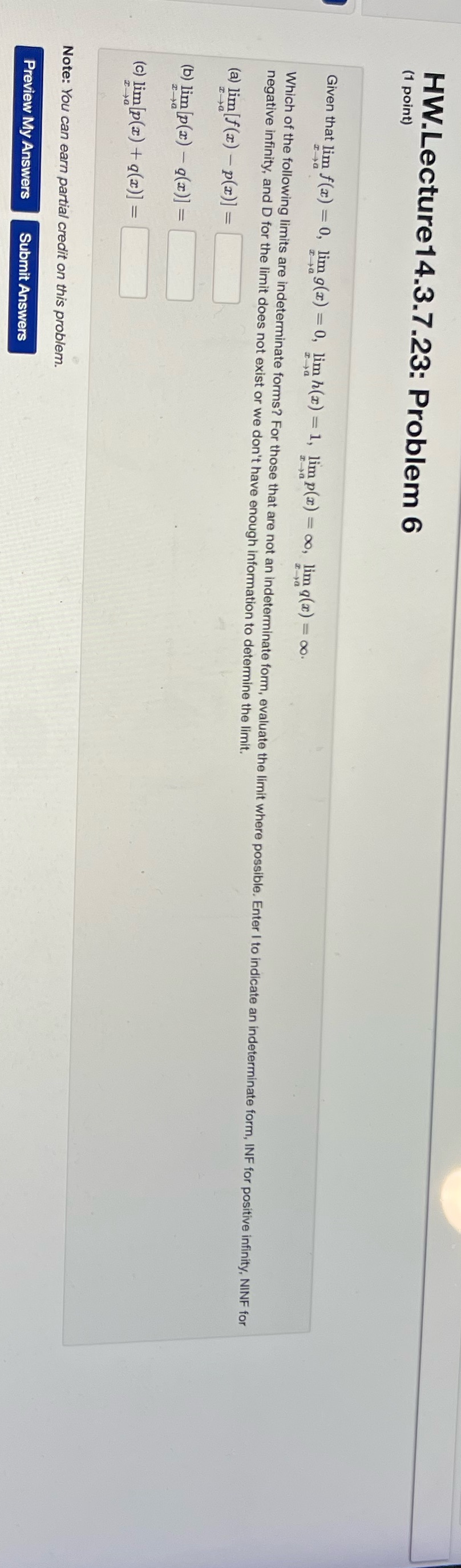
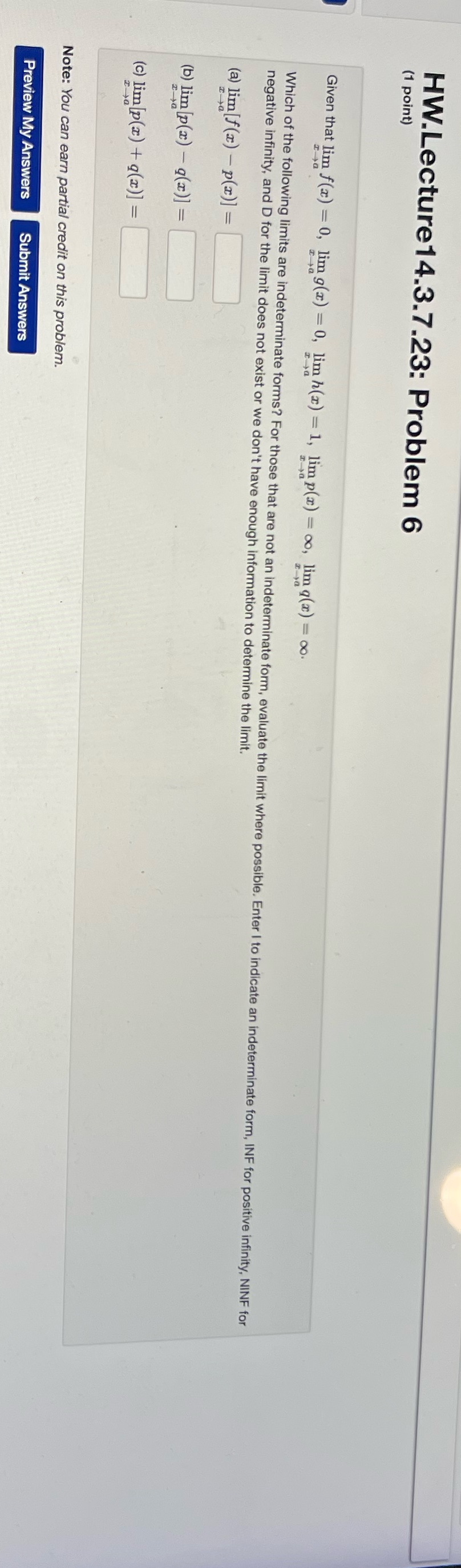
HW.Lecture14.3.7.23: Problem 6 (1 point) Given that lim f(x) = 0, lim g(x) = 0, lim h(x) = 1, limp(x) = 0o, lim q(x) = 00. Which of the following limits are indeterminate forms? For those that are not an indeterminate form, evaluate the limit where possible. Enter I to indicate an indeterminate form, INF for positive infinity, NINF for negative infinity, and D for the limit does not exist or we don't have enough information to determine the limit. (a) lim f(x) - p(x)] = (b) lim [p(x) - q(x)] = (c) lim [p(z) + q(x)] = Note: You can earn partial credit on this problem. Preview My Answers Submit Answers
Step by Step Solution
There are 3 Steps involved in it
1 Expert Approved Answer
Step: 1 Unlock

Question Has Been Solved by an Expert!
Get step-by-step solutions from verified subject matter experts
Step: 2 Unlock
Step: 3 Unlock
 Study Help