







Question: Hypothesis Testing: t-tests Instructions: Solve the following problems. Show your complete solutions. Independent Samples Suppose a gerontologist is interested in comparing two methods for
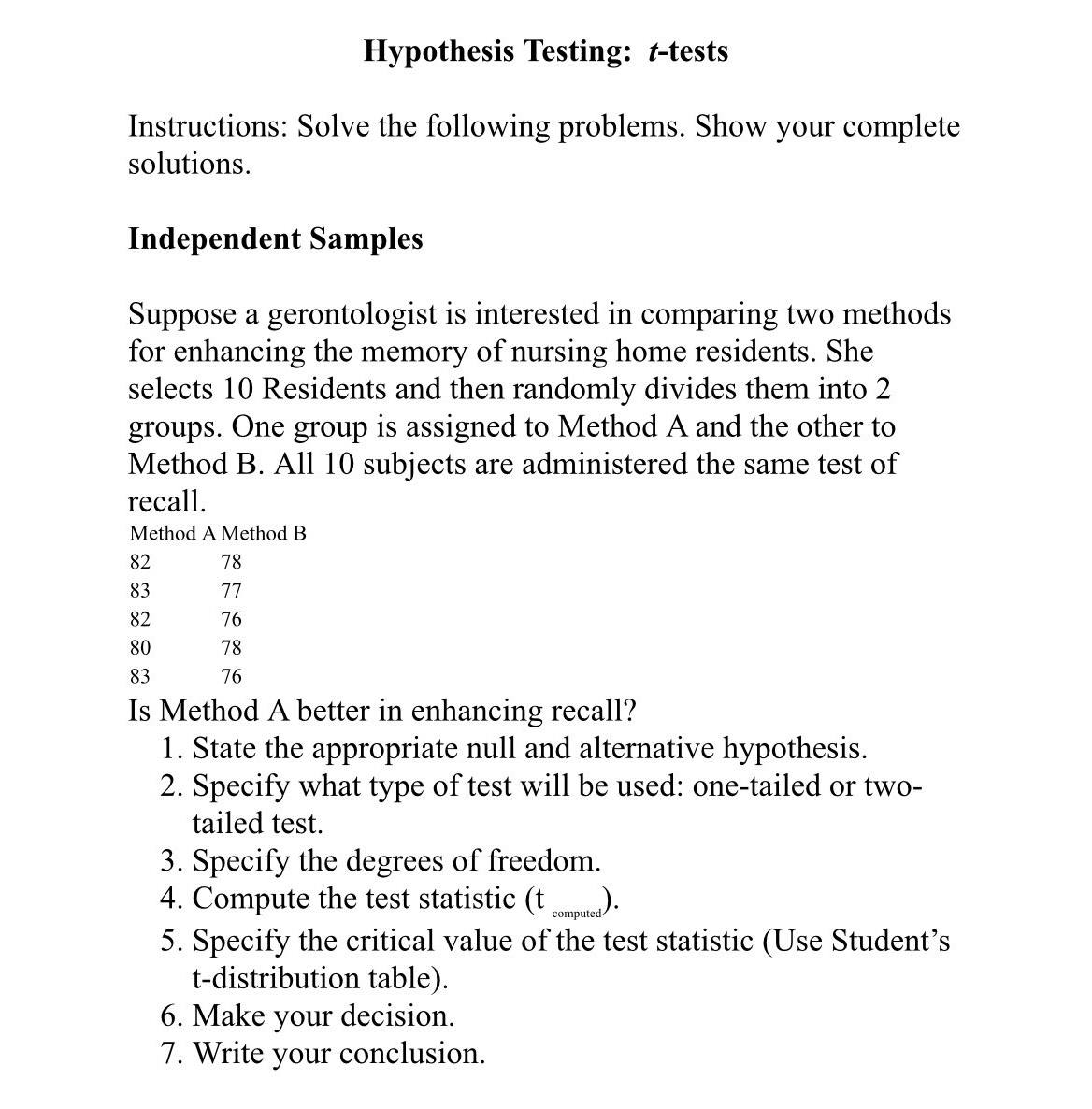
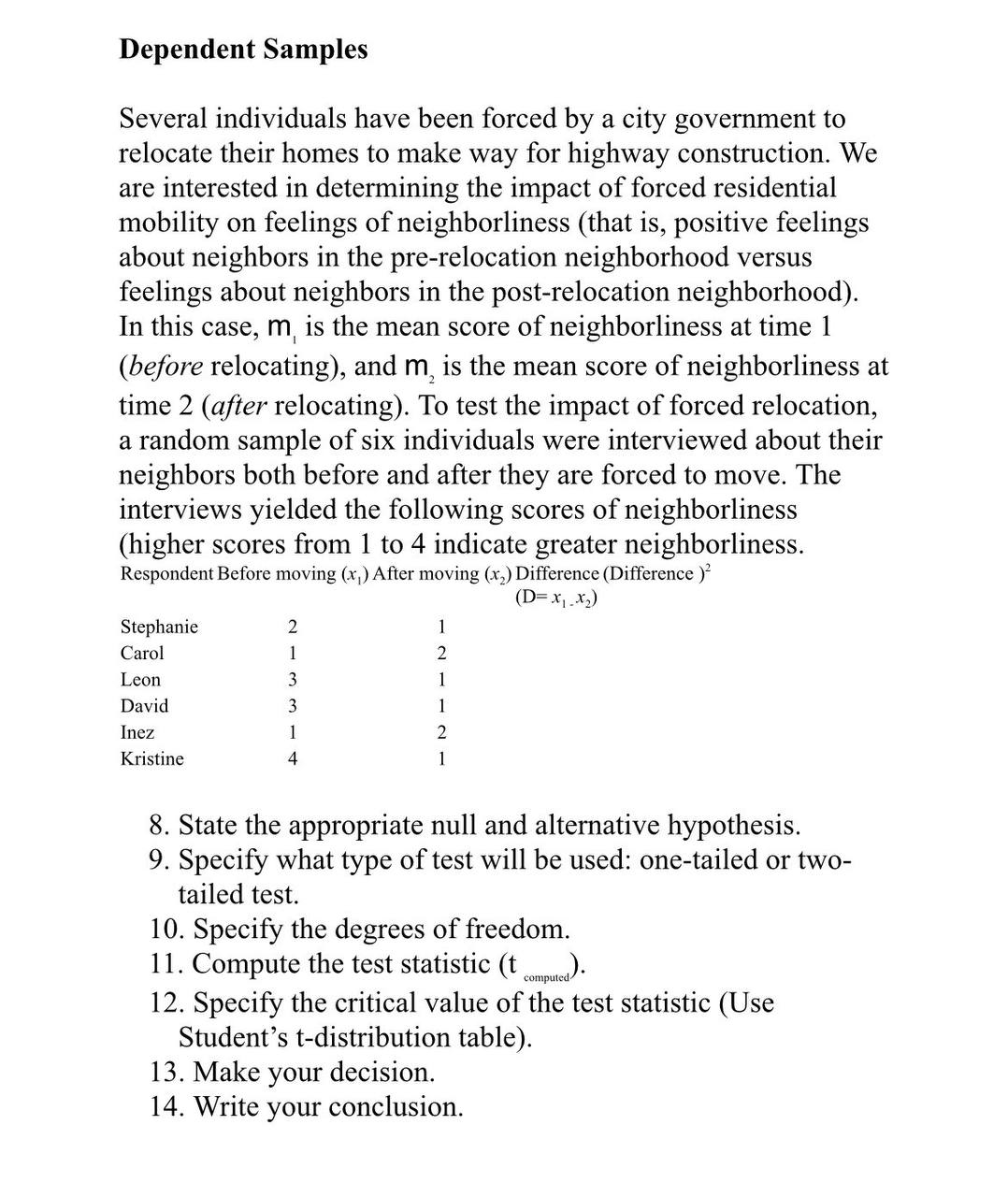
Hypothesis Testing: t-tests Instructions: Solve the following problems. Show your complete solutions. Independent Samples Suppose a gerontologist is interested in comparing two methods for enhancing the memory of nursing home residents. She selects 10 Residents and then randomly divides them into 2 groups. One group is assigned to Method A and the other to Method B. All 10 subjects are administered the same test of recall. Method A Method B 82 78 83 77 82 76 80 78 83 76 Is Method A better in enhancing recall? 1. State the appropriate null and alternative hypothesis. 2. Specify what type of test will be used: one-tailed or two- tailed test. 3. Specify the degrees of freedom. 4. Compute the test statistic (t computed). 5. Specify the critical value of the test statistic (Use Student's t-distribution table). 6. Make your decision. 7. Write your conclusion. Dependent Samples Several individuals have been forced by a city government to relocate their homes to make way for highway construction. We are interested in determining the impact of forced residential mobility on feelings of neighborliness (that is, positive feelings about neighbors in the pre-relocation neighborhood versus feelings about neighbors in the post-relocation neighborhood). In this case, m, is the mean score of neighborliness at time 1 (before relocating), and m, is the mean score of neighborliness at time 2 (after relocating). To test the impact of forced relocation, a random sample of six individuals were interviewed about their neighbors both before and after they are forced to move. The interviews yielded the following scores of neighborliness (higher scores from 1 to 4 indicate greater neighborliness. Respondent Before moving (x,) After moving (x2) Difference (Difference ) Stephanie 2 1 Carol 1 2 Leon 3 1 David 3 1 Inez 1 2 Kristine 4 1 (D=x_x) 8. State the appropriate null and alternative hypothesis. 9. Specify what type of test will be used: one-tailed or two- tailed test. 10. Specify the degrees of freedom. 11. Compute the test statistic (t computed). 12. Specify the critical value of the test statistic (Use Student's t-distribution table). 13. Make your decision. 14. Write your conclusion.
Step by Step Solution
There are 3 Steps involved in it

Get step-by-step solutions from verified subject matter experts
 Study Help