







Question: i = (30cm) i = 2(60 cm) Width (cm) X11 21 22 X23 124 Xs *36 15 2 0 0 4 2 2 0 0
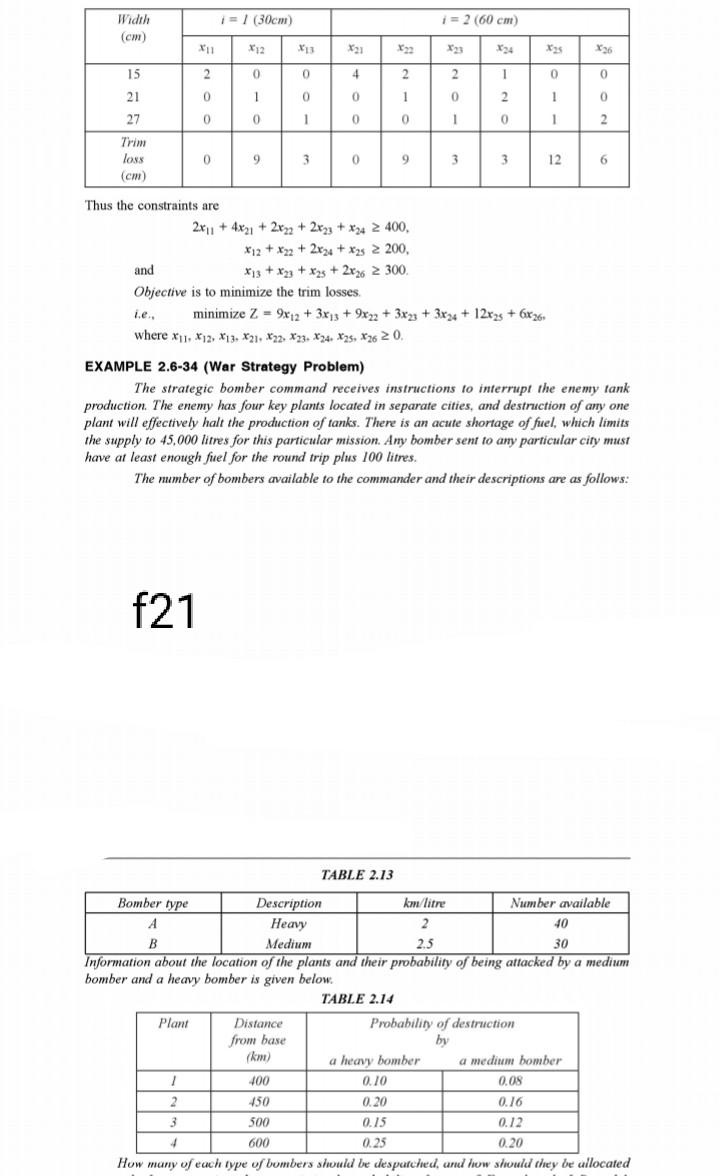
i = (30cm) i = 2(60 cm) Width (cm) X11 21 22 X23 124 Xs *36 15 2 0 0 4 2 2 0 0 1 2 0 1 0 0 1 1 0 21 27 0 1 0 0 1 0 0 0 1 2 0 9 3 0 9 3 3 12 6 loss (cm) Thus the constraints are 2x + 4x2 + 2xy + 2xy + x34 2 400, *12+ Xx2 + 2x34 + x 200, and X13 + xy + xy + 2x26 2 300 Objective is to minimize the trim losses. ie minimize Z - 9x12 + 3x3 + 9x22 + 3x2 + 3x34 + 12x25 + 6x 26 where X11, X12, X13, 221, 222, X3, X24. X2, X262 0. EXAMPLE 2.6-34 (War Strategy Problem) The strategic bomber command receives instructions to interrupt the enemy tank production. The enemy has four key plants located in separate cities, and destruction of any one plant will effectively halt the production of tanks. There is an acute shortage of fuel, which limits the supply to 45,000 litres for this particular mission. Any bomber sent to any particular city must have at least enough fuel for the round trip plus 100 litres. The number of bombers available to the commander and their descriptions are as follows: f21 TABLE 2.13 30 Bomber type Description km/litre Number available Heavy 2 40 B Medium 2.5 Information about the location of the plants and their probability of being attacked by a medium bomber and a heavy bomber is given below. TABLE 2.14 Plant Distance Probability of destruction from base by (km) a heavy bomber a medium bomber 1 1 400 0.10 0.08 2 450 0.20 0.16 3 500 0.15 0.12 4 600 0.25 0.20 How many of each type of bombers should be desparched, und how should they be allocated
Step by Step Solution
There are 3 Steps involved in it

Get step-by-step solutions from verified subject matter experts
 Study Help