



Question: i) (4 points) Show the IEEE 754 binary representation of the number -0.045625 (ten) and of the number 0.001875 in single precision. IEEE 754 single
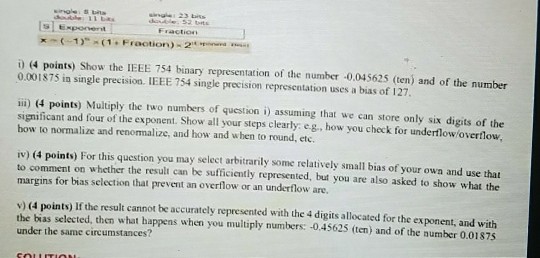
i) (4 points) Show the IEEE 754 binary representation of the number -0.045625 (ten) and of the number 0.001875 in single precision. IEEE 754 single precision representation uses a bias of 127 ii) (4 points) Multiply the two numbers of question i) assuming that we can store only six digits of the significant and four of the exponent. Show all your steps clearly eg, how you check for underflow/overtlow, how to normalize and renomalize, and how and when to round, etc. iv) (4 points) For this question you may select arbitrarily some relatively small bias of your own and use that to comment on whether the result can be sufficiently represented, but you are also asked to show what the margins for bias selection that prevent an overflow or an underflow are. v) (4 points) If the result cannot be accurately represented with the 4 digits allocated for the exponent, and with the bias selected, then what happens whe? you multiply numbers: 045625 (ten) and of the number 001875 under the same circumstances? i) (4 points) Show the IEEE 754 binary representation of the number -0.045625 (ten) and of the number 0.001875 in single precision. IEEE 754 single precision representation uses a bias of 127 ii) (4 points) Multiply the two numbers of question i) assuming that we can store only six digits of the significant and four of the exponent. Show all your steps clearly eg, how you check for underflow/overtlow, how to normalize and renomalize, and how and when to round, etc. iv) (4 points) For this question you may select arbitrarily some relatively small bias of your own and use that to comment on whether the result can be sufficiently represented, but you are also asked to show what the margins for bias selection that prevent an overflow or an underflow are. v) (4 points) If the result cannot be accurately represented with the 4 digits allocated for the exponent, and with the bias selected, then what happens whe? you multiply numbers: 045625 (ten) and of the number 001875 under the same circumstances
Step by Step Solution
There are 3 Steps involved in it

Get step-by-step solutions from verified subject matter experts