







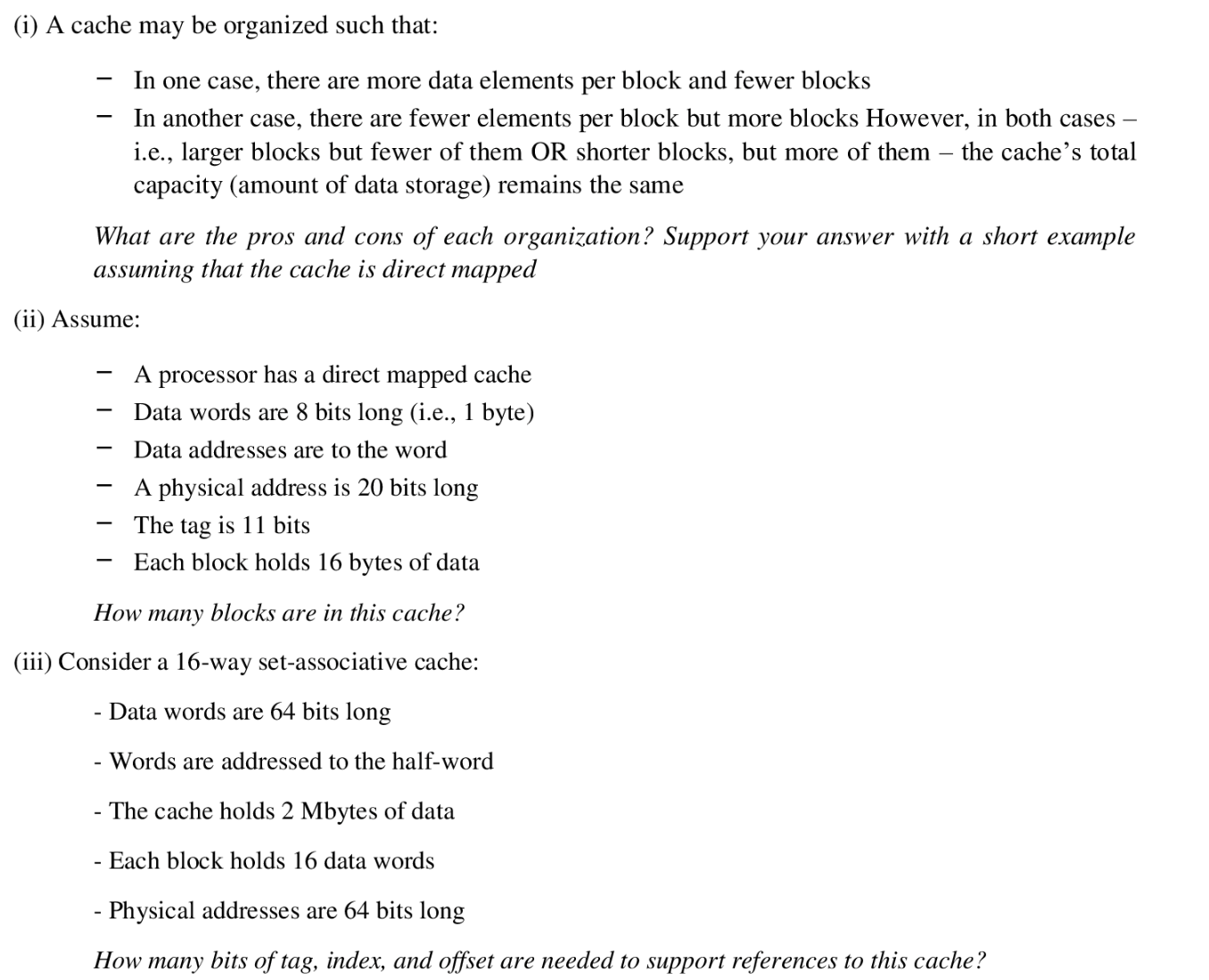
Question: ( i ) A cache may be organized such that: In one case, there are more data elements per block and fewer blocks In another
i A cache may be organized such that:
In one case, there are more data elements per block and fewer blocks
In another case, there are fewer elements per block but more blocks However, in both cases
ie larger blocks but fewer of them OR shorter blocks, but more of them the cache's total
capacity amount of data storage remains the same
What are the pros and cons of each organization? Support your answer with a short example
assuming that the cache is direct mapped
ii Assume:
A processor has a direct mapped cache
Data words are bits long ie byte
Data addresses are to the word
A physical address is bits long
The tag is bits
Each block holds bytes of data
How many blocks are in this cache?
iii Consider a way setassociative cache:
Data words are bits long
Words are addressed to the halfword
The cache holds Mbytes of data
Each block holds data words
Physical addresses are bits long
How many bits of tag, index, and offset are needed to support references to this cache?
Step by Step Solution
There are 3 Steps involved in it
1 Expert Approved Answer
Step: 1 Unlock

Question Has Been Solved by an Expert!
Get step-by-step solutions from verified subject matter experts
Step: 2 Unlock
Step: 3 Unlock
 Study Help