







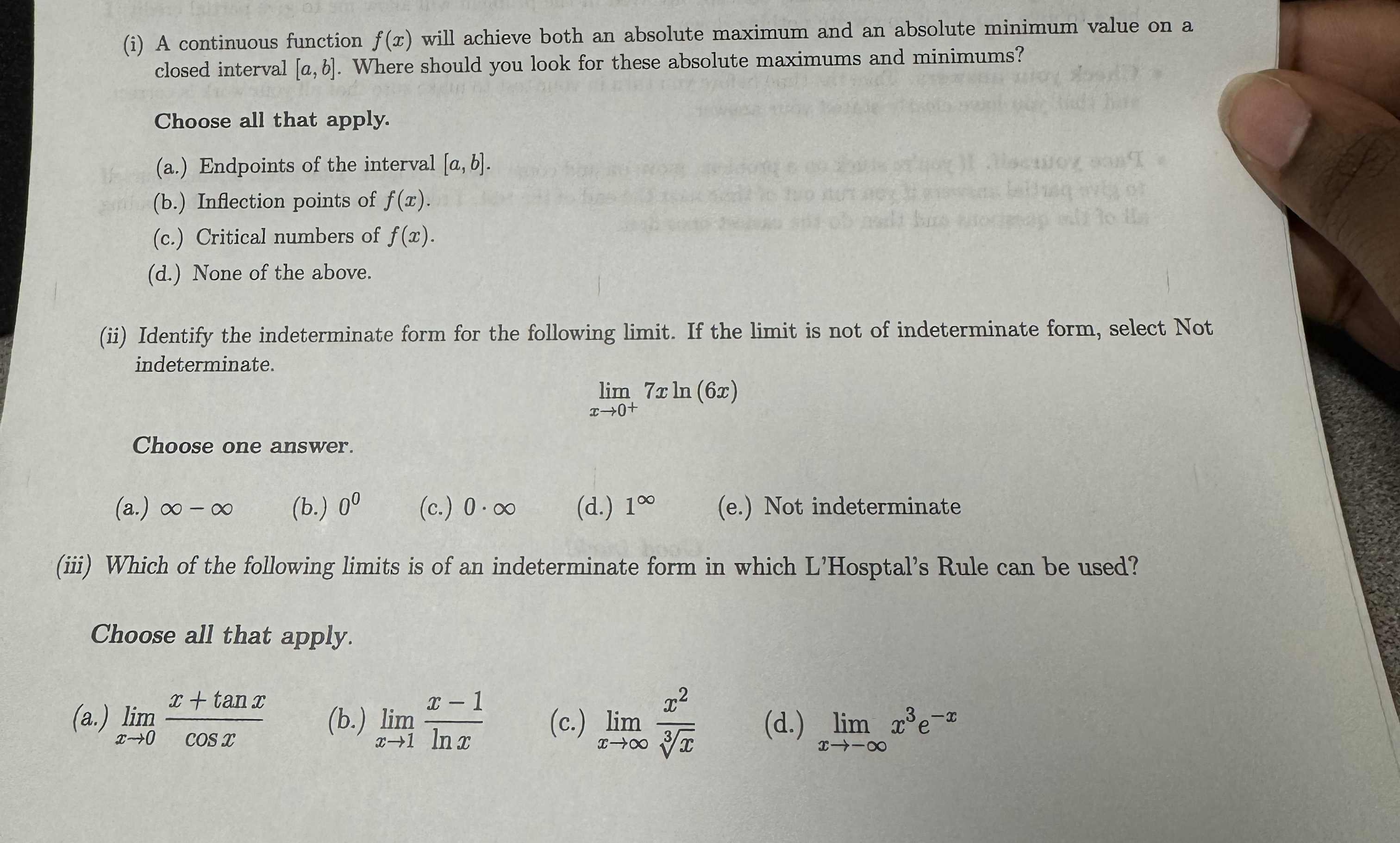
Question: ( i ) A continuous function f ( x ) will achieve both an absolute maximum and an absolute minimum value on a closed interval
i A continuous function will achieve both an absolute maximum and an absolute minimum value on a closed interval Where should you look for these absolute maximums and minimums?
Choose all that apply.
a Endpoints of the interval
b Inflection points of
c Critical numbers of
d None of the above.
ii Identify the indeterminate form for the following limit If the limit is not of indeterminate form, select Not indeterminate.
Choose one answer.
a
b
c
d
e Not indeterminate
iii Which of the following limits is of an indeterminate form in which L'Hosptal's Rule can be used?
Choose all that apply.
a
b
c
d
Step by Step Solution
There are 3 Steps involved in it
1 Expert Approved Answer
Step: 1 Unlock

Question Has Been Solved by an Expert!
Get step-by-step solutions from verified subject matter experts
Step: 2 Unlock
Step: 3 Unlock
 Study Help