







Question: I added additional information and please help me. I do not know why coursehero refunded my question. But this is all the information the professor
I added additional information and please help me. I do not know why coursehero refunded my question. But this is all the information the professor gave us. Thank you and please help me.
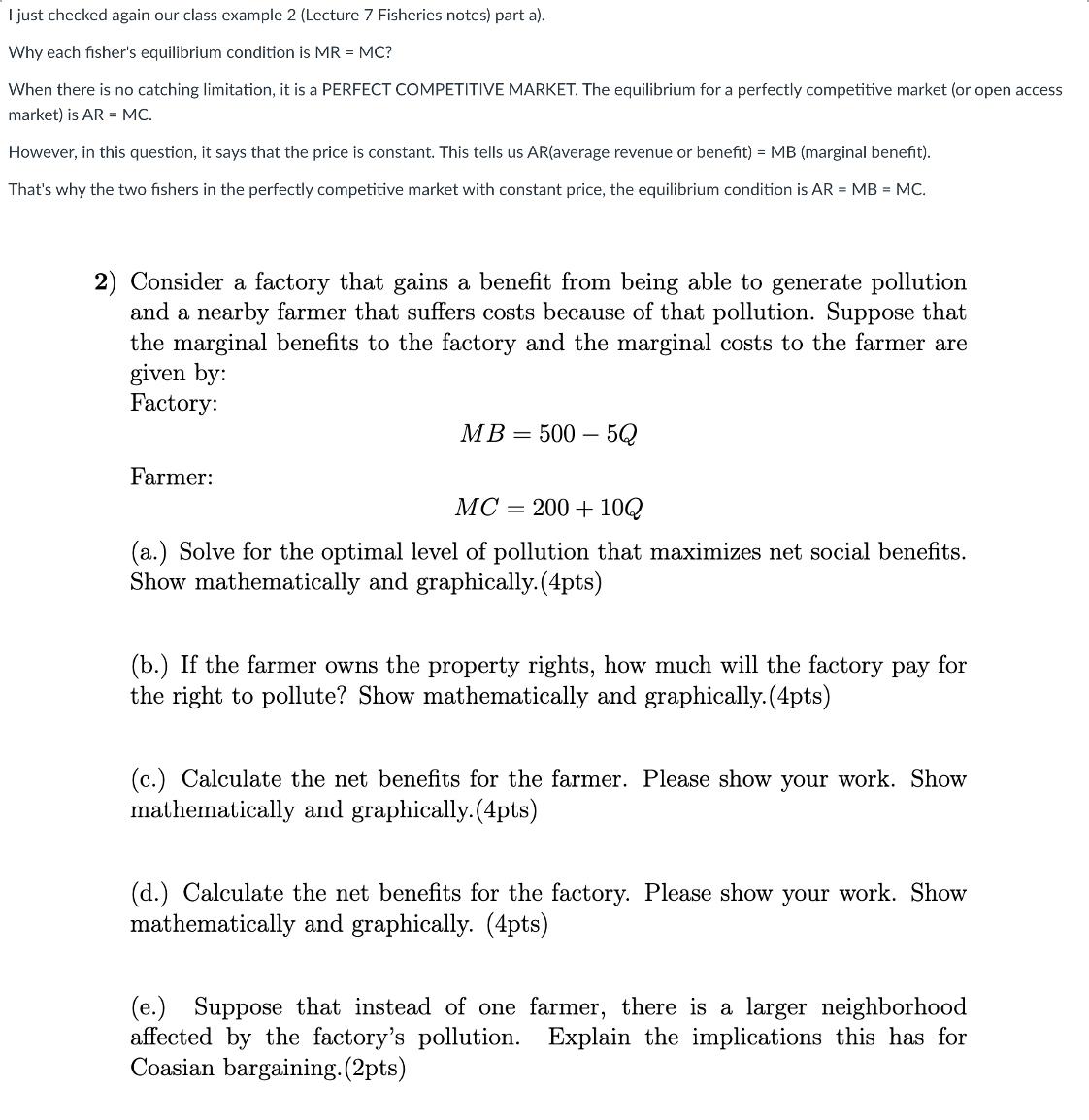
I just checked again our class example 2 (Lecture 7 Fisheries notes) part a). Why each fisher's equilibrium condition is MR = MC? When there is no catching limitation, it is a PERFECT COMPETITIVE MARKET. The equilibrium for a perfectly competitive market (or open access market) is AR = MC. However, in this question, it says that the price is constant. This tells us AR(average revenue or benefit) = MB (marginal benefit). That's why the two fishers in the perfectly competitive market with constant price, the equilibrium condition is AR = MB = MC. 2) Consider a factory that gains a benefit from being able to generate pollution and a nearby farmer that suffers costs because of that pollution. Suppose that the marginal benefits to the factory and the marginal costs to the farmer are given by: Factory: MB = 500 - 5Q Farmer: MC = 200 + 10Q (a.) Solve for the optimal level of pollution that maximizes net social benefits. Show mathematically and graphically. (4pts) (b.) If the farmer owns the property rights, how much will the factory pay for the right to pollute? Show mathematically and graphically. (4pts) (c.) Calculate the net benefits for the farmer. Please show your work. Show mathematically and graphically. (4pts) (d.) Calculate the net benefits for the factory. Please show your work. Show mathematically and graphically. (4pts) (e.) Suppose that instead of one farmer, there is a larger neighborhood affected by the factory's pollution. Explain the implications this has for Coasian bargaining. (2pts)
Step by Step Solution
There are 3 Steps involved in it

Get step-by-step solutions from verified subject matter experts
 Study Help