







Question: I am being asked to answer Discussion question #2 : Is Peter Mercer correct that caffeinated alcoholic beverages serve no socially redeeming purpose? Is that
I am being asked to answer Discussion question #2 : Is Peter Mercer correct that caffeinated alcoholic beverages serve "no socially redeeming purpose? Is that the proper test for determining whether society should permit a product to be sold? What about the fact that there is a market demand for these products?
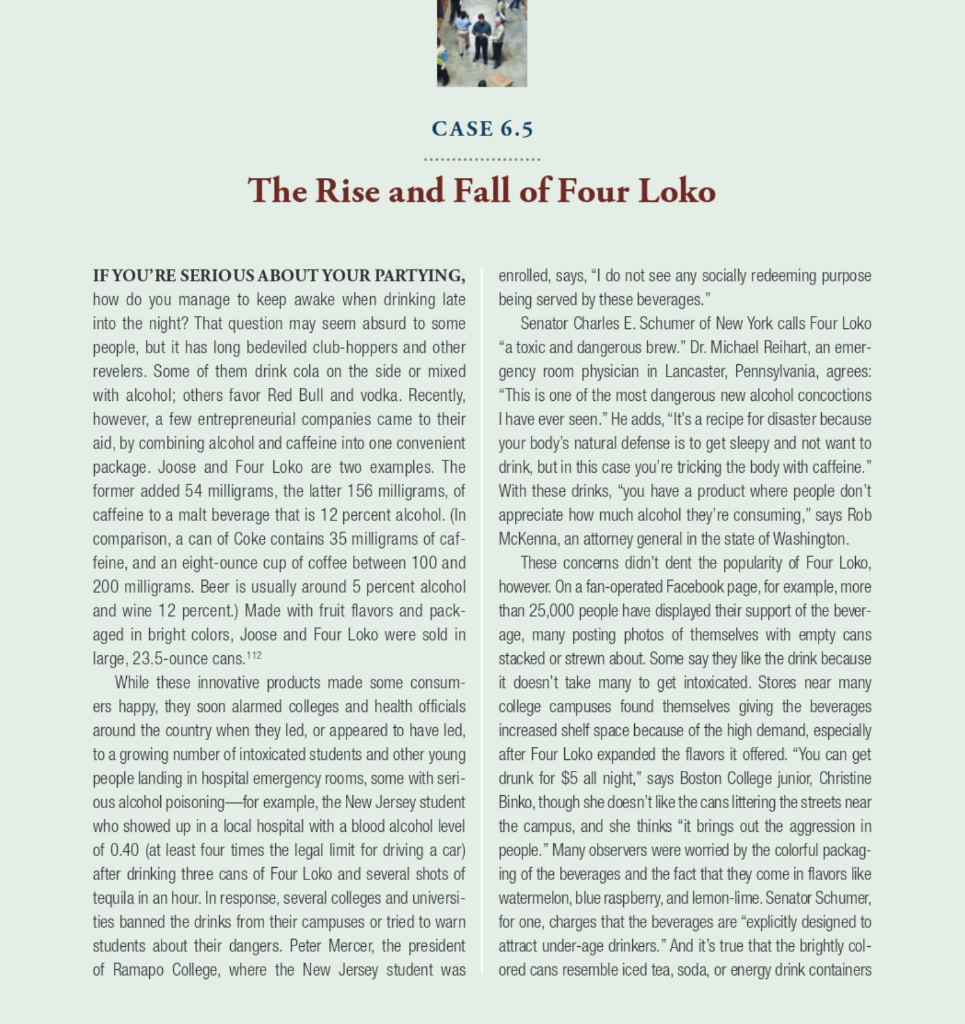
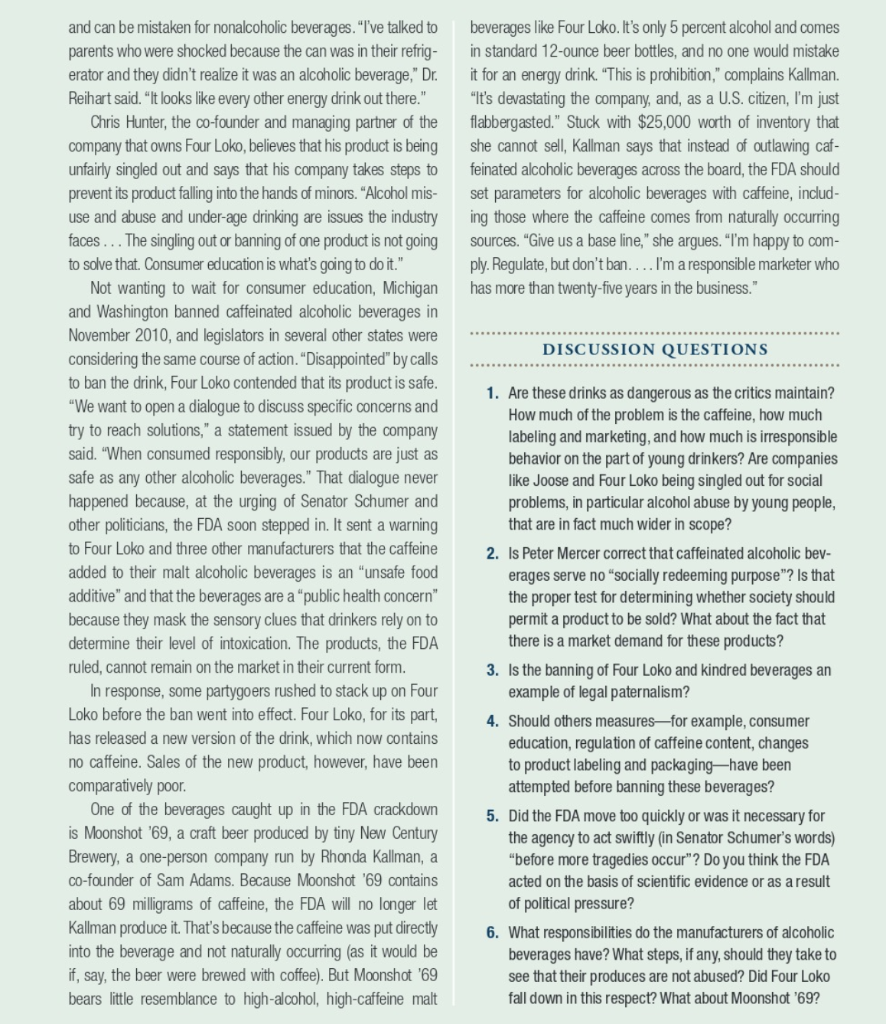
CASE 6.5 The Rise and Fall of Four Loko IF YOU'RE SERIOUS ABOUT YOUR PARTYING, how do you manage to keep awake when drinking late into the night? That question may seem absurd to some people, but it has long bedeviled club-hoppers and other revelers. Some of them drink cola on the side or mixed with alcohol; others favor Red Bull and vodka. Recently, however, a few entrepreneurial companies came to their aid, by combining alcohol and caffeine into one convenient package. Joose and Four Loko are two examples. The former added 54 milligrams, the latter 156 milligrams, of caffeine to a malt beverage that is 12 percent alcohol. (In comparison, a can of Coke contains 35 milligrams of caf- feine, and an eight-ounce cup of coffee between 100 and 200 milligrams. Beer is usually around 5 percent alcohol and wine 12 percent.) Made with fruit flavors and pack- aged in bright colors, Joose and Four Loko were sold in large, 23.5-ounce cans. 112 While these innovative products made some consum- ers happy, they soon alarmed colleges and health officials around the country when they led, or appeared to have led, to a growing number of intoxicated students and other young people landing in hospital emergency rooms, some with seri- ous alcohol poisoningfor example, the New Jersey student who showed up in a local hospital with a blood alcohol level of 0.40 (at least four times the legal limit for driving a car) after drinking three cans of Four Loko and several shots of tequila in an hour. In response, several colleges and universi- ties banned the drinks from their campuses or tried to warn students about their dangers. Peter Mercer, the president of Ramapo College, where the New Jersey student was enrolled, says, "I do not see any socially redeeming purpose being served by these beverages." Senator Charles E. Schumer of New York calls Four Loko "a toxic and dangerous brew." Dr. Michael Reihart, an emer- gency room physician in Lancaster, Pennsylvania, agrees: "This is one of the most dangerous new alcohol concoctions I have ever seen." He adds, "It's a recipe for disaster because your body's natural defense is to get sleepy and not want to drink, but in this case you're tricking the body with caffeine." With these drinks, "you have a product where people don't appreciate how much alcohol they're consuming," says Rob McKenna, an attorney general in the state of Washington. These concerns didn't dent the popularity of Four Loko, however. On a fan-operated Facebook page, for example, more than 25,000 people have displayed their support of the bever- age, many posting photos of themselves with empty cans stacked or strewn about. Some say they like the drink because it doesn't take many to get intoxicated. Stores near many college campuses found themselves giving the beverages increased shelf space because of the high demand, especially after Four Loko expanded the flavors it offered. "You can get drunk for $5 all night," says Boston College junior, Christine Binko, though she doesn't like the cans littering the streets near the campus, and she thinks "it brings out the aggression in people." Many observers were worried by the colorful packag- ing of the beverages and the fact that they come flavors like watermelon, blue raspberry, and lemon-lime. Senator Schumer, for one, charges that the beverages are "explicitly designed to attract under-age drinkers." And it's true that the brightly col- ored cans resemble iced tea, soda, or energy drink containers beverages like Four Loko. It's only 5 percent alcohol and comes in standard 12-ounce beer bottles, and no one would mistake it for an energy drink. This is prohibition," complains Kallman. "It's devastating the company, and, as a U.S. citizen, I'm just flabbergasted." Stuck with $25,000 worth of inventory that she cannot sell, Kallman says that instead of outlawing caf- feinated alcoholic beverages across the board, the FDA should set parameters for alcoholic beverages with caffeine, includ- ing those where the caffeine comes from naturally occurring sources. "Give us a base line," she argues. I'm happy to com- ply. Regulate, but don't ban.... I'm a responsible marketer who has more than twenty-five years in the business." DISCUSSION QUESTIONS and can be mistaken for nonalcoholic beverages. "I've talked to parents who were shocked because the can was in their refrig- erator and they didn't realize it was an alcoholic beverage," Dr. Reihart said. "It looks like every other energy drink out there." Chris Hunter, the co-founder and managing partner of the company that owns Four Loko, believes that his product is being unfairly singled out and says that his company takes steps to prevent its product falling into the hands of minors. "Alcohol mis- use and abuse and under-age drinking are issues the industry faces ... The singling out or banning of one product is not going to solve that. Consumer education is what's going to do it." Not wanting to wait for consumer education, Michigan and Washington banned caffeinated alcoholic beverages in November 2010, and legislators in several other states were considering the same course of action. "Disappointed" by calls to ban the drink, Four Loko contended that its product is safe. We want to open a dialogue to discuss specific concerns and try to reach solutions," a statement issued by the company said. "When consumed responsibly, our products are just as safe as any other alcoholic beverages." That dialogue never happened because, at the urging of Senator Schumer and other politicians, the FDA soon stepped in. It sent a warning to Four Loko and three other manufacturers that the caffeine added to their malt alcoholic beverages is an "unsafe food additive" and that the beverages are a public health concern" because they mask the sensory clues that drinkers rely on to determine their level of intoxication. The products, the FDA ruled, cannot remain on the market in their current form. In response, some partygoers rushed to stack up on Four Loko before the ban went into effect. Four Loko, for its part, has released a new version of the drink, which now contains no caffeine. Sales of the new product, however, have been comparatively poor. One of the beverages caught up in the FDA crackdown is Moonshot '69, a craft beer produced by tiny New Century Brewery, a one-person company run by Rhonda Kallman, a co-founder of Sam Adams. Because Moonshot '69 contains about 69 milligrams of caffeine, the FDA will no longer let Kallman produce it. That's because the caffeine was put directly into the beverage and not naturally occurring (as it would be if, say, the beer were brewed with coffee). But Moonshot '69 bears little resemblance to high-alcohol, high-caffeine malt 1. Are these drinks as dangerous as the critics maintain? How much of the problem is the caffeine, how much labeling and marketing, and how much is irresponsible behavior on the part of young drinkers? Are companies like Joose and Four Loko being singled out for social problems, in particular alcohol abuse by young people, that are in fact much wider in scope? 2. Is Peter Mercer correct that caffeinated alcoholic bev- erages serve no "socially redeeming purpose"? Is that the proper test for determining whether society should permit a product to be sold? What about the fact that there is a market demand for these products? 3. Is the banning of Four Loko and kindred beverages an example of legal paternalism? 4. Should others measuresfor example, consumer education, regulation of caffeine content, changes to product labeling and packaginghave been attempted before banning these beverages? 5. Did the FDA move too quickly or was it necessary for the agency to act swiftly (in Senator Schumer's words) "before more tragedies occur? Do you think the FDA acted on the basis of scientific evidence or as a result of political pressure? 6. What responsibilities do the manufacturers of alcoholic beverages have? What steps, if any, should they take to see that their produces are not abused? Did Four Loko fall down in this respect? What about Moonshot '69Step by Step Solution
There are 3 Steps involved in it
1 Expert Approved Answer
Step: 1 Unlock

Question Has Been Solved by an Expert!
Get step-by-step solutions from verified subject matter experts
Step: 2 Unlock
Step: 3 Unlock
 Study Help