







Question: I am coding a Syntax Analyser in Java. Here is the BNF : The result is : I have already done the Lexical Analyser. Code
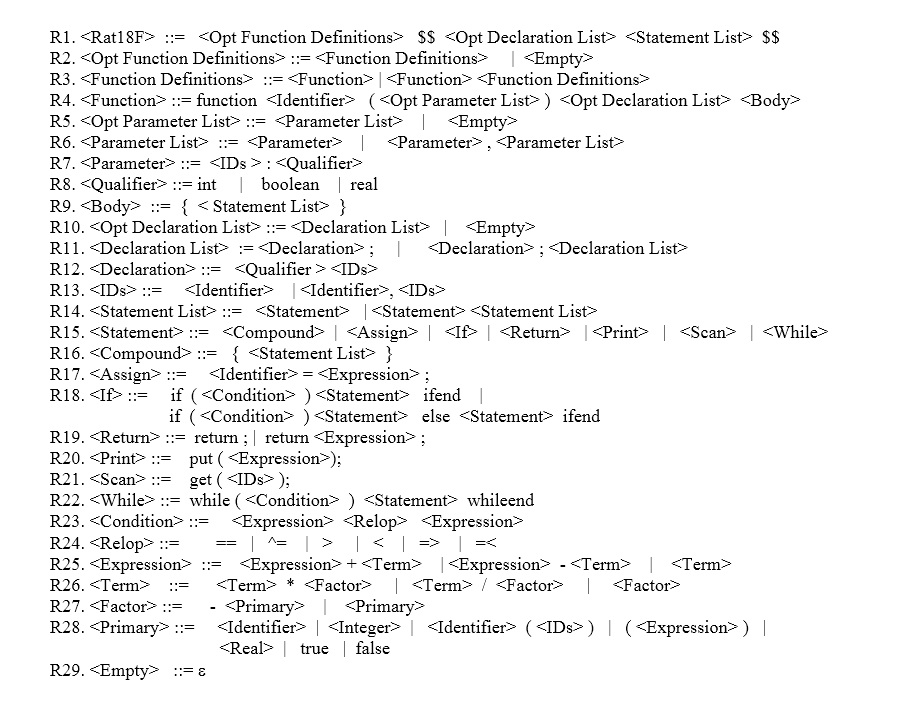
I am coding a Syntax Analyser in Java. Here is the BNF :
The result is :
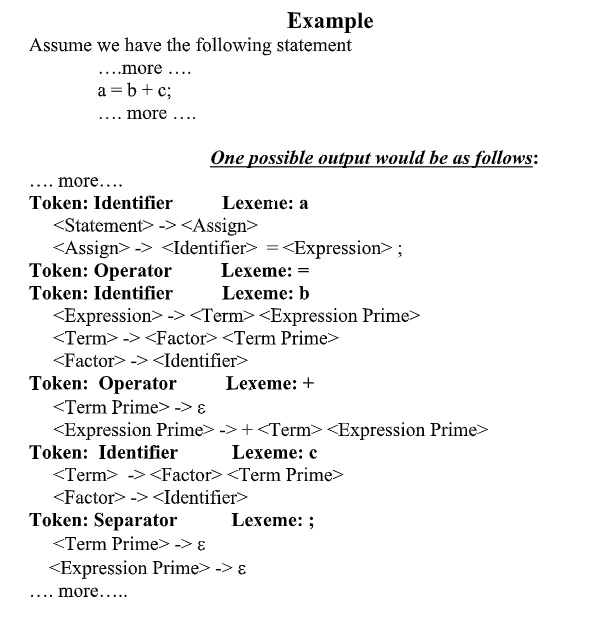
I have already done the Lexical Analyser. Code is pasted in the end. Please use RDP and add as much Syntax Rules as you can to my current code, I'll finish the rest. Amend the code as needed.
My Lexical Analyer has three classes:
E.java (Main)
public class E {
public static void main(String[] args) {
L lexer = new L(System.getProperty("user.dir") + "\\input.txt");
System.out.println("Lexical Analysis Output");
System.out.println("token lexeme");
System.out.println("------------------------------------------------");
while (!lexer.isExhausted()) {
int strStartIndex = lexer.currentToken().toString().indexOf("_");
int strEndIndex = lexer.currentToken().toString().lastIndexOf("_");
String result = lexer.currentToken().toString().substring(strStartIndex + 1, strEndIndex);
System.out.printf("%-38s : %s ", result, lexer.currentLexema());
lexer.moveAhead();
}
if (lexer.isSuccessful()) {
System.out.println("------------------------------------------------");
System.out.println("Analysis Complete.");
} else {
System.out.println(lexer.errorMessage());
}
}
}
T.java (Token definition)
import java.util.regex.Matcher;
import java.util.regex.Pattern;
public enum T {
T_KEYWORD_DEFINE ("define"),
T_KEYWORD_AS ("as"),
T_KEYWORD_INT ("int"),
T_KEYWORD_WHILE ("while"),
T_KEYWORD_END ("end"),
T_KEYWORD_RETURN ("return"),
T_KEYWORD_GET ("get"),
T_KEYWORD_PUT ("put"),
T_KEYWORD_IS ("is"),
T_KEYWORD_ENDIF ("ifend"),
T_KEYWORD_IF ("if"),
T_KEYWORD_THEN ("then"),
T_KEYWORD_ELSE ("else"),
T_KEYWORD_REAL ("real"),
T_KEYWORD_BOOLEAN ("boolean"),
T_KEYWORD_TRUE ("true"),
T_KEYWORD_FALSE ("false"),
T_KEYWORD_FUNCTION ("function"),
T_OPERATOR_LEG ("
T_OPERATOR_GEQ (">="),
T_OPERATOR_DIFFERENT (""),
T_OPERATOR_OR ("\\|"),
T_OPERATOR_EQ ("=="),
T_OPERATOR_NOT ("~"),
T_OPERATOR_EXCLAMATION ("!"),
T_OPERATOR_CARETEQ ("\\^="),
T_OPERATOR_EQGREAT ("=>"),
T_OPERATOR_EQLESS ("=
T_OPERATOR_MINUS ("-"),
T_OPERATOR_PLUS ("\\+"),
T_OPERATOR_DIV ("/"),
T_OPERATOR_ASSIGN ("="),
T_OPERATOR_LESS ("
T_OPERATOR_GT (">"),
T_SEPARATOR_CODESTART ("[$][$]"),
T_SEPARATOR_COLON (":"),
T_SEPARATOR_SEMI (";"),
T_SEPARATOR_COMMA (","),
T_SEPARATOR_OPENPARENTHESIS ("\\("),
T_SEPARATOR_CLOSEPARENTHESIS ("\\)"),
T_SEPARATOR_OPENBRACKET ("\\{"),
T_SEPARATOR_CLOSEBRACKET ("\\}"),
T_COMMENT_ ("\\[\\*[\\s\\S]*?\\*\\]|([^:]|^)\\/\\/.*$"),
T_SEPARATOR_OPENSQUAREBRACKET ("\\["),
T_SEPARATOR_CLOSESQUAREBRACKET ("\\]"),
T_OPERATOR_MUL ("\\*"),
T_REAL_ ("(-?\\d*)\\.(\\d+)?"),
T_INTEGER_ ("\\-?\\d+"),
T_ILLEGLEIDENTIFIER_ ("([A-Z]+[a-z]+[0-9]+)"),
T_ILLEGLESYMBOL_ ("[#|^|&]"),
T_IDENTIFIER_ ("([a-zA-Z]+\\d+[a-zA-Z]+)|([a-zA-Z]+[a-zA-Z]*)");
private final Pattern pattern;
T(String regex) {
pattern = Pattern.compile("^" + regex);
}
int endOfMatch(String s) {
Matcher m = pattern.matcher(s);
if (m.find()) {
return m.end();
}
return -1;
}
}
L.java (Lex processing)
import java.io.IOException;
import java.nio.file.Files;
import java.nio.file.Paths;
import java.util.HashSet;
import java.util.Set;
import java.util.stream.Stream;
public class L {
private StringBuilder input = new StringBuilder();
private T token;
private String lexema;
private boolean exhausted = false;
private String errorMessage = "";
private Set
public L(String filePath) {
try (Stream
st.forEach(input::append);
} catch (IOException ex) {
exhausted = true;
errorMessage = "Could not read file: " + filePath;
return;
}
blankChars.add(' ');
blankChars.add(' ');
blankChars.add((char) 8);
blankChars.add((char) 9);
blankChars.add((char) 11);
blankChars.add((char) 12);
blankChars.add((char) 32);
moveAhead();
}
public void moveAhead() {
if (exhausted) {
return;
}
if (input.length() == 0) {
exhausted = true;
return;
}
ignoreWhiteSpaces();
if (findNextToken()) {
return;
}
exhausted = true;
if (input.length() > 0) {
errorMessage = "Undefined symbol: '" + input.charAt(0) + "'";
}
}
private void ignoreWhiteSpaces() {
int charsToDelete = 0;
while (blankChars.contains(input.charAt(charsToDelete))) {
charsToDelete++;
}
if (charsToDelete > 0) {
input.delete(0, charsToDelete);
}
}
private boolean findNextToken() {
for (T t : T.values()) {
int end = t.endOfMatch(input.toString());
if (end != -1) {
token = t;
lexema = input.substring(0, end);
input.delete(0, end);
return true;
}
}
return false;
}
public T currentToken() {
return token;
}
public String currentLexema() {
return lexema;
}
public boolean isSuccessful() {
return errorMessage.isEmpty();
}
public String errorMessage() {
return errorMessage;
}
public boolean isExhausted() {
return exhausted;
}
}
R1.
Step by Step Solution
There are 3 Steps involved in it

Get step-by-step solutions from verified subject matter experts
 Study Help