







Question: I am confused how to set this problem up? Back in the old days, a railway owned tracks that ran between two small cities. Several
I am confused how to set this problem up?
Back in the old days, a railway owned tracks that ran between two small cities. Several farms were located alongside the tracks. The steam engines used in those days sometimes threw off sparks, which would cause crops beside the tracks to catch fire. The specific facts of the situation are as follows:
The cost of raising crops in the acreage within range of the sparks was $100 per year.
The market value of the crops grown on land within range of sparks (if there were no fires) was $130 per year.
The engine that pulled the trains between the two towns could be fitted with a device that eliminated spark damage (no matter how many round trips it took) at a cost of $70 per year.
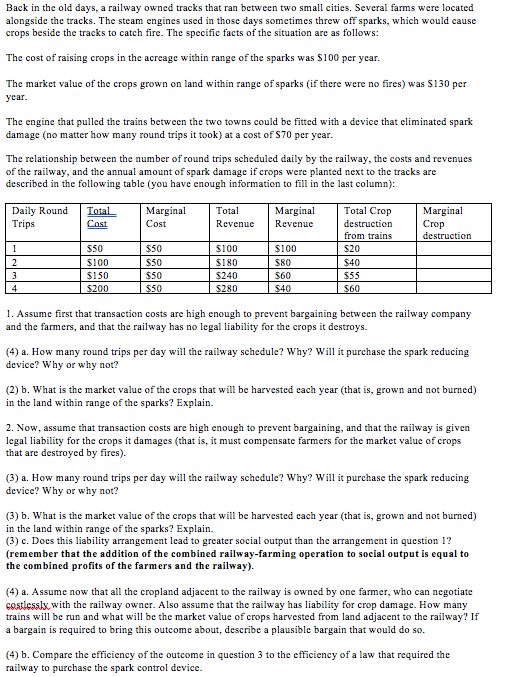
The relationship between the number of round trips scheduled daily by the railway, the costs and revenues of the railway, and the annual amount of spark damage if crops were planted next to the tracks are described in the following table (you have enough information to fill in the last column):
PICTURE OF GRAPH ATTACHED
1. Assume first that transaction costs are high enough to prevent bargaining between the railway company and the farmers, and that the railway has no legal liability for the crops it destroys.
(4) a. How many round trips per day will the railway schedule? Why? Will it purchase the spark reducing device? Why or why not?
(2) b. What is the market value of the crops that will be harvested each year (that is, grown and not burned) in the land within range of the sparks? Explain.
2. Now, assume that transaction costs are high enough to prevent bargaining, and that the railway is given legal liability for the crops it damages (that is, it must compensate farmers for the market value of crops that are destroyed by fires).
(3) a. How many round trips per day will the railway schedule? Why? Will it purchase the spark reducing device? Why or why not?
(3) b. What is the market value of the crops that will be harvested each year (that is, grown and not burned) in the land within range of the sparks? Explain.
(3) c. Does this liability arrangement lead to greater social output than the arrangement in question 1? (remember that the addition of the combined railway-farming operation to social output is equal to the combined profits of the farmers and the railway).
(4) a. Assume now that all the cropland adjacent to the railway is owned by one farmer, who can negotiate costlessly with the railway owner. Also assume that the railway has liability for crop damage. How many trains will be run and what will be the market value of crops harvested from land adjacent to the railway? If a bargain is required to bring this outcome about, describe a plausible bargain that would do so.
- (4) b. Compare the efficiency of the outcome in question 3 to the efficiency of a law that required the railway to purchase the spark control device.
Back in the old days, a railway owned tracks that ran between two small cities. Several farms were located alongside the tracks. The steam engines used in those days sometimes threw off sparks, which would cause crops beside the tracks to catch fire. The specific facts of the situation are as follows: The cost of raising crops in the acreage within range of the sparks was $100 per year. The market value of the crops grown on land within range of sparks (if there were no fires) was $130 per year. The engine that pulled the trains between the two towns could be fitted with a device that eliminated spark damage (no matter how many round trips it took) at a cost of $70 per year. The relationship between the number of round trips scheduled daily by the railway, the costs and revenues of the railway, and the annual amount of spark damage if crops were planted next to the tracks are described in the following table (you have enough information to fill in the last column): Daily Round Total Marginal Total Marginal Total Crop Marginal Trips Cost Cost Revenue Revenue destruction Crop from trains destruction 1 $50 $50 $100 $100 $20 2 $100 $50 $180 $80 $40 3 $150 $50 $240 $60 $55 A $200 $50 $280 $40 $60 1. Assume first that transaction costs are high enough to prevent bargaining between the railway company and the farmers, and that the railway has no legal liability for the crops it destroys. (4) a. How many round trips per day will the railway schedule? Why? Will it purchase the spark reducing device? Why or why not? (2) b. What is the market value of the crops that will be harvested each year (that is, grown and not burned) in the land within range of the sparks? Explain. 2. Now, assume that transaction costs are high enough to prevent bargaining, and that the railway is given legal liability for the crops it damages (that is, it must compensate farmers for the market value of crops that are destroyed by fires). (3) a. How many round trips per day will the railway schedule? Why? Will it purchase the spark reducing device? Why or why not? (3) b. What is the market value of the crops that will be harvested cach year (that is, grown and not burned) in the land within range of the sparks? Explain. (3) c. Does this liability arrangement lead to greater social output than the arrangement in question 1? (remember that the addition of the combined railway-farming operation to social output is equal to the combined profits of the farmers and the railway). (4) a. Assume now that all the cropland adjacent to the railway is owned by one farmer, who can negotiate costlessly with the railway owner. Also assume that the railway has liability for crop damage. How many trains will be run and what will be the market value of crops harvested from land adjacent to the railway? If a bargain is required to bring this outcome about, describe a plausible bargain that would do so. (4) b. Compare the efficiency of the outcome in question 3 to the efficiency of a law that required the railway to purchase the spark control device
Step by Step Solution
There are 3 Steps involved in it

Get step-by-step solutions from verified subject matter experts
 Study Help