







Question: I am having a difficult time with this practice problem. Any help would be greatly appreciated! TIA! Step 3 of 3: Draw a conclusion and
I am having a difficult time with this practice problem. Any help would be greatly appreciated! TIA!
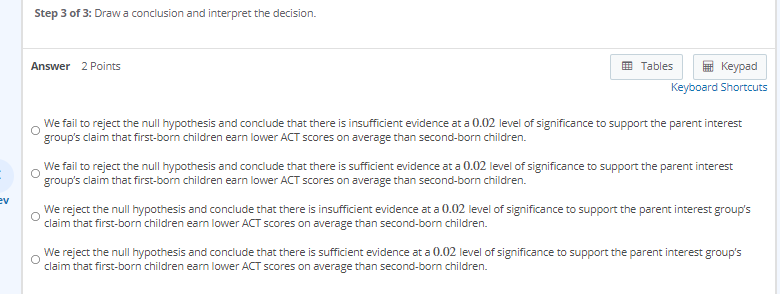
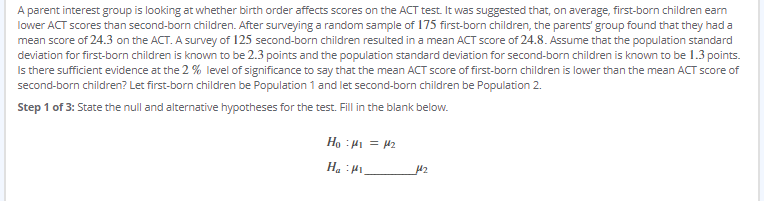
Step 3 of 3: Draw a conclusion and interpret the decision. Answer 2 Points Tables Keypad Keyboard Shortcuts We fail to reject the null hypothesis and conclude that there is insufficient evidence at a 0.02 level of significance to support the parent interest group's claim that first-born children earn lower ACT scores on average than second-born children. O We fail to reject the null hypothesis and conclude that there is sufficient evidence at a 0.02 level of significance to support the parent interest group's claim that first-born children earn lower ACT scores on average than second-born children. O We reject the null hypothesis and conclude that there is insufficient evidence at a 0.02 level of significance to support the parent interest group's claim that first-born children earn lower ACT scores on average than second-born children. O We reject the null hypothesis and conclude that there is sufficient evidence at a 0.02 level of significance to support the parent interest group's claim that first-born children earn lower ACT scores on average than second-born children.A parent interest group is looking at whether birth order affects scores on the ACT test. It was suggested that, on average, first-born children earn lower ACT scores than second-born children. After surveying a random sample of 175 first-born children, the parents' group found that they had a mean score of 24.3 on the ACT. A survey of 125 second-born children resulted in a mean ACT score of 24.8. Assume that the population standard deviation for first-born children is known to be 2.3 points and the population standard deviation for second-born children is known to be 1.3 points. Is there sufficient evidence at the 2 %% level of significance to say that the mean ACT score of first-born children is lower than the mean ACT score of second-born children? Let first-born children be Population 1 and let second-born children be Population 2. Step 1 of 3: State the null and alternative hypotheses for the test. Fill in the blank below. Ho : HI = /2 Ha : HI
Step by Step Solution
There are 3 Steps involved in it

Get step-by-step solutions from verified subject matter experts
 Study Help