







Question: I am having issues with the test cases. My code is not passing all the test cases, failing at test 6. Below is what I
 I am having issues with the test cases. My code is not passing all the test cases, failing at test 6. Below is what I have, but I need help with refining my code to pass all the test cases.
BST.java
package lab2;
import java.io.*; import java.util.*;
public class BST { /** * Problem: Perform rotations on tree1 to make it equivalent to tree2. */ public static void problem(BST tree1, BST tree2) { Stack
// --------------------------------------------------------------------- // Do not change any of the code below!
private class Node { public Node left = null; public Node right = null; public Node parent = null;
public int key;
public Node(int key) { this.key = key; } }
private Node root = null;
public int getRootKey() { return root.key; }
private Node find(int key) { for (Node cur = root; cur != null;) { if (key cur.key { cur = cur.right; } }
return null; }
// x y // / \ / \ // a y => x c // / \ / \ // b c a b private void rotateL(Node xNode) { Node xPar = xNode.parent; boolean isRoot = xPar == null; boolean isLChild = !isRoot && xPar.left == xNode;
Node yNode = xNode.right; Node beta = yNode.left;
if (isRoot) root = yNode; else if (isLChild) xPar.left = yNode; else xPar.right = yNode;
yNode.parent = xPar; yNode.left = xNode;
xNode.parent = yNode; xNode.right = beta;
if (beta != null) beta.parent = xNode; }
// y x // / \ / \ // x c => a y // / \ / \ // a b b c private void rotateR(Node yNode) { Node yPar = yNode.parent; boolean isRoot = yPar == null; boolean isLChild = !isRoot && yPar.left == yNode;
Node xNode = yNode.left; Node beta = xNode.right;
if (isRoot) root = xNode; else if (isLChild) yPar.left = xNode; else yPar.right = xNode;
xNode.parent = yPar; xNode.right = yNode;
yNode.parent = xNode; yNode.left = beta;
if (beta != null) beta.parent = yNode; }
public void insert(int key) { if (root == null) { root = new Node(key); return; }
Node par = null;
for (Node node = root; node != null;) { par = node;
if (key node.key) { node = node.right; } else // key == node.key { // Nothing to do, because no value to update. return; } }
// Create node and set pointers. Node newNode = new Node(key); newNode.parent = par;
if (key
public int[] getInOrder() { if (root == null) return new int[] { };
Stack
for (Node node = root;;) { if (node == null) { if (stack.empty()) break;
node = stack.pop(); orderList.add(node.key); node = node.right; } else { stack.push(node); node = node.left; } }
int[] order = new int[orderList.size()]; for (int i = 0; i
return order; }
public int[] getPreOrder() { if (root == null) return new int[] { };
Stack
for (Node node = root;;) { if (node == null) { if (stack.empty()) break;
node = stack.pop(); node = node.right; } else { orderList.add(node.key); stack.push(node); node = node.left; } }
int[] order = new int[orderList.size()]; for (int i = 0; i
return order; } }
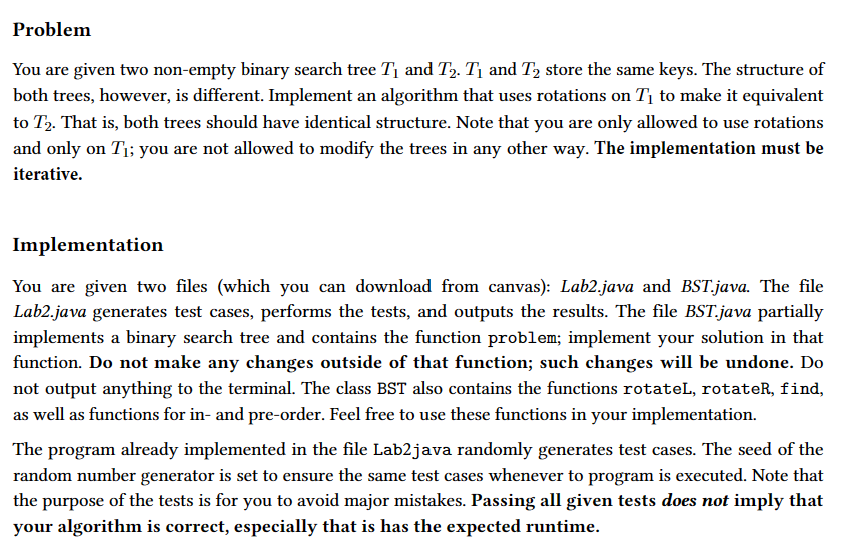
You are given two non-empty binary search tree T1 and T2.T1 and T2 store the same keys. The structure of both trees, however, is different. Implement an algorithm that uses rotations on T1 to make it equivalent to T2. That is, both trees should have identical structure. Note that you are only allowed to use rotations and only on T1; you are not allowed to modify the trees in any other way. The implementation must be iterative. Implementation You are given two files (which you can download from canvas): Lab2.java and BST.java. The file Lab2.java generates test cases, performs the tests, and outputs the results. The file BST.java partially implements a binary search tree and contains the function problem; implement your solution in that function. Do not make any changes outside of that function; such changes will be undone. Do not output anything to the terminal. The class BST also contains the functions rotateL, rotateR, find, as well as functions for in- and pre-order. Feel free to use these functions in your implementation. The program already implemented in the file Lab 2 java randomly generates test cases. The seed of the random number generator is set to ensure the same test cases whenever to program is executed. Note that the purpose of the tests is for you to avoid major mistakes. Passing all given tests does not imply that your algorithm is correct, especially that is has the expected runtime
Step by Step Solution
There are 3 Steps involved in it

Get step-by-step solutions from verified subject matter experts
 Study Help