Question: I am having trouble with this assignment... Could you explain in as much detail as possible, Who would agree more with each quote; Hobbes or
I am having trouble with this assignment...
Could youexplain in as much detail as possible,Who would agree more with each quote; Hobbes or Locke and why?
Quotes:
Why has the government been instituted at all? Because the passions of men will not conform to the dictates of reason and justice, without constraint." Alexander Hamilton (1787)
"That To secure these rights, Governments are instituted among Men, deriving their just powers from the consent of the governed..." Thomas Jefferson (1787)
Here are some of the sources that I was given:
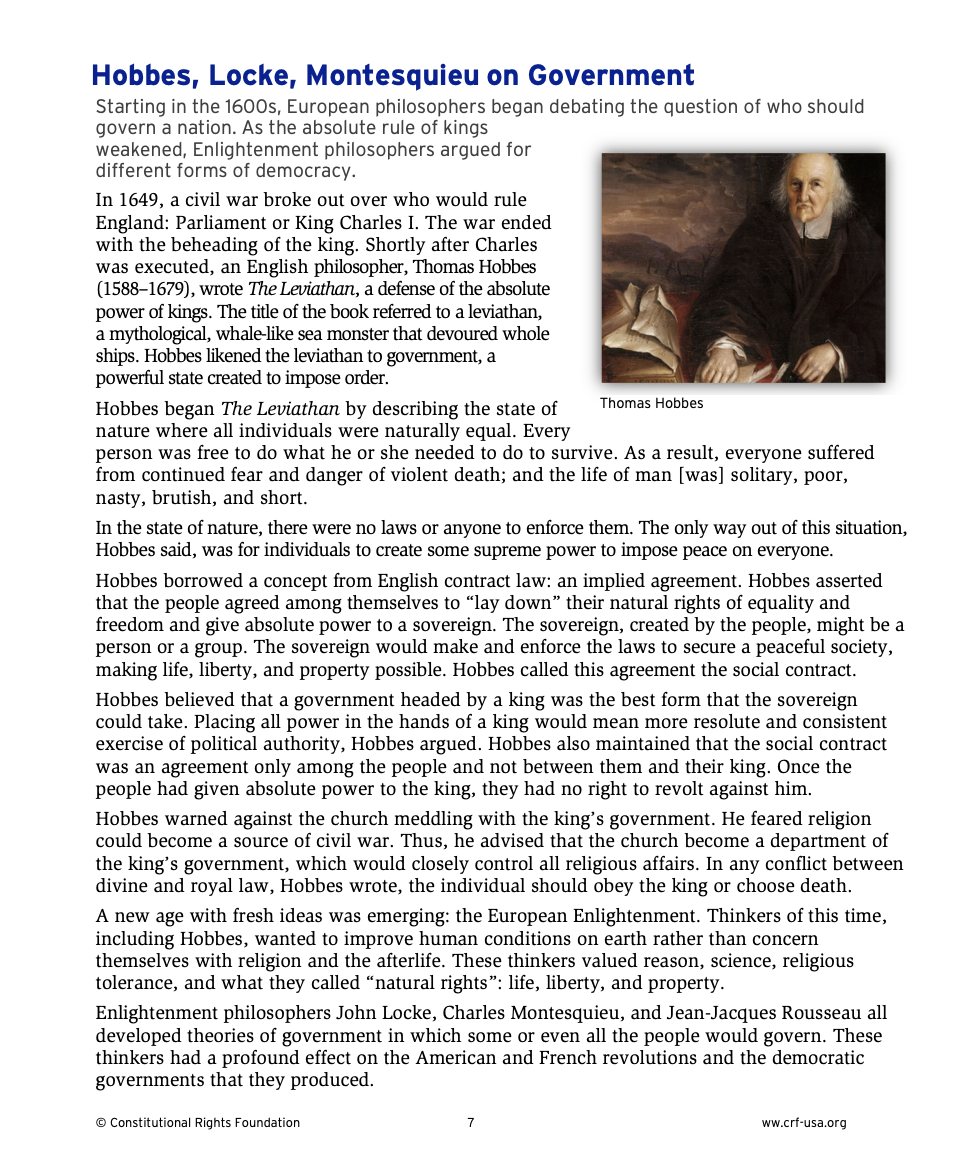
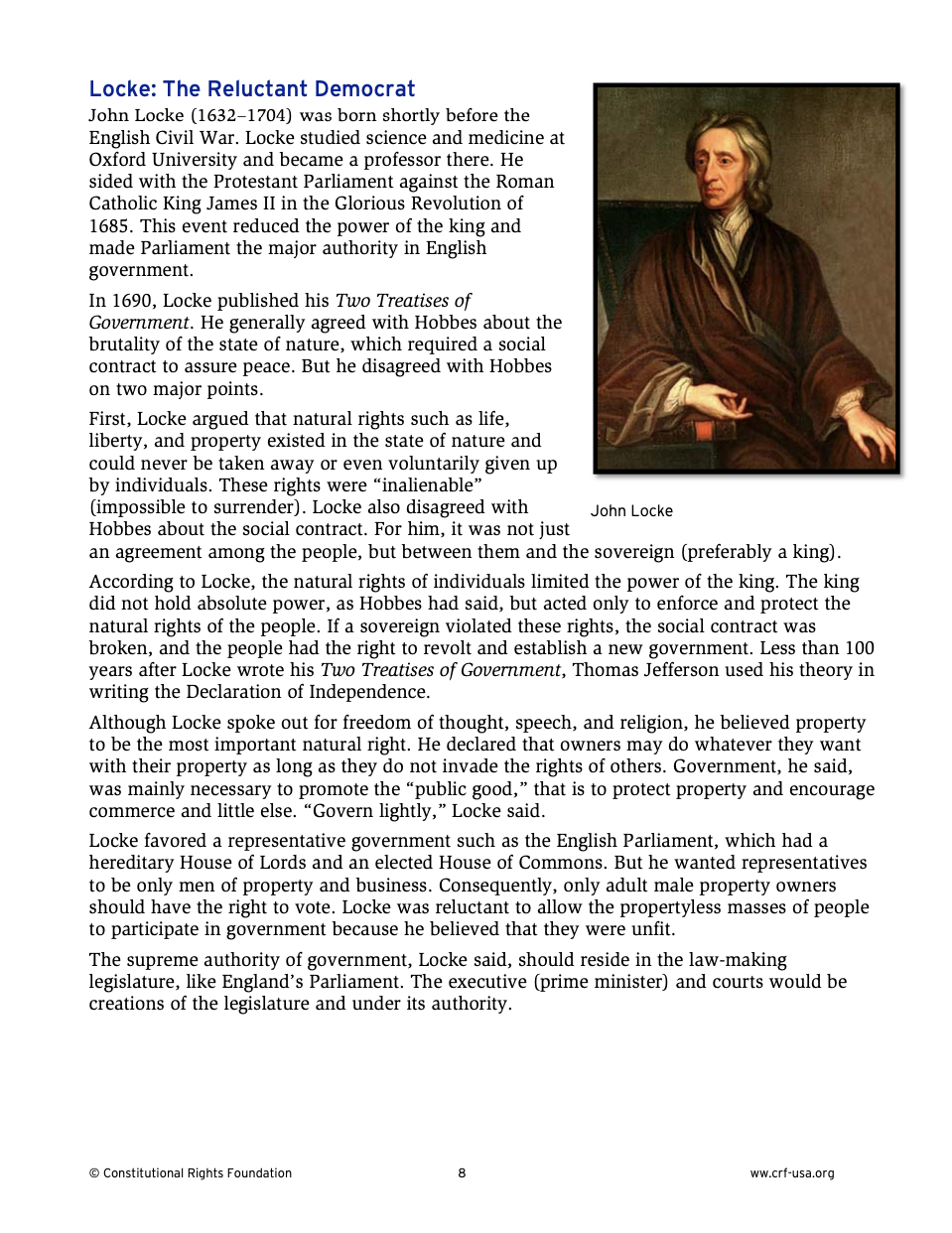
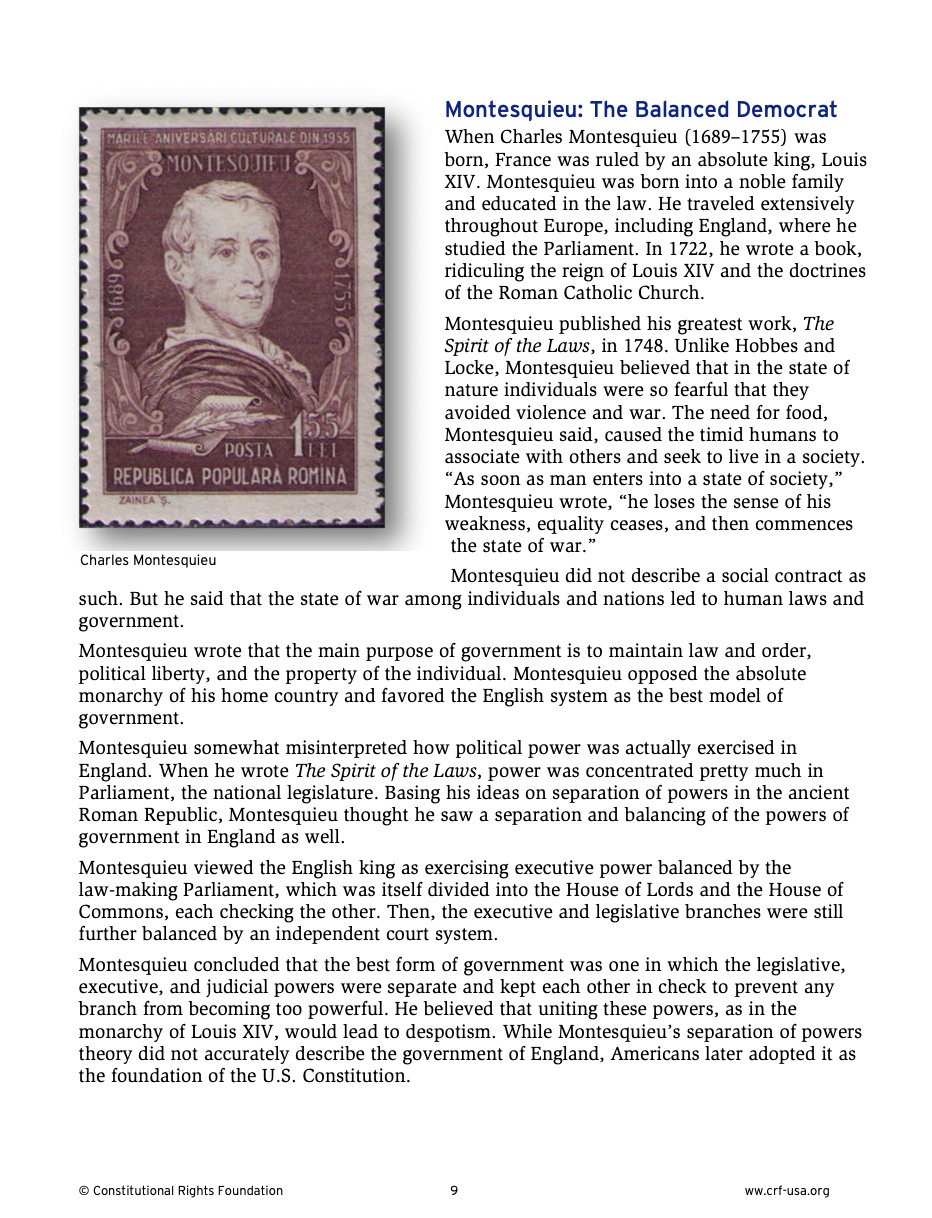
Hobbes. Locke, Montesquieu on Government Starting in the 16005. European philosophers began debating the question of who should govern a nation. As the absolute rule of kings weakened. Enlightenment philosophers argued for different forms of democracy. In 1649, a civil war broke out over who would rule England: Parliament or King Charles I. The war ended with the beheading of the king. Shortly after Charles was executed, an English philosopher, Thomas Hobbes [1588-1679], wrote TheLm'athan, a defense of the absolute power of ldngs. The title of the book referred to a leviathan, a mythological, whale-like sea monster that devoured whole ships. Hobbes likened the leviathan to government, a powerful state created to impose order. Hobbes began The Leviathan by describing the state of \"was Homes nature where all individuals were naturally equal. Every person was free to do what he or she needed to do to survive. As a result, everyone suffered from continued fear and danger of violent death; and the life of man [was] solitary, poor, nasty, brutish, and short. In the state of nature, there were no laws or anyone to enforce them. The only way out of this situation, Hobbes said, was for individuals to create some supreme power to impose peace on everyone. Hobbes borrowed a concept from English contract law: an implied agreement. Hobbes asserted that the people agreed among themselves to "lay down\" their natural rights of equality and freedom and give absolute power to a sovereign. The sovereign, created by the people, might be a person or a group. The sovereign would make and enforce the laws to secure a peaceful society, making life, liberty, and property possible. Hobbes called this agreement the social contract. Hobbes believed that a government headed by a king was the best form that the sovereign could take. Placing all power in the hands of a king would mean more resolute and consistent exercise of political authority, Hobbes argued. Hobbes also maintained that the social contract was an agreement only among the people and not between them and their king. Once the people had given absolute power to the king, they had no right to revolt against him. Hobbes warned against the church meddling with the king's government. He feared religion could become a source of civil war. Thus, he advised that the church become a department of the king's government, which would closely control all religious affairs. In any conflict between divine and royal law, Hobbes wrote, the individual should obey the king or choose death. A new age with fresh ideas was emerging: the European Enlightenment. Thinkers of this time, including Hobbes, wanted to improve human conditions on earth rather than concern themselves with religion and the afterlife. These thinkers valued reason, science, religious tolerance, and what they called "natural rights\": life, liberty, and property. Enlightenment philosophers John Locke, Charles Montesquieu, and J ean-Jacques Rousseau all developed theories of government in which some or even all the people would govern. These thinkers had a profound effect on the American and French revolutions and the democratic governments that they produced. Constitutional Rights Foundation ? ww.cr1-usa.org Locke: The Reluctant Democrat John Locke (16321704) was born shortly before the English Civil War. Locke studied science and medicine at Oxford University and became a professor there. He sided with the Protestant Parliament against the Roman Catholic King James II in the Glorious Revolution of 1685. This event reduced the power of the king and made Parliament the major authority in English government. In 1690, Locke published his Two Treatises of Government. He generally agreed with Hobbes about the brutality of the state of nature, which required a social contract to assure peace. But he disagreed with Hobbes on two major points. First, Locke argued that natural rights such as life, liberty, and property existed in the state of nature and could never be taken away or even voluntarily given up by individuals. These rights were "inalienable\" [impossible to surrender]. Locke also disagreed with John Locke Hobbes about the social contract. For him, it was not just an agreement among the people, but between them and the sovereign (preferably a king}. According to Locke, the natural rights of individuals limited the power of the king. The king did not hold absolute power, as Hobbes had said, but acted only to enforce and protect the natural rights of the people. If a sovereign violated these rights, the social contract was broken, and the people had the right to revolt and establish a new government. Less than 100 years after Locke wrote his Two Treatises of Government, Thomas Jefferson used his theory in writing the Declaration of Independence. Although Locke spoke out for freedom of thought, speech, and religion, he believed property to be the most important natural right. He declared that owners may do whatever they want with their property as long as they do not invade the rights of others. Government, he said, was mainly necessary to promote the \" public good,\" that is to protect property and encourage commerce and little else. "Govern lightly,\" Locke said. Locke favored a representative government such as the English Parliament, which had a hereditary House of Lords and an elected House of Commons. But he wanted representatives to be only men of property and business. Consequently, only adult male property owners should have the right to vote. Locke was reluctant to allow the propertyless masses of people to participate in government because he believed that they were unfit. The supreme authority of government, Locke said, should reside in the law-making legislature, like England's Parliament. The executive [prime minister] and courts would be creations of the legislature and under its authority. Constitutional Rights Foundation 8 ww.crfusa.org Montesquieu: The Balanced Democrat When Charles Montesquieu [16891755) was born, France was ruled by an absolute king, Louis XIV. Montesquieu was born into a noble family and educated in the law. He traveled extensively throughout Europe, including England, where he studied the Parliament. In 1722, he wrote a book, ridiculing the reign of Louis XIV and the doctrines of the Roman Catholic Church. Montesquieu published his greatest work, The Spirit of the Laws, in 1748. Unlike Hobbes and Locke, Montesquieu believed that in the state of nature individuals were so fearful that they avoided violence and war. The need for food, Montesquieu said, caused the timid humans to associate with others and seek to live in a society. "As soon as man enters into a state of society,\" Montesquieu wrote, "he loses the sense of his weakness, equality ceases, and then commences the state of war.\" Charles Montesquieu Montesquieu did not describe a social contract as such. But he said that the state of war among individuals and nations led to human laws and government. Montesquieu wrote that the main purpose of government is to maintain law and order, political liberty, and the property of the individual. Montesquieu opposed the absolute monarchy of his home country and favored the English system as the best model of government. Montesquieu somewhat misinterpreted how political power was actually exercised in England. When he wrote The Spirit of the Laws, power was concentrated pretty much in Parliament, the national legislature. Basing his ideas on separation of powers in the ancient Roman Republic, Montesquieu thought he saw a separation and balancing of the powers of government in England as well. Montesquieu viewed the English king as exercising executive power balanced by the law-making Parliament, which was itself divided into the House of Lords and the House of Commons, each checking the other. Then, the executive and legislative branches were still further balanced by an independent court system. Montesquieu concluded that the best form of government was one in which the legislative, executive, and judicial powers were separate and kept each other in check to prevent any branch from becoming too powerful. He believed that uniting these powers, as in the monarchy of Louis XIV, would lead to despotism. While Montesquieu's separation of powers theory did not accurately describe the government of England, Americans later adopted it as the foundation of the US. Constitution. Constitutional Rights Foundation 9 ww.cr1-usa.org
Step by Step Solution
There are 3 Steps involved in it
1 Expert Approved Answer
Step: 1 Unlock
Question Has Been Solved by an Expert!
Get step-by-step solutions from verified subject matter experts
Step: 2 Unlock
Step: 3 Unlock
Students Have Also Explored These Related Mathematics Questions!









 Study Help