



Question: I am not able to understand the questions. Please help me. I am stuck..!! 5) Let's examine the relationship between CPS and hypothesis tests: 6)
I am not able to understand the questions. Please help me. I am stuck..!!
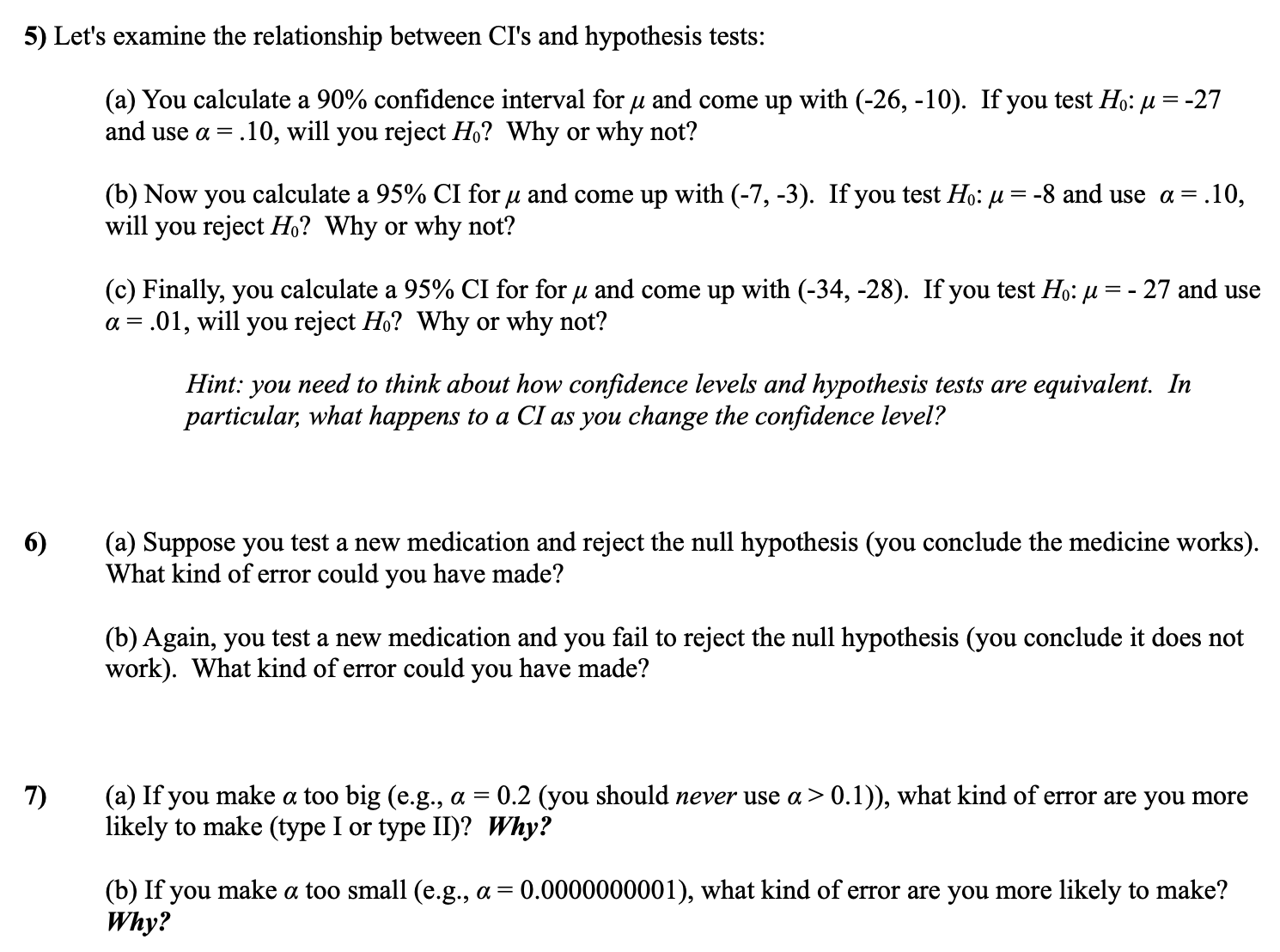
5) Let's examine the relationship between CPS and hypothesis tests: 6) 7) (a) You calculate a 90% condence interval for Ju and come up with (-26, -10). If you test H0: Ju = -27 and use a = .10, will you reject H0? Why or why not? (b) Now you calculate a 95% CI for Ju and come up with (-7, -3). If you test Ho: ,u = -8 and use a = .10, will you reject Ho? Why or why not? (c) Finally, you calculate a 95% CI for for p and come up with (-34, -28). If you test Ho: Ju = - 27 and use a = .01, will you reject Ho? Why or why not? Hint: you need to think about how condence levels and hypothesis tests are equivalent. In particular; what happens to a CI as you change the condence level? (a) Suppose you test a new medication and reject the null hypothesis (you conclude the medicine works). What kind of error could you have made? (b) Again, you test a new medication and you fail to reject the null hypothesis (you conclude it does not work). What kind of error could you have made? (a) If you make a too big (e.g., a = 0.2 (you should never use a > 0.1)), What kind of error are you more likely to make (type I or type 11)? Why? (b) If you make a too small (e.g., a = 0.0000000001), what kind of error are you more likely to make? Why
Step by Step Solution
There are 3 Steps involved in it

Get step-by-step solutions from verified subject matter experts