





Question: I am working on a problem from Winston's Operations Research: Applications and Algorithms (4th edition). It is in section 3.9, problem 10. I do not

I am working on a problem from Winston's "Operations Research: Applications and Algorithms (4th edition)". It is in section 3.9, problem 10. I do not think the solution that was posted here is correct, and I wanted to see if anyone can help me with this specific problem, particularly with setting up the correct constraints.
I am working on a problem from Winston's

I am working on a problem from Winston's

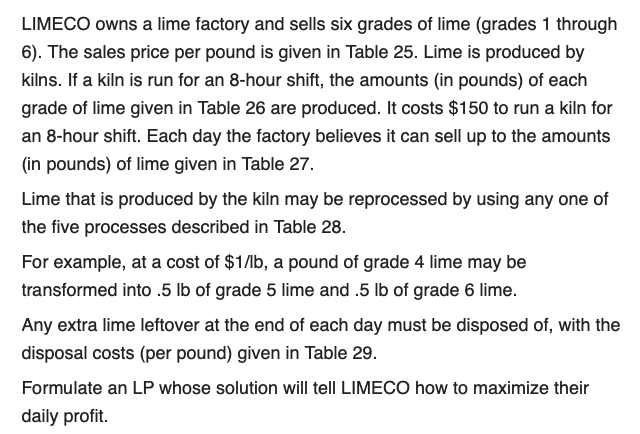
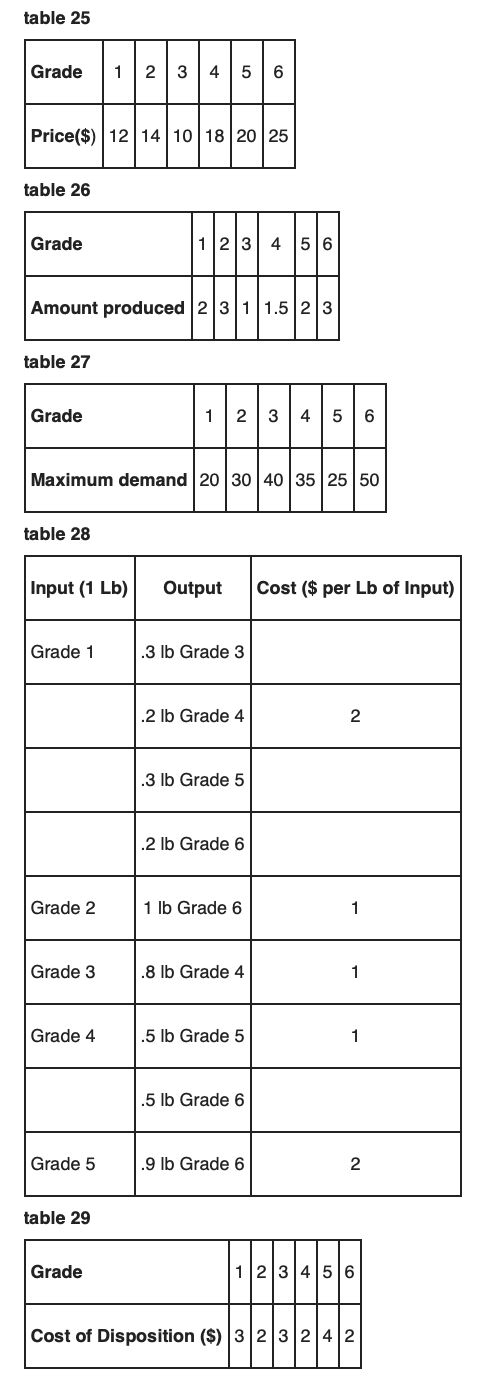
LIMECO owns a lime factory and sells six grades of lime (grades 1 through 6). The sales price per pound is given in Table 25. Lime is produced by kilns. If a kiln is run for an 8-hour shift, the amounts (in pounds) of each grade of lime given in Table 26 are produced. It costs $150 to run a kiln for an 8-hour shift. Each day the factory believes it can sell up to the amounts (in pounds) of lime given in Table 27. Lime that is produced by the kiln may be reprocessed by using any one of the five processes described in Table 28. For example, at a cost of $1/1b, a pound of grade 4 lime may be transformed into .5 lb of grade 5 lime and .5 lb of grade 6 lime. Any extra lime leftover at the end of each day must be disposed of, with the disposal costs (per pound) given in Table 29. Formulate an LP whose solution will tell LIMECO how to maximize their daily profit. table 25 Grade 6 Price(s) 12 14 10 18 20 2025 table 26 Grade 1 2 3 4 5 6 Amount produced 23 11.5 23 table 27 Grade 1 6 Maximum demand 20 30 40 35 25 50 table 28 Input (1 lb) Output Cost ($ per Lb of Input) Grade 1 .3 lb Grade 3 .2 lb Grade 4 2 .3 lb Grade 5 .2 lb Grade 6 Grade 2 1 lb Grade 6 1 Grade 3 .8 lb Grade 4 1 Grade 4 .5 lb Grade 5 1 .5 lb Grade 6 Grade 5 .9 lb Grade 6 2 table 29 Grade 1 2 3 4 5 6 Cost of Disposition ($) 3 23 24 2 LIMECO owns a lime factory and sells six grades of lime (grades 1 through 6). The sales price per pound is given in Table 25. Lime is produced by kilns. If a kiln is run for an 8-hour shift, the amounts (in pounds) of each grade of lime given in Table 26 are produced. It costs $150 to run a kiln for an 8-hour shift. Each day the factory believes it can sell up to the amounts (in pounds) of lime given in Table 27. Lime that is produced by the kiln may be reprocessed by using any one of the five processes described in Table 28. For example, at a cost of $1/1b, a pound of grade 4 lime may be transformed into .5 lb of grade 5 lime and .5 lb of grade 6 lime. Any extra lime leftover at the end of each day must be disposed of, with the disposal costs (per pound) given in Table 29. Formulate an LP whose solution will tell LIMECO how to maximize their daily profit. table 25 Grade 6 Price(s) 12 14 10 18 20 2025 table 26 Grade 1 2 3 4 5 6 Amount produced 23 11.5 23 table 27 Grade 1 6 Maximum demand 20 30 40 35 25 50 table 28 Input (1 lb) Output Cost ($ per Lb of Input) Grade 1 .3 lb Grade 3 .2 lb Grade 4 2 .3 lb Grade 5 .2 lb Grade 6 Grade 2 1 lb Grade 6 1 Grade 3 .8 lb Grade 4 1 Grade 4 .5 lb Grade 5 1 .5 lb Grade 6 Grade 5 .9 lb Grade 6 2 table 29 Grade 1 2 3 4 5 6 Cost of Disposition ($) 3 23 24 2

Step by Step Solution

There are 3 Steps involved in it

1 Expert Approved Answer
Step: 1 Unlock blur-text-image

Question Has Been Solved by an Expert!

Get step-by-step solutions from verified subject matter experts

Step: 2 Unlock
Step: 3 Unlock

Students Have Also Explored These Related General Management Questions!