







Question: I ASKED FOR THE 3RD TIME .. I NEED MATLAB CODE PLEASE !!!!!!!!! Procedure: The DTFS is the only Fourier representation that is discrete valued
 I ASKED FOR THE 3RD TIME .. I NEED MATLAB CODE PLEASE !!!!!!!!!
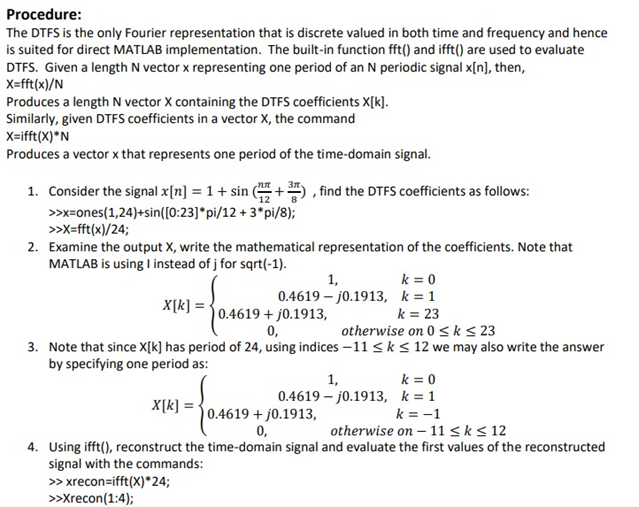
Procedure: The DTFS is the only Fourier representation that is discrete valued in both time and frequency and hence is suited for direct MATLAB implementation. The built-in function fft( ) and ifft() are used to evaluate DTFS. Given a length N vector x representing one period of an N periodic signal x[n], then, X=fft(x)/N Produces a length N vector X containing the DTFS coefficients X[k]. Similarly, given DTFS coefficients in a vector X, the command X=ifft(X)N Produces a vector x that represents one period of the time-domain signal. 1. Consider the signal x[n]=1+sin(12n+83), find the DTFS coefficients as follows: >>x=ones(1,24)+sin([0:23]pi/12+3pi/8);>=fft(x)/24; 2. Examine the output X, write the mathematical representation of the coefficients. Note that MATLAB is using 1 instead of j for sqrt(-1). X[k]=1,0.4619j0.1913,0.4619+j0.1913,0,k=0k=1k=23otherwiseon0k23 3. Note that since X[k] has period of 24 , using indices 11k12 we may also write the answer by specifying one period as: X[k]=1,0.4619j0.1913,0.4619+j0.1913,0,k=0k=1k=1otherwiseon11k12 4. Using ifft(), reconstruct the time-domain signal and evaluate the first values of the reconstructed signal with the commands: >> xrecon=ifft (X)24; >>recon(1:4)
Step by Step Solution
There are 3 Steps involved in it

Get step-by-step solutions from verified subject matter experts
 Study Help