







Question: I asked this same question yesterday but it was wrong, please read the question carefully :) In part b, we're asked to use the restricted
I asked this same question yesterday but it was wrong, please read the question carefully :) In part b, we're asked to use the restricted OLS SRF to test if Rt=DCR.
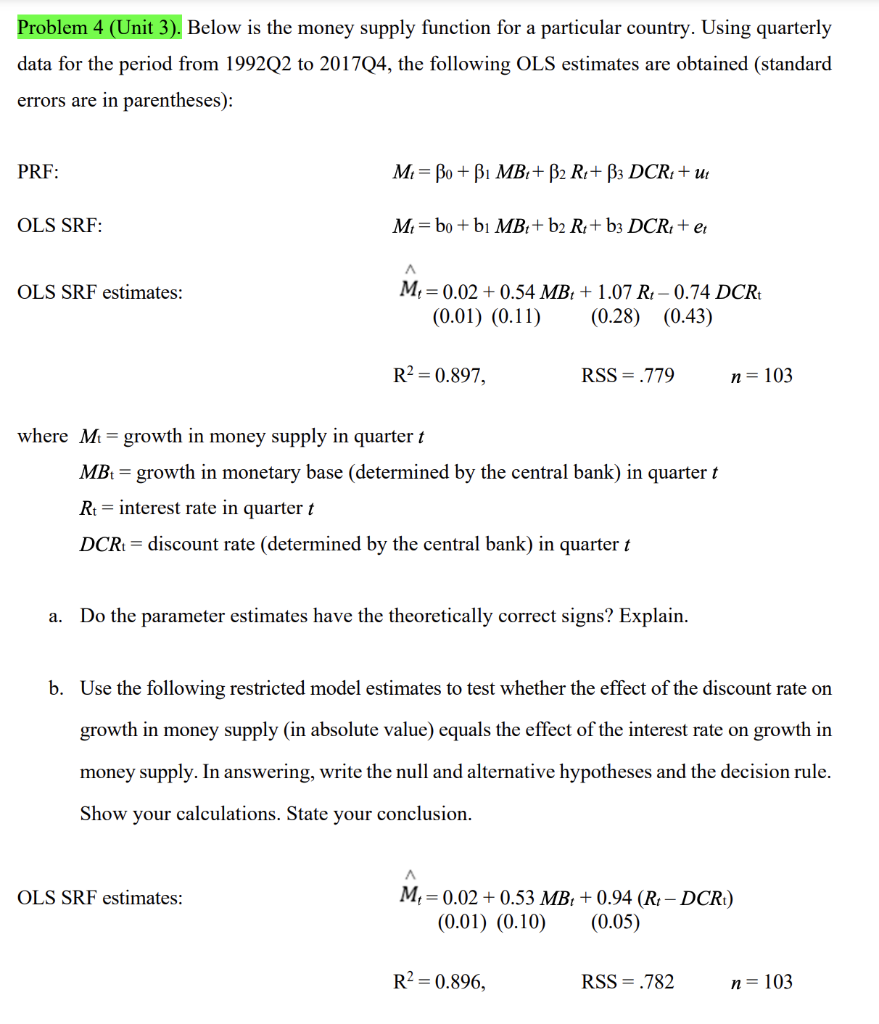
Problem 4 (Unit 3). Below is the money supply function for a particular country. Using quarterly data for the period from 1992Q2 to 2017Q4, the following OLS estimates are obtained (standard errors are in parentheses): PRF: Mt=0+1MBt+2Rt+3DCRt+ut OLS SRF: Mt=b0+b1MBt+b2Rt+b3DCRt+et OLS SRF estimates: M^t=0.02+0.54MBt+1.07Rt0.74DCRt (0.01) (0.11) (0.28)(0.43) R2=0.897,RSS=.779n=103 where Mt= growth in money supply in quarter t MBt= growth in monetary base (determined by the central bank) in quarter t Rt= interest rate in quarter t DCRt= discount rate (determined by the central bank) in quarter t a. Do the parameter estimates have the theoretically correct signs? Explain. b. Use the following restricted model estimates to test whether the effect of the discount rate on growth in money supply (in absolute value) equals the effect of the interest rate on growth in money supply. In answering, write the null and alternative hypotheses and the decision rule. Show your calculations. State your conclusion. OLS SRF estimates: M^t=R2=0.02+0.53MBt+0.94(RtDCRt)(0.01)(0.10)(0.05)0.896,RSS=.782n=103
Step by Step Solution
There are 3 Steps involved in it

Get step-by-step solutions from verified subject matter experts
 Study Help