







Question: I attached an image with the information needed to complete the following questions: Which of the following is the appropriate null hypothesis? Small and medium
I attached an image with the information needed to complete the following questions:
- Which of the following is the appropriate null hypothesis?
Small and medium claims are equally likely to be judged overpayments.
Small claims are more likely to be judged overpayments compared to medium claims.
Small claims are less likely to be judged overpayments compared to medium claims.
Small and medium claims are not equally likely to be judged overpayments.
- Which of the following is the appropriate alternative hypothesis?
Small and medium claims are equally likely to be judged overpayments.
Small claims are more likely to be judged overpayments compared to medium claims.
Small claims are less likely to be judged overpayments compared to medium claims.
Small and medium claims are not equally likely to be judged overpayments.
- In this context, which of the following is an (are) appropriate statistic value(s) to compare small to medium claims? Choose all that apply.
14/60 ? 8/60 = 0.10
14/30 ? 8/30 = 0.20
14/22 ? 16/38 = 0.22
(14/30)/(8/30) = 1.75
- Suppose that we want to use cards to carry out a randomization test of the appropriate hypotheses. How many cards will we need?
60
30
Doesn't matter
22
- We need cards of two different colors. Let's say we decide to use red and black cards. Which of the following is an appropriate combination of red and black cards? Choose all that apply.
22 red and 38 black
30 red and 30 black
14 red and 8 black
38 red and 22 black
- You shuffle the stack of red and black cards and deal them into two piles. How many cards should you place in each pile?
22 red cards in one pile and 38 black cards in the other, representing overpayments.
30 random cards in each pile, representing 30 medium claims and 30 small claims.
30 red cards in one pile and 30 black cards in the other, 30 medium claims and 30 small claims.
14 red cards and 8 black cards in one pile, and the other 38 cards in another pile, representing overpayments
- What statistic should you record after you have shuffled and dealt the cards into two piles? Choose all that apply.
difference in conditional proportions
simulation
relative risk
null hypothesis
observed risk
- Suppose that you have repeated the shuffle-and-deal many times and recorded the appropriate statistic every single time. What should you do next to find the p-value?
Find how often the simulation results in the observed value or a more extreme value.
Calculate the difference in conditional proportions.
Specify the null hypothesis.
Verify that the observed differences occurred by chance.
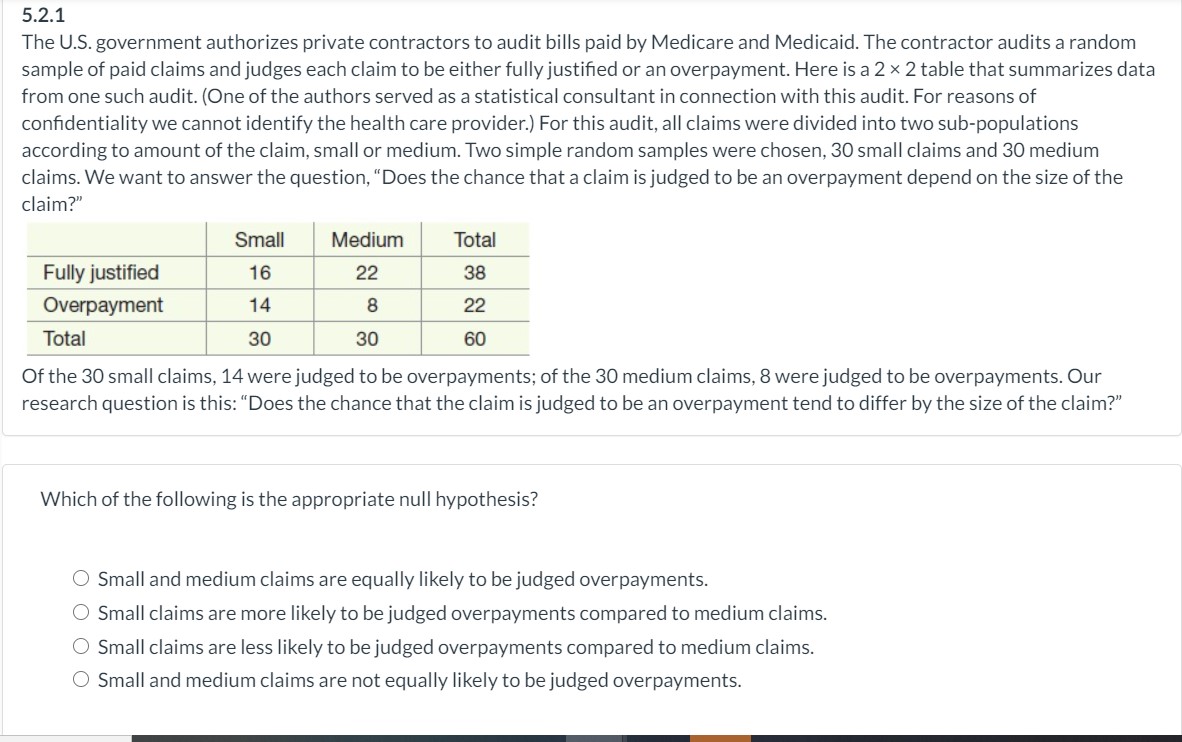
5.2.1 The U.S. government authorizes private contractors to audit bills paid by Medicare and Medicaid. The contractor audits a random sample of paid claims and judges each claim to be either fully justified or an overpayment. Here is a 2 x 2 table that summarizes data from one such audit. (One of the authors served as a statistical consultant in connection with this audit. For reasons of confidentiality we cannot identify the health care provider.) For this audit, all claims were divided into two sub-populations according to amount of the claim, small or medium. Two simple random samples were chosen, 30 small claims and 30 medium claims. We want to answer the question, "Does the chance that a claim is judged to be an overpayment depend on the size of the claim?" Small Medium Total Fully justified 16 22 38 Overpayment 14 8 22 Total 30 30 60 Of the 30 small claims, 14 were judged to be overpayments; of the 30 medium claims, 8 were judged to be overpayments. Our research question is this: "Does the chance that the claim is judged to be an overpayment tend to differ by the size of the claim?" Which of the following is the appropriate null hypothesis? O Small and medium claims are equally likely to be judged overpayments. O Small claims are more likely to be judged overpayments compared to medium claims. O Small claims are less likely to be judged overpayments compared to medium claims. O Small and medium claims are not equally likely to be judged overpayments
Step by Step Solution
There are 3 Steps involved in it

Get step-by-step solutions from verified subject matter experts
 Study Help