







Question: I. Consider an archer ring an arrow at a target that is directly (i.e. horizontally) across from him. Suppose the arrow acts like a projectile
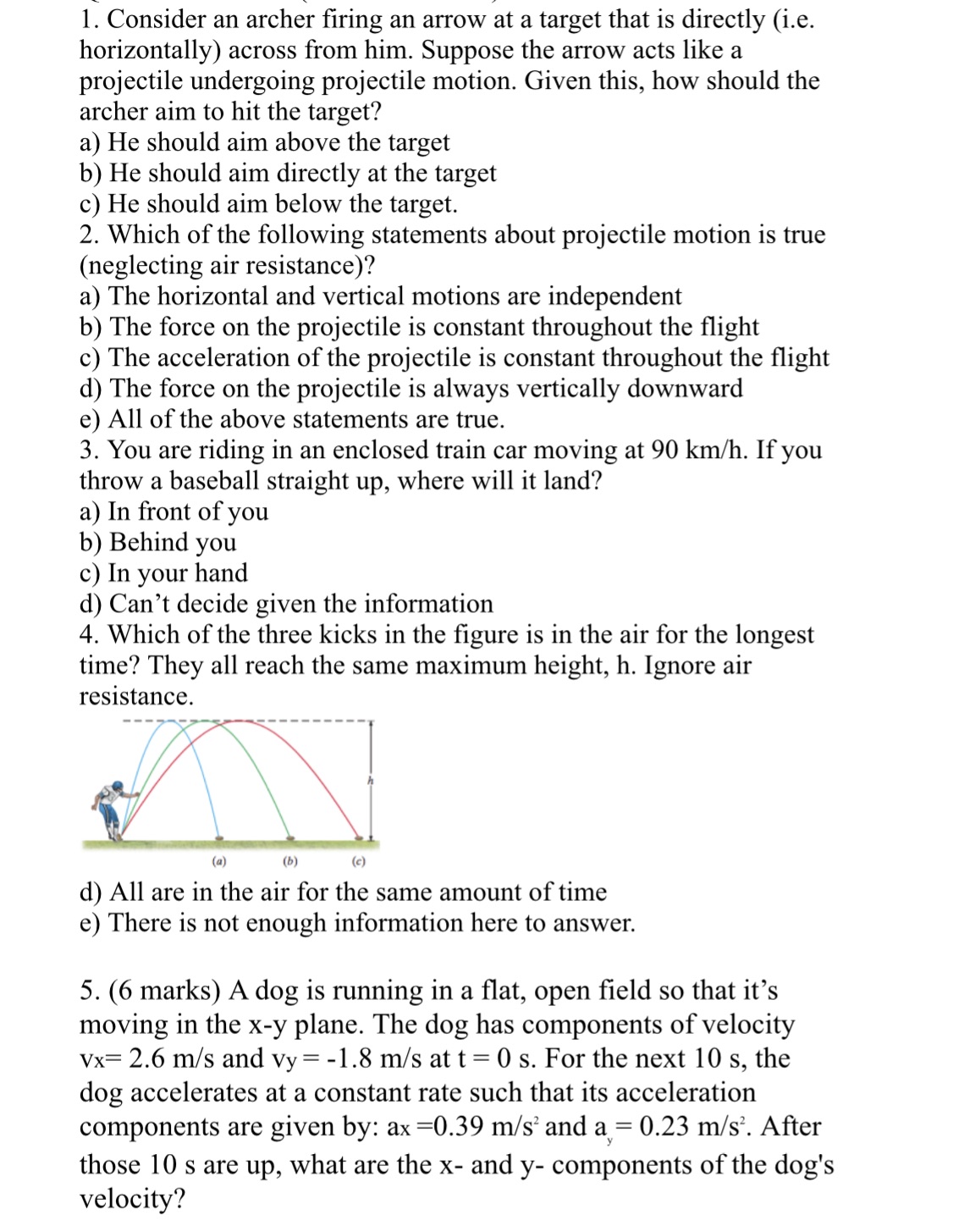
I. Consider an archer ring an arrow at a target that is directly (i.e. horizontally) across from him. Suppose the arrow acts like a projectile undergoing projectile motion. Given this, how should the archer aim to hit the target? a) He should aim above the target b) He should aim directly at the target c) He should aim below the target. 2. Which of the following statements about projectile motion is true (neglecting air resistance)? a) The horizontal and vertical motions are independent b) The force on the projectile is constant throughout the ight c) The acceleration of the projectile is constant throughout the ight d) The force on the projectile is always vertically downward e) All of the above statements are true. 3. You are riding in an enclosed train car moving at 90 km/h. If you throw a baseball straight up, where will it land? a) In front of you b) Behind you c) In your hand d) Can't decide given the information 4. Which of the three kicks in the gure is in the air for the longest time? They all reach the same maximum height, h. Ignore air resistance. [:1]: lb] h I d) All are in the air for the same amount of time e) There is not enough information here to answer. 5. (6 marks) A dog is running in a flat, open eld so that it's moving in the x-y plane. The dog has components of velocity Vx= 2.6 m/s and Vy = -1.8 m/s at t = O s. For the next 10 s, the dog accelerates at a constant rate such that its acceleration components are given by: ax =0.39 m/53 and av= 0.23 m/si. After those 10 s are up, what are the x- and y- components of the dog's velocity
Step by Step Solution
There are 3 Steps involved in it

Get step-by-step solutions from verified subject matter experts
 Study Help