







Question: (i) Define what is meant by an ideal solution. For a binary A-B ideal-solution, what would be the slope of the curve representing the free
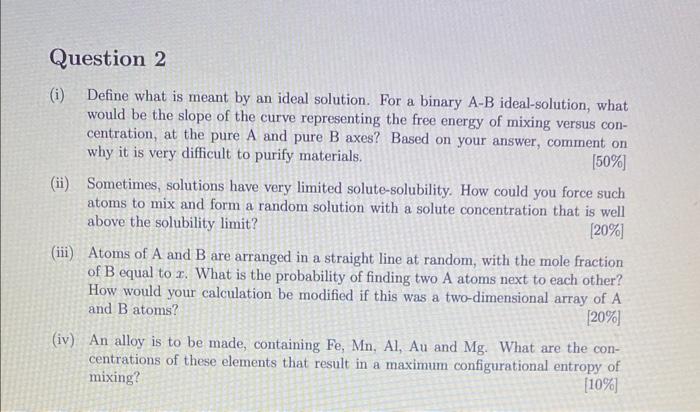
(i) Define what is meant by an ideal solution. For a binary A-B ideal-solution, what would be the slope of the curve representing the free energy of mixing versus concentration, at the pure A and pure B axes? Based on your answer, comment on why it is very difficult to purify materials. [50%] (ii) Sometimes, solutions have very limited solute-solubility. How could you force such atoms to mix and form a random solution with a solute concentration that is well above the solubility limit? [20%] (iii) Atoms of A and B are arranged in a straight line at random, with the mole fraction of B equal to x. What is the probability of finding two A atoms next to each other? How would your calculation be modified if this was a two-dimensional array of A and B atoms? [20\%] (iv) An alloy is to be made, containing Fe, Mn, Al, Au and Mg. What are the concentrations of these elements that result in a maximum configurational entropy of mixing? [10%]
Step by Step Solution
There are 3 Steps involved in it

Get step-by-step solutions from verified subject matter experts
 Study Help