







Question: I do not get those question. Help would be greatly appreciated. 4. (1 point) The following sum m2+mz++m2 is a right Riemann sum for the
I do not get those question. Help would be greatly appreciated.
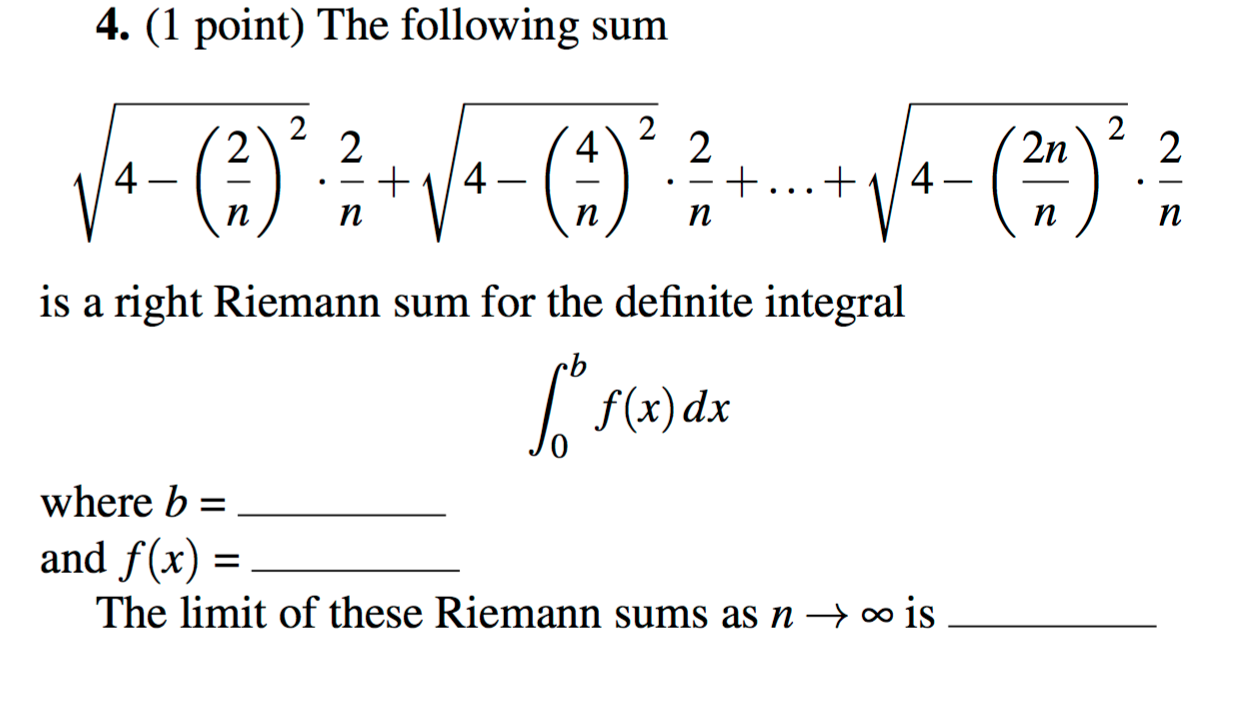
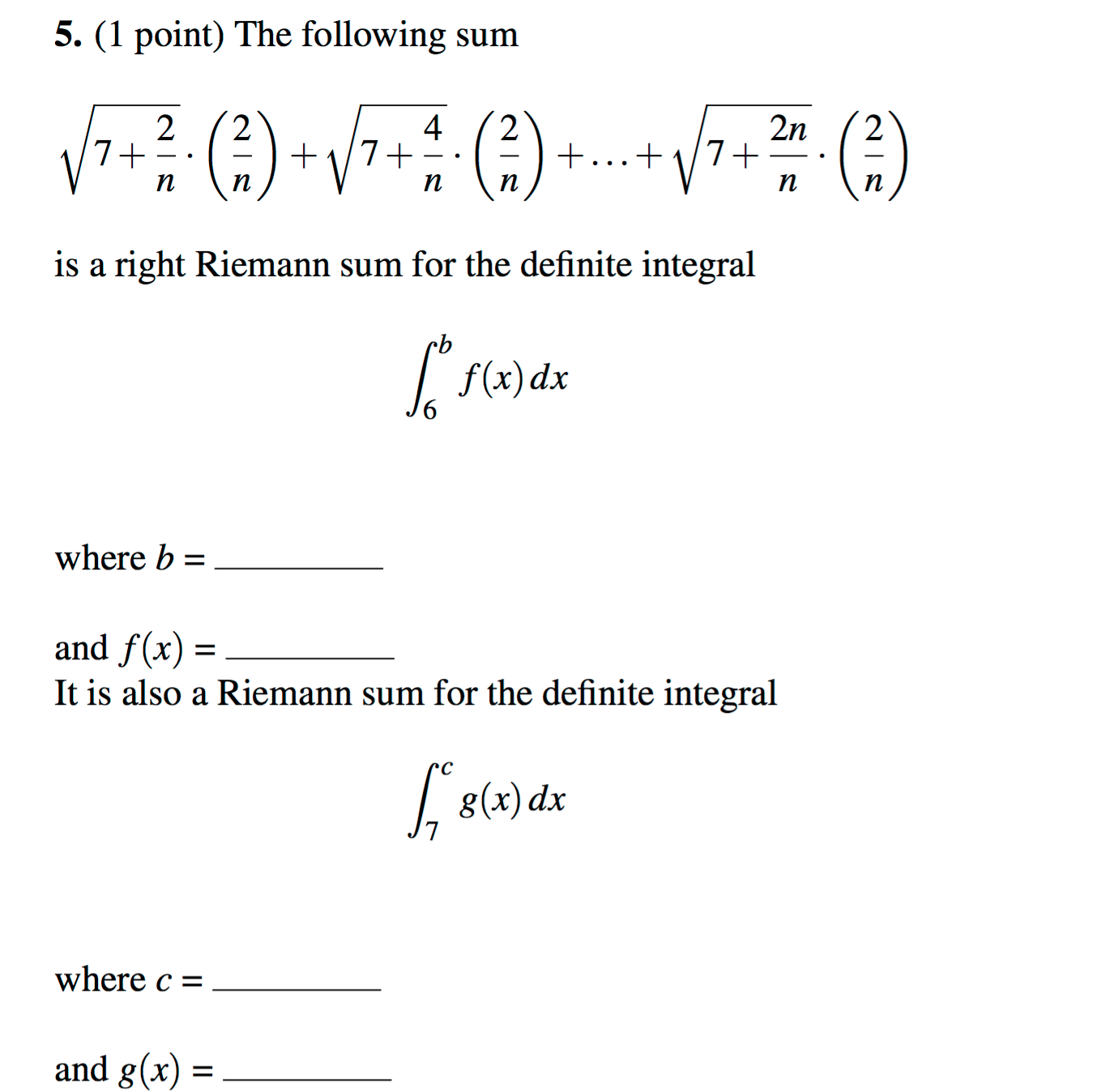
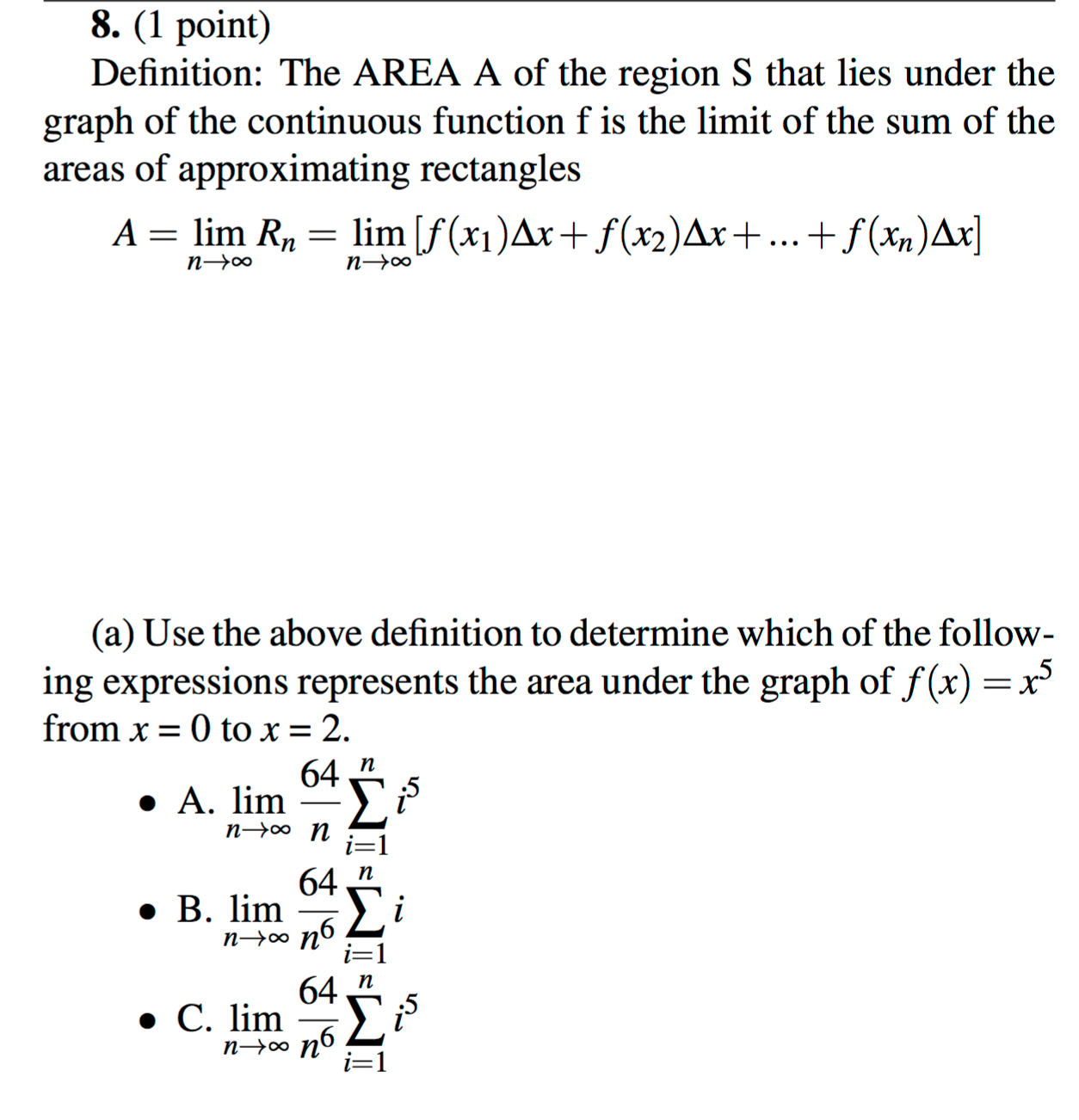
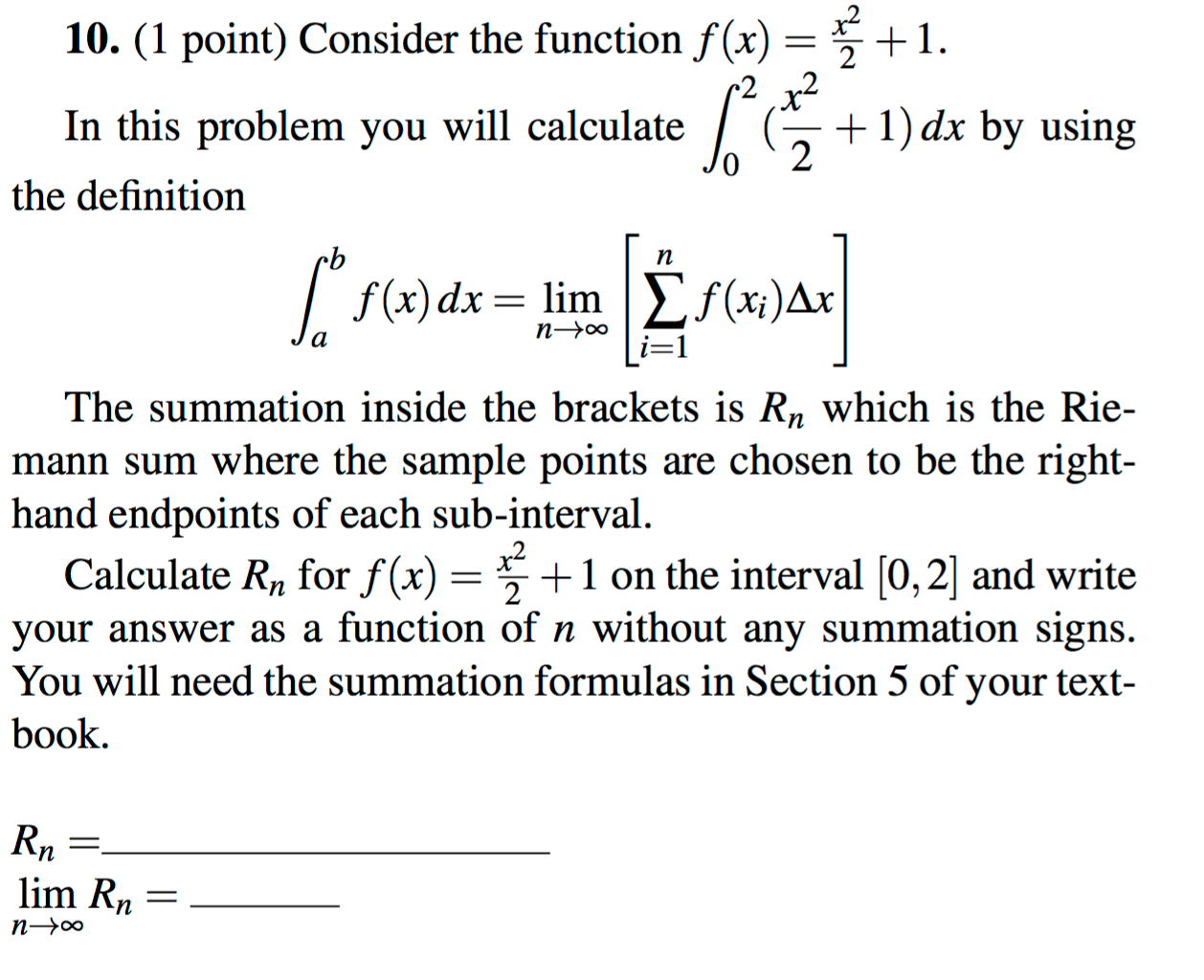
4. (1 point) The following sum m2+mz++m2 is a right Riemann sum for the denite integral /Obf(x)dx where b = and f (x) = The limit of these Riemann sums as n > oo is 5. (1 point) The following sum W(2)+\\/H4(2)++\\/H2(2) is a right Riemann sum for the denite integral 1; ffma 6 Where b = and f (x) = It is also a Riemann sum for the denite integral C / 3(x) dx 7 where c = and g(x) = 8. (1 point) Denition: The AREA A of the region S that lies under the graph of the continuous function f is the limit of the sum of the areas of approximating rectangles A = '1an = gigoif(x1)Ax+f(X2)Ax+ +f(xn)AX] (a) Use the above denition to determine which of the follow- ing expressions represents the area under the graph of f (x) = x5 fromx=0tox=2. n . A. lim E i5 non n . l g: . 64 n , o B. 11m 6 z n>oon ._1 g 4 n . c. lim 66 i5 "Hm\" i=1 10. (1 point) Consider the function f (x) = \"'72 +1. 2 2 In this problem you will calculate (x3 + 1) dx by using 0 the denition The summation inside the brackets is Rn which is the Rie- mann sum where the sample points are chosen to be the right- hand endpoints of each sub-interval. Calculate Rn for f (x) = \"672 +1 on the interval [0, 2] and write your answer as a function of n without any summation signs. You will need the summation formulas in Section 5 of your text- book. Rn: lim Rn = _ I'll>00
Step by Step Solution
There are 3 Steps involved in it

Get step-by-step solutions from verified subject matter experts
 Study Help