



Question: I do not know questions 11, 17, 18, and 23. Question 11 is multiple choice, the options are: Problem 7 Q11 options are: A) p=1/6,
I do not know questions 11, 17, 18, and 23.
Question 11 is multiple choice, the options are:
Problem 7 Q11 options are:
A) p=1/6, r=1
B) p=1/6
C) N=30, G=6, n=5
D) mean=6, SD=2.041
E) n=30, p=1/6
F) none of the above
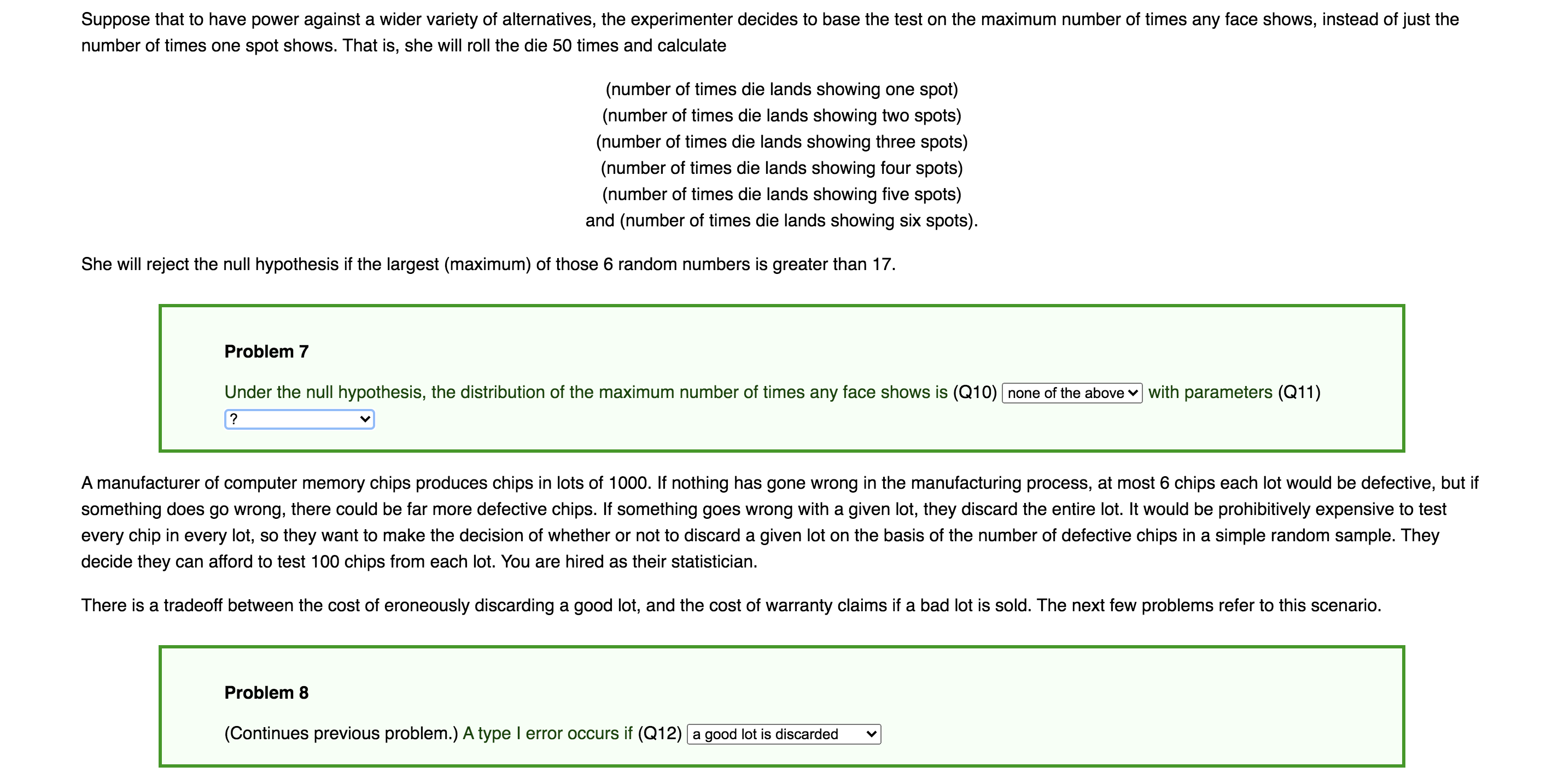
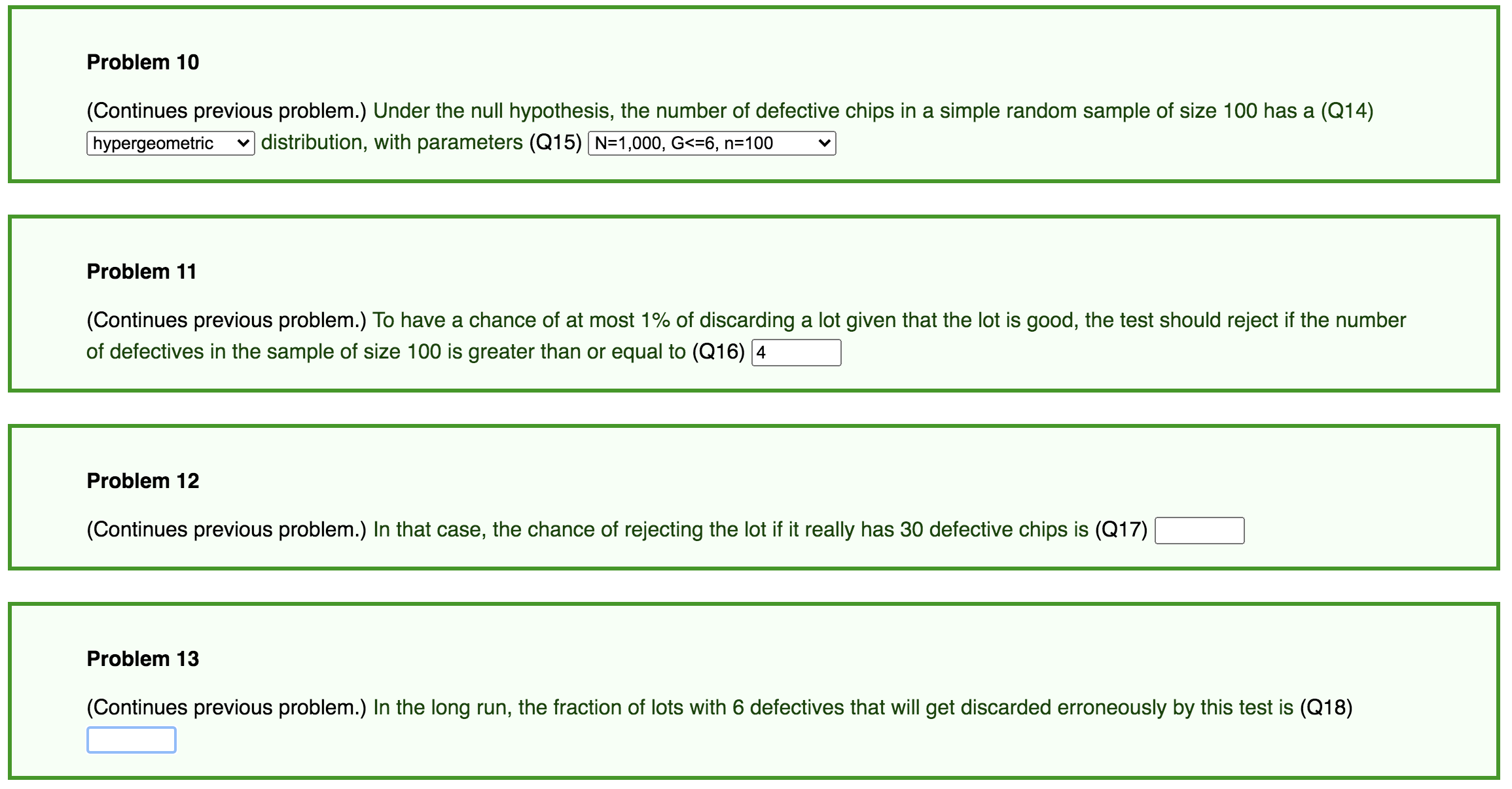
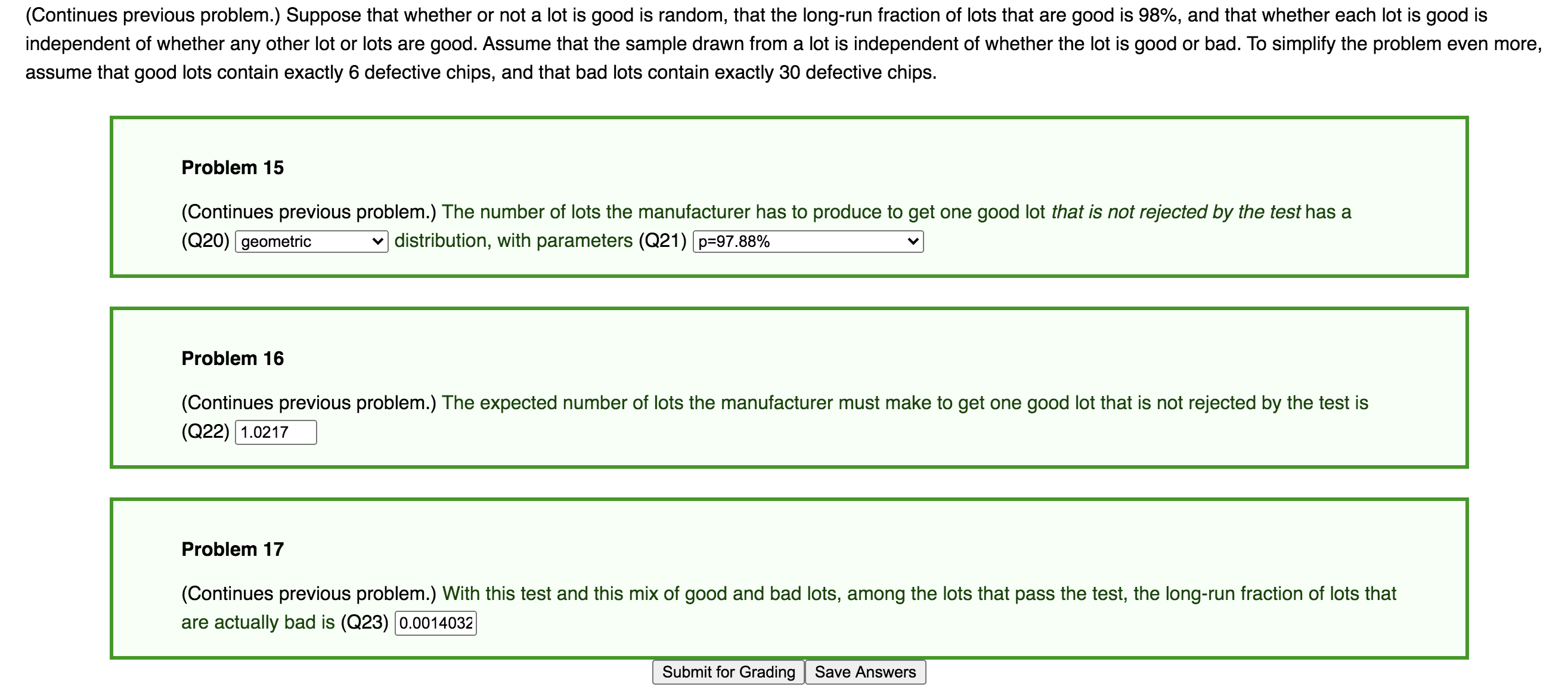

Suppose that to have power against a wider variety of alternatives, the experimenter decides to base the test on the maximum number of times any face shows, instead of just the number of times one spot shows. That is, she will roll the die 50 times and calculate (number of times die lands showing one spot) (number of times die lands showing two spots) (number of times die lands showing three spots) (number of times die lands showing four spots) (number of times die lands showing five spots) and (number of times die lands showing six spots). She will reject the null hypothesis if the largest (maximum) of those 6 random numbers is greater than 17. Problem 7 Under the null hypothesis, the distribution of the maximum number of times any face shows is (010) none of the abovev with parameters (011) A manufacturer of computer memory chips produces chips in lots of 1000. If nothing has gone wrong in the manufacturing process, at most 6 chips each lot would be defective, but if something does go wrong, there could be far more defective chips. If something goes wrong with a given lot, they discard the entire lot. It would be prohibitively expensive to test every chip in every lot, so they want to make the decision of whether or not to discard a given lot on the basis of the number of defective chips in a simple random sample. They decide they can afford to test 100 chips from each lot. You are hired as their statistician. There is a tradeoff between the cost of eroneously discarding a good lot, and the cost of warranty claims if a bad lot is sold. The next few problems refer to this scenario. Problem 8 (Continues previous problem.) Atype I error occurs if (012) Problem 10 (Continues previous problem.) Under the null hypothesis, the number of defective chips in a simple random sample of size 100 has a (Q14) hypergeometric v distribution, with parameters (015) N=1,ooo, G
Step by Step Solution
There are 3 Steps involved in it

Get step-by-step solutions from verified subject matter experts