Question: I don't know how to calculate with activity-based costing. How to calculate the Cost per activity given the questions? Exhibit 1: Cost data for the
I don't know how to calculate with activity-based costing. How to calculate the Cost per activity given the questions?
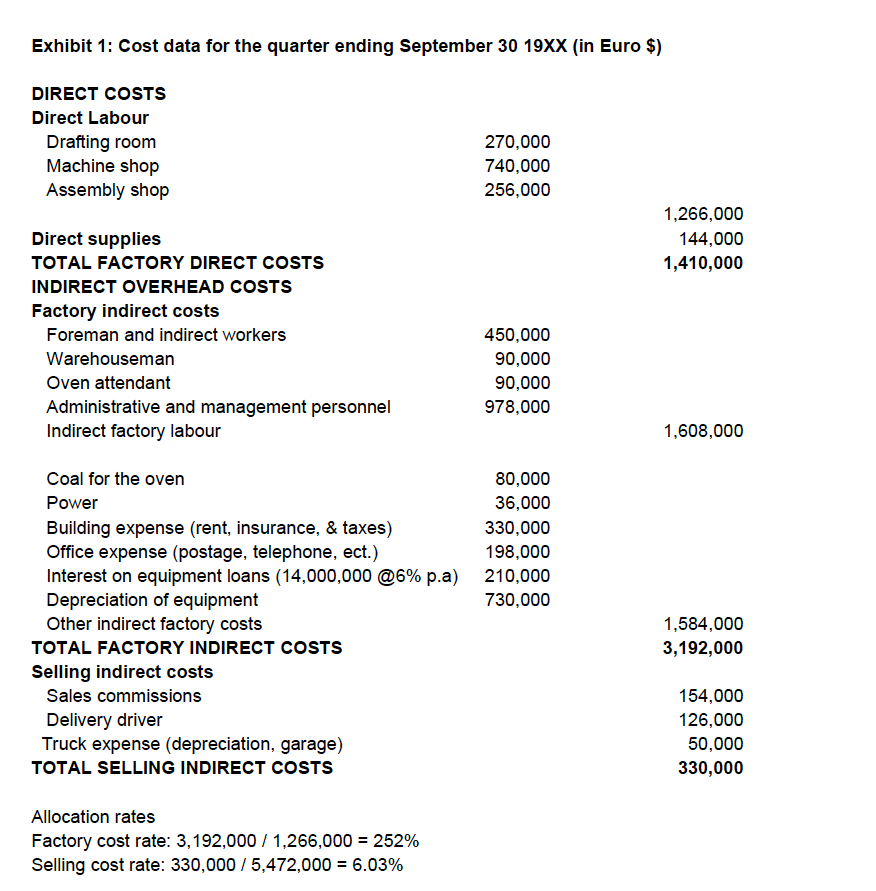
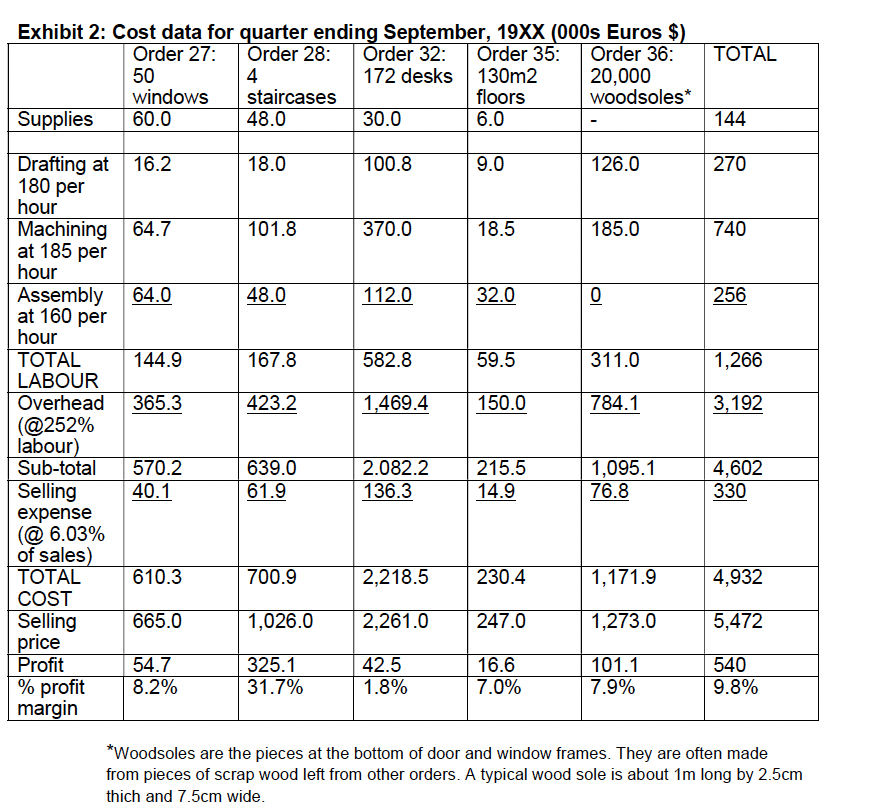
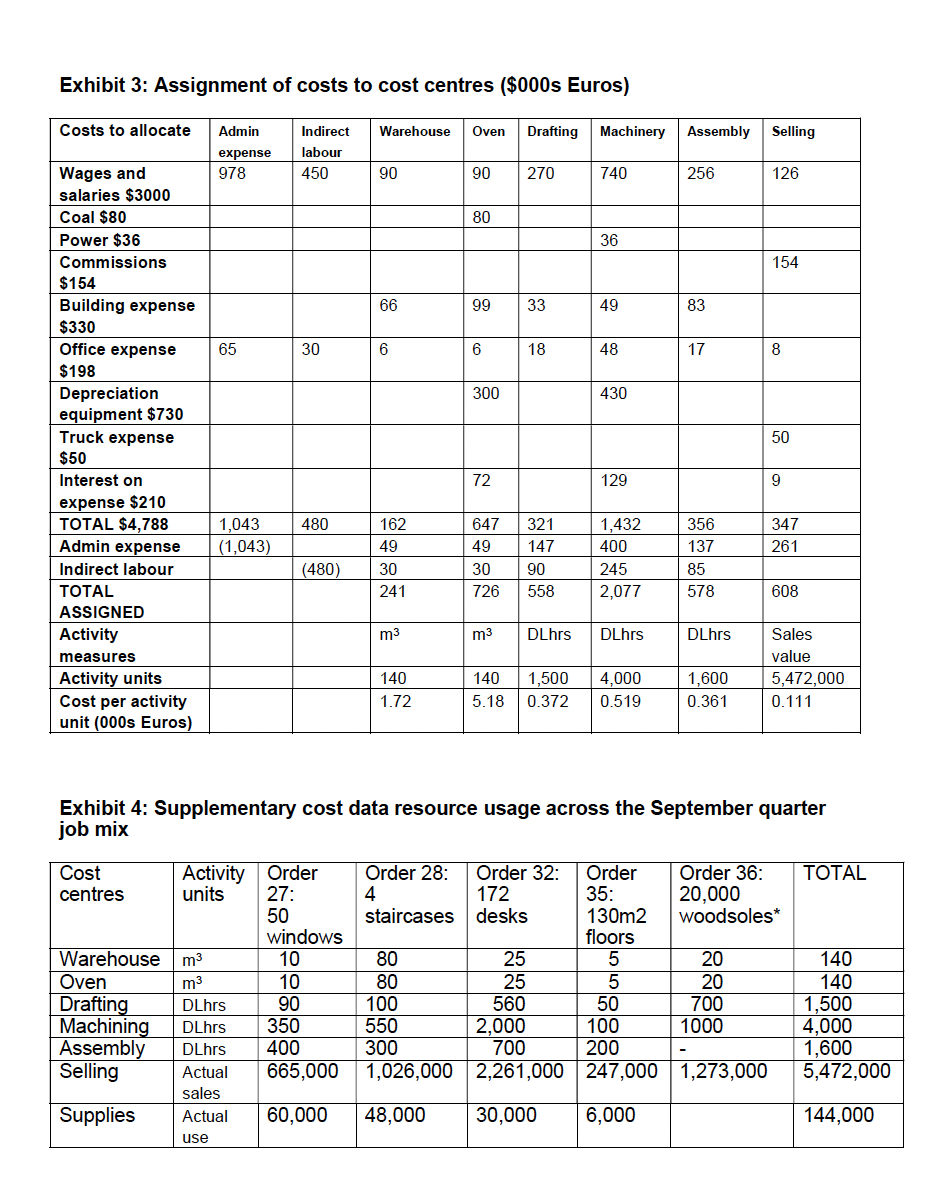
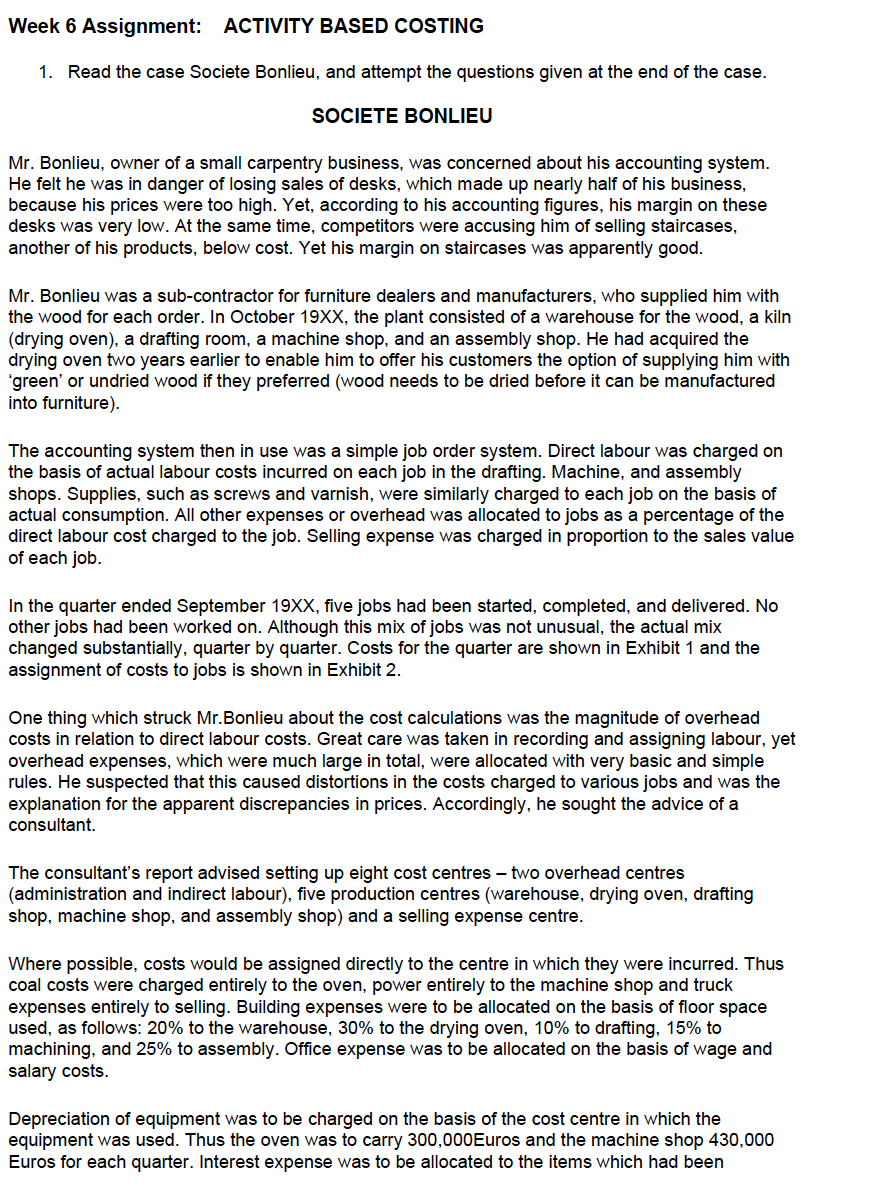
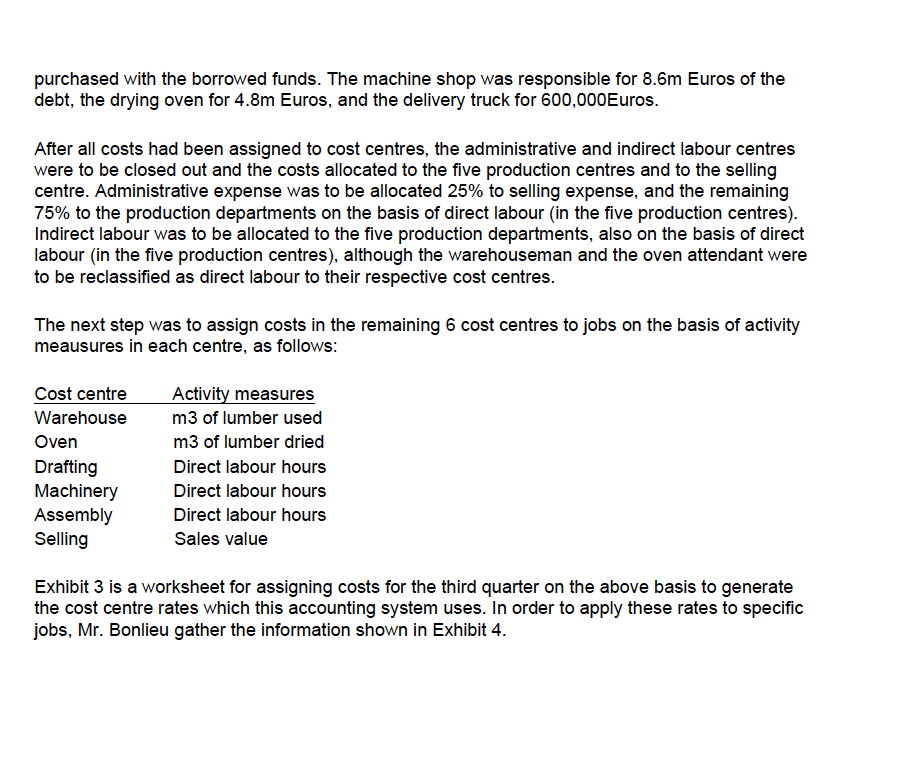
Exhibit 1: Cost data for the quarter ending September 30 19XX (in Euro $1 DIRECT COSTS Direct Labour Drafting room 270,000 Machine shop 740,000 Assembly shop 256,000 1,266,000 Direct supplies 144,000 TOTAL FACTORY DIRECT COSTS 1,410,000 INDIRECT OVERHEAD COSTS Factory indirect costs Foreman and indirect workers 450,000 Warehousernan 90,000 Oven attendant 90,000 Administrative and management personnel 970,000 Indirect factory labour 1,600,000 Coal for the oven 80,000 Power 36,000 Building expense (rent, insurance, 8. taxes) 330,000 Ofce expense (postage, telephone, ect.) 198,000 Interest on equipment loans (14,000,000 @696 pa) 210,000 Depreciation of equipment 730,000 Other indirect factoryf costs 1,504,000 TOTAL FACTORY INDIRECT COSTS 3,192,000 Selling indirect costs Sales commissions 154,000 Delivery driver 126,000 Truck expense (depreciation, garage) 50,000 TOTAL SELLING INDIRECT COSTS 330,000 Allocation rates Factory cost rate: 3,192,000 I 1,266,000 = 252% Selling cost rate: 330,000 I 5,472,000 = 6.03% Exhibit 2: Cost data for quarter ending September, 19XX (000s Euros $) Order 27: Order 28: Order 32: Order 35: Order 36: TOTAL 50 4 172 desks 130m2 20,000 windows staircases floors woodsoles* Supplies 60.0 48.0 30.0 6.0 144 Drafting at 16.2 18.0 100.8 9.0 126.0 270 180 per hour Machining 64.7 101.8 370.0 18.5 185.0 740 at 185 per hour Assembly 64.0 48.0 112.0 32.0 0 256 at 160 per hour TOTAL 144.9 167.8 582.8 59.5 311.0 1,266 LABOUR Overhead 365.3 423.2 1,469.4 150.0 784.1 3, 192 (@252% labour) Sub-total 570.2 639.0 2.082.2 215.5 1,095.1 4,602 Selling 40.1 61.9 136.3 14.9 76.8 330 expense (@ 6.03% of sales) TOTAL 610.3 700.9 2,218.5 230.4 1, 171.9 4,932 COST Selling 665.0 1,026.0 2,261.0 247.0 1,273.0 5,472 price Profit 54.7 325.1 42.5 16.6 101.1 540 % profit 8.2% 31.7% 1.8% 7.0% 7.9% 9.8% margin *Woodsoles are the pieces at the bottom of door and window frames. They are often made from pieces of scrap wood left from other orders. A typical wood sole is about 1m long by 2.5cm thich and 7.5cm wide.Exhibit 3: Assignment of costs to cost centres ($0005 Euros) Costs to allocate Admin Indirect Warehouse Oven Drafting Machinery Assembly Selling expense labour Wages and 078 450 90 90 270 740 256 ' 126 salaries $3000 Coal $80 80 Power $36 36 Commissions I 154 $154 Building expense 66 99 33 49 83 $330 Office expense 65 30 6 6 18 48 17 ' 8 $198 Depreciation 300 430 equipment $730 Truck expense ' 50 $50 Interest on 72 129 9 expense 5210 TOTAL 54,788 1,043 480 162 647 321 1,432 356 I: 347 Admin expense (1,043) 40 40 147 400 137 _ 261 Indirect labour (480} 30 30 90 245 85 TOTAL 241 726 558 2,077 578 608 ASSIGNED Activity m3 m3 DLhrs DLhrs DLhrs Sales measures value Activity units 140 140 1,500 4,000 1,600 ' 5,472,000 Cost per activity 1.72 5.18 0.372 0.510 0.361 0.111 unit (0005 Euros] Exhibit 4: Supplementary cost data resource usage across the September quarter job mix Cost Activity Order Order 28: Order 32: Order Order 36: TOTAL centres units 27: 4 172 35: 20,000 50 staircases desks 130m2 woodsoles' windows floors Warehouse m3 10 80 25 5 20 140 Oven m3 10 80 25 5 20 140 Drafting DLhrs . 90 100 560 50 700 g 1,500 Machinin DLhrs . 350 _ 550 2,000 100 1000 . 4,000 Assembly DLhrs 400 300 700 200 - 1,600 Selling Actual 665,000 1,026,000 2,261,000 247,000 1,273,000 ' 5,472,000 sales . . _ Supplies Actual 60,000 48,000 30,000 6,000 144,000 U59 Week 6 Assignment: ACTIVITY BASED COSTING 1. Read the case Societe Bonlieu, and attempt the questions given at the end of the case. SOCIETE BONLIEU Mr. Bonlieu, owner of a small carpentry business. was concerned about his accounting system. He felt he was in danger of losing sales of desks, which made up nearly half of his business, because his prices were too high. Yet, according to his accounting gures, his margin on these desks was very low. At the same time, competitors were accusing him of selling staircases, another of his products, below cost. Yet his margin on staircases was apparently good. Mr. Bonlieu was a sub-contractor for furniture dealers and manufacturers, who supplied him with the wood for each order. In October 19XX, the plant consisted of a warehouse for the wood, a kiln (drying oven), a drafting room, a machine shop, and an assembly shop. He had acquired the drying oven two years earlier to enable him to offer his customers the option of supplying him with 'green' or undried wood if they preferred (wood needs to be dried before it can be manufactured into furniture). The accounting system then in use was a simple job order system. Direct labour was charged on the basis of actual labour costs incurred on each job in the drafting. Machine, and assembly shops. Supplies, such as screws and varnish, were similarly charged to each job on the basis of actual consumption. All other expenses or overhead was allocated to jobs as a percentage of the direct labour cost charged to the job. Selling expense was charged in proportion to the sales value of each job. In the quarter ended September 19XX, ve jobs had been started, completed, and delivered. No otherjobs had been worked on. Although this mix ofjobs was not unusual, the actual mix changed substantially, quarter by quarter. Costs for the quarter are shown in Exhibit 1 and the assignment of costs to jobs is shown in Exhibit 2. One thing which struck Mr.Bonlieu about the cost calculations was the magnitude of overhead costs in relation to direct labour costs. Great care was taken in recording and assigning labour, yet overhead expenses, which were much large in total, were allocated with very basic and simple rules. He suspected that this caused distortions in the costs charged to variousjobs and was the explanation for the apparent discrepancies in prices. Accordingly, he sought the advice of a consultant. The consultant's report advised setting up eight cost centres two overhead centres {administration and indirect labour), ve production centres (warehouse, drying oven, drafting shop, machine shop, and assembly shop) and a selling expense centre. Where possible, costs would be assigned directly to the centre in which they were incurred. Thus coal costs were charged entirely to the oven, power entirely to the machine shop and truck expenses entirely to selling. Building expenses were to be allocated on the basis of floor space used, as follows: 20% to the warehouse, 30% to the drying oven, 10% to drafting, 15% to machining, and 25% to assembly. Ofce expense was to be allocated on the basis of wage and salary costs. Depreciation of equipment was to be charged on the basis of the cost centre in which the equipment was used. Thus the oven was to carry 300,000Euros and the machine shop 430,000 Euros for each quarter. Interest expense was to be allocated to the items which had been purchased with the borrowed funds. The machine shop was responsible for 8.6m Euros of the debt, the drying oven for 4.8m Euros, and the delivery truck for 500,000Euros. After all costs had been assigned to cost centres, the administrative and indirect labour centres were to be closed out and the costs allocated to the ve production centres and to the selling centre. Administrative expense was to be allocated 25% to selling expense, and the remaining 75% to the production departments on the basis of direct labour (in the ve production centres}. Indirect labour was to be allocated to the five production departments, also on the basis of direct labour (in the ve production centres), although the warehouseman and the oven attendant were to be reclassied as direct labour to their respective cost centres. The next step was to assign costs in the remaining 6 cost centres to jobs on the basis of activity meausures in each centre, as follows: Cost centre Activity measures Warehouse m3 of lumber used Oven m3 of lumber dried Drafting Direct labour hours Machinery Direct labour hours Assembly Direct labour hours Selling Sales value Exhibit 3 is a worksheet for assigning costs for the third quarter on the above basis to generate the cost centre rates which this accounting system uses. In order to appEy these rates to specic jobs, Mr. Bonlieu gather the information shown in Exhibit 4
Step by Step Solution
There are 3 Steps involved in it
1 Expert Approved Answer
Step: 1 Unlock
Question Has Been Solved by an Expert!
Get step-by-step solutions from verified subject matter experts
Step: 2 Unlock
Step: 3 Unlock
Students Have Also Explored These Related Accounting Questions!