







Question: I. Draw the state diagram for a PDA that recognizes bitstrings of the form ambm where 0 least 1) followed by a smaller number ofb's
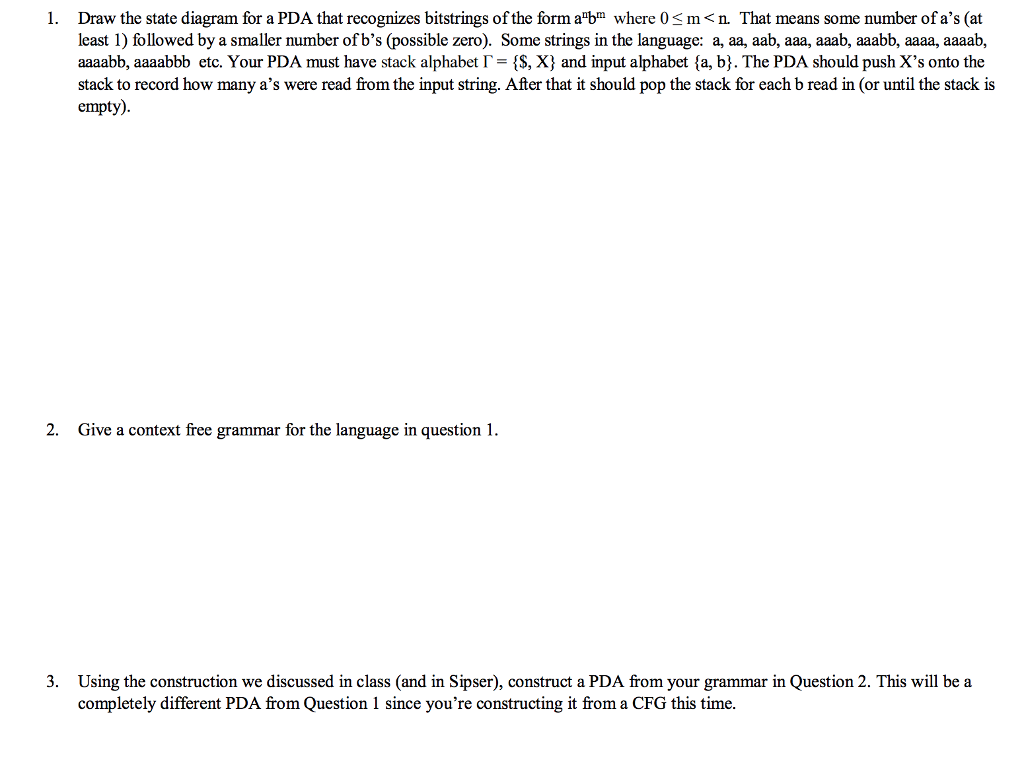
I. Draw the state diagram for a PDA that recognizes bitstrings of the form ambm where 0 least 1) followed by a smaller number ofb's (possible zero). Some strings in the language: a, aa, aab, aaa, aaab, aaabb, aaaa, aaaab, aaaabb, aaaabbb etc. Your PDA must have stack alphabet ? = {$, X} and input alphabet {a, b} . The PDA should push X's onto the stack to record how many a's were read from the input string. After that it should pop the stack for each b read in (or until the stack is empty) m?n. That means some number of a's (at 2. Give a context free grammar for the language in question Using the construction we discussed in class (and in Sipser), construct a PDA from your grammar in Question 2. This will be a completely different PDA from Question 1 since you're constructing it from a CFG this time
Step by Step Solution
There are 3 Steps involved in it

Get step-by-step solutions from verified subject matter experts
 Study Help