







Question: I EDITED. Please do it carefully, thank you much. Please do it. And this 2 picture is instructions and one example of research proposal. You
I EDITED. Please do it carefully, thank you much. Please do it.
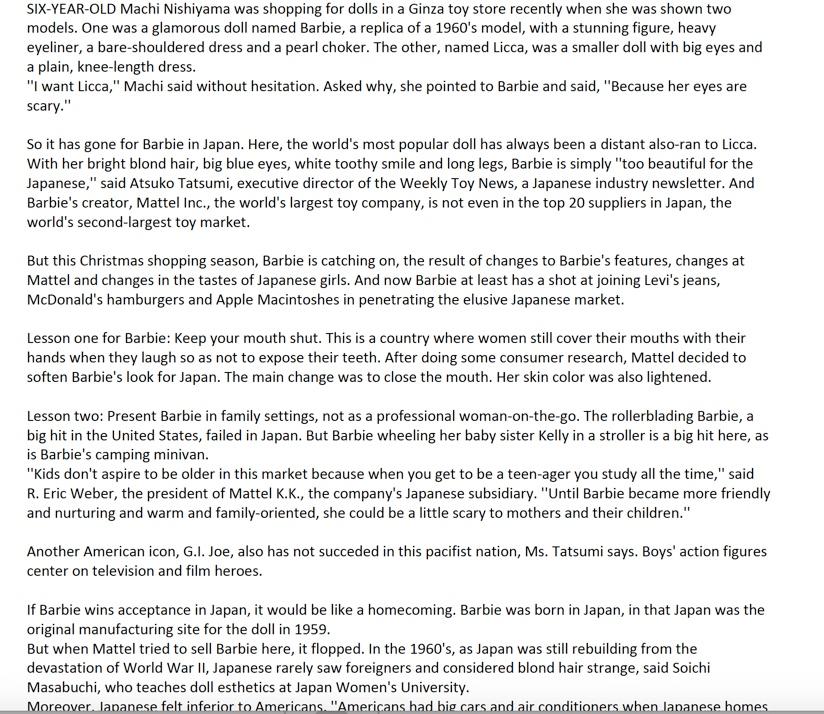
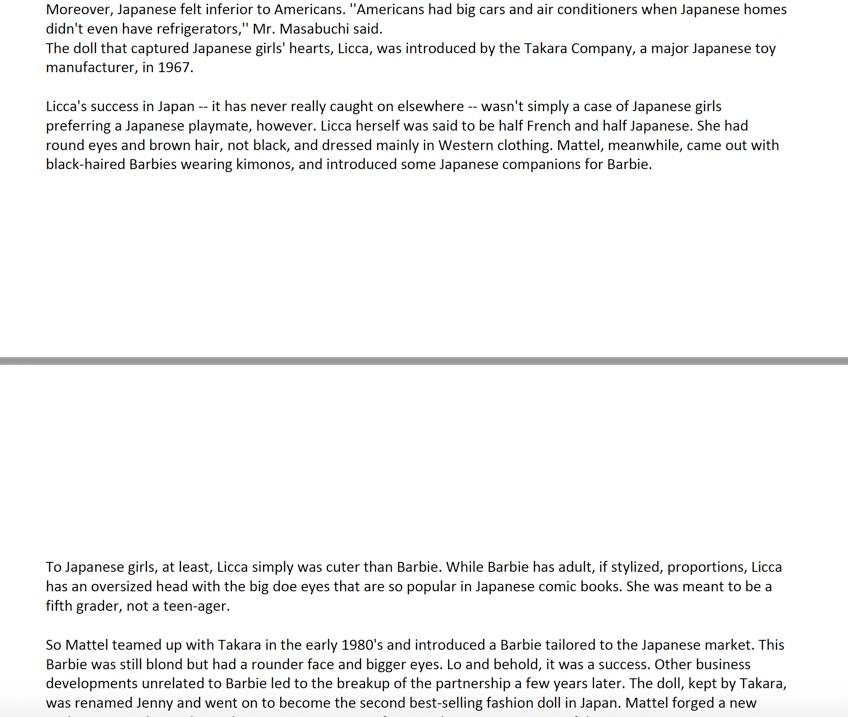
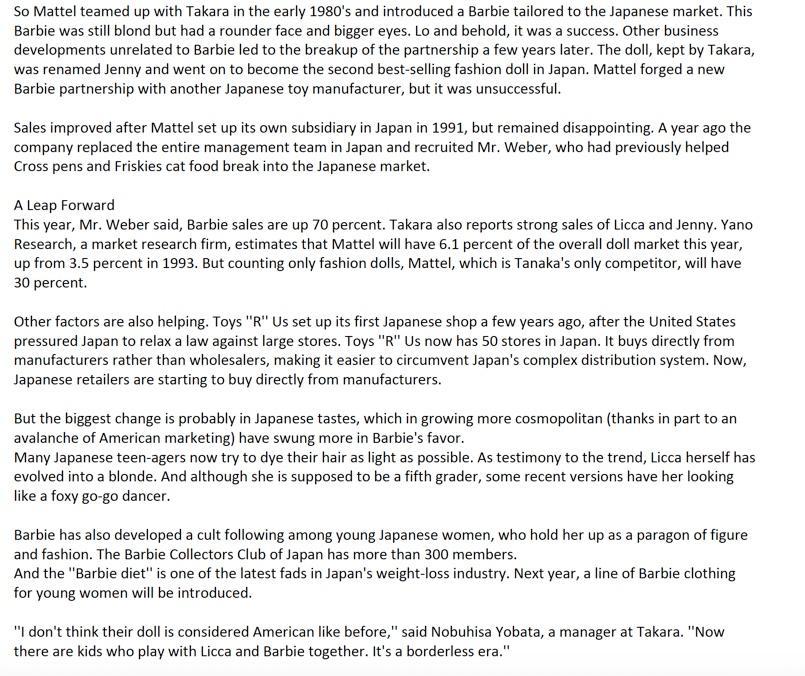
And this 2 picture is instructions and one example of research proposal. You should do it same format but the topic will be BArb. n Japan.thanksss.
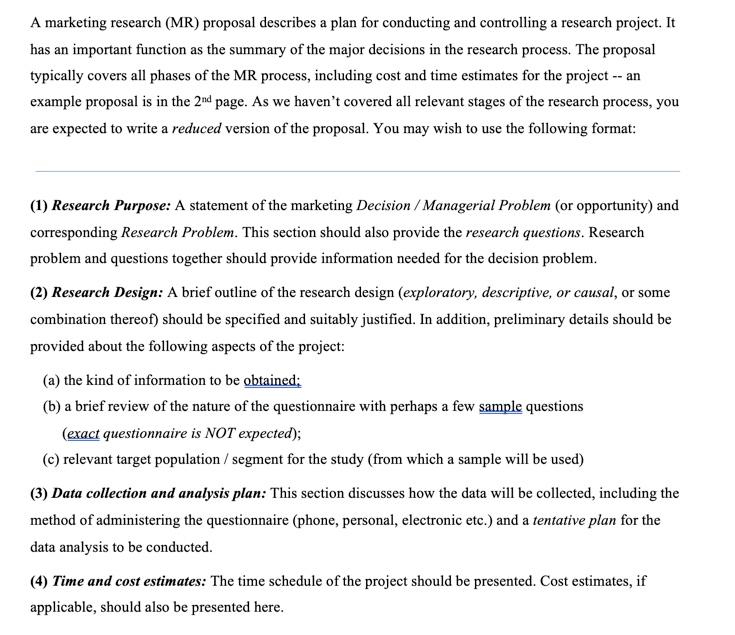
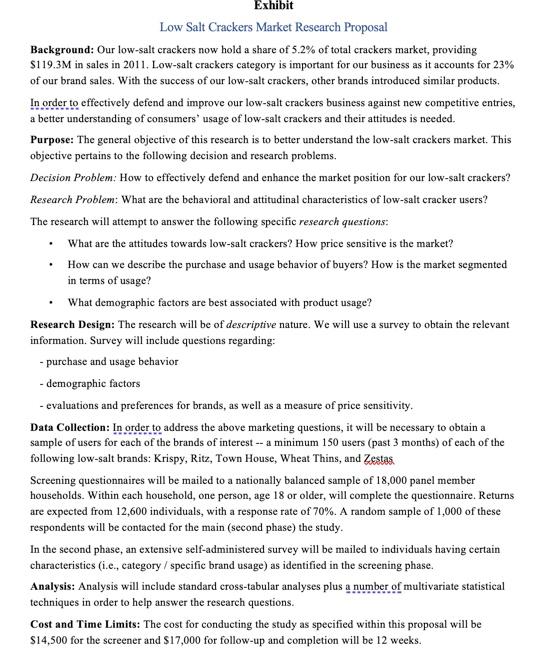
SIX-YEAR-OLD Machi Nishiyama was shopping for dolls in a Ginza toy store recently when she was shown two models. One was a glamorous doll named Barbie, a replica of a 1960's model, with a stunning figure, heavy eyeliner, a bare-shouldered dress and a pearl choker. The other, named Licca, was a smaller doll with big eyes and a plain, knee-length dress. "I want Licca," Machi said without hesitation. Asked why, she pointed to Barbie and said, "Because her eyes are scary." So it has gone for Barbie in Japan. Here, the world's most popular doll has always been a distant also ran to Licca. With her bright blond hair, big blue eyes, white toothy smile and long legs, Barbie is simply "too beautiful for the Japanese," said Atsuko Tatsumi, executive director of the Weekly Toy News, a Japanese industry newsletter. And Barbie's creator, Mattel Inc., the world's largest toy company, is not even in the top 20 suppliers in Japan, the world's second-largest toy market. But this Christmas shopping season, Barbie is catching on, the result of changes to Barbie's features, changes at Mattel and changes in the tastes of Japanese girls. And now Barbie at least has a shot at joining Levi's jeans, McDonald's hamburgers and Apple Macintoshes in penetrating the elusive Japanese market. Lesson one for Barbie: Keep your mouth shut. This is a country where women still cover their mouths with their hands when they laugh so as not to expose their teeth. After doing some consumer research, Mattel decided to soften Barbie's look for Japan. The main change was to close the mouth. Her skin color was also lightened. Lesson two: Present Barbie in family settings, not as a professional woman-on-the-go. The rollerblading Barbie, a big hit in the United States, failed in Japan. But Barbie wheeling her baby sister Kelly in a stroller is a big hit here, as is Barbie's camping minivan. "Kids don't aspire to be older in this market because when you get to be a teen-ager you study all the time," said R. Eric Weber, the president of Mattel K.K., the company's Japanese subsidiary. "Until Barbie became more friendly and nurturing and warm and family-oriented, she could be a little scary to mothers and their children." Another American icon, G.I. Joe, also has not succeded in this pacifist nation, Ms. Tatsumi says. Boys' action figures center on television and film heroes. If Barbie wins acceptance in Japan, it would be like a homecoming. Barbie was born in Japan, in that Japan was the i original manufacturing site for the doll in 1959. But when Mattel tried to sell Barbie here, it flopped. In the 1960's, as Japan was still rebuilding from the devastation of World War II, Japanese rarely saw foreigners and considered blond hair strange, said Soichi Masabuchi, who teaches doll esthetics at Japan Women's University. Moreover, Japanese felt inferior to Americans. "Americans had big cars and air conditioners when lapanese homes Moreover, Japanese felt inferior to Americans. "Americans had big cars and air conditioners when Japanese homes didn't even have refrigerators," Mr. Masabuchi said. The doll that captured Japanese girls' hearts, Licca, was introduced by the Takara Company, a major Japanese toy manufacturer, in 1967. Licca's success in Japan -- it has never really caught on elsewhere -- wasn't simply a case of Japanese girls preferring a Japanese playmate, however. Licca herself was said to be half French and half Japanese. She had round eyes and brown hair, not black, and dressed mainly in Western clothing. Mattel, meanwhile, came out with black-haired Barbies wearing kimonos, and introduced some Japanese companions for Barbie. To Japanese girls, at least, Licca simply was cuter than Barbie. While Barbie has adult, if stylized, proportions, Licca has an oversized head with the big doe eyes that are so popular in Japanese comic books. She was meant to be a fifth grader, not a teen-ager. So Mattel teamed up with Takara in the early 1980's and introduced a Barbie tailored to the Japanese market. This Barbie was still blond but had a rounder face and bigger eyes. Lo and behold, it was a success. Other business developments unrelated to Barbie led to the breakup of the partnership a few years later. The doll, kept by Takara, was renamed Jenny and went on to become the second best-selling fashion doll in Japan. Mattel forged a new So Mattel teamed up with Takara in the early 1980's and introduced a Barbie tailored to the Japanese market. This Barbie was still blond but had a rounder face and bigger eyes. Lo and behold, it was a success. Other business developments unrelated to Barbie led to the breakup of the partnership a few years later. The doll, kept by Takara, was renamed Jenny and went on to become the second best-selling fashion doll in Japan. Mattel forged a new Barbie partnership with another Japanese toy manufacturer, but it was unsuccessful. Sales improved after Mattel set up its own subsidiary in Japan in 1991, but remained disappointing. A year ago the company replaced the entire management team in Japan and recruited Mr. Weber, who had previously helped Cross pens and Friskies cat food break into the Japanese market. A Leap Forward This year, Mr. Weber said, Barbie sales are up 70 percent. Takara also reports strong sales of Licca and Jenny. Yano Research, a market research firm, estimates that Mattel will have 6.1 percent of the overall doll market this year, up from 3.5 percent in 1993. But counting only fashion dolls, Mattel, which is Tanaka's only competitor, will have 30 percent. Other factors are also helping. Toys"R" Us set up its first Japanese shop a few years ago, after the United States pressured Japan to relax a law against large stores. Toys"R"Us now has 50 stores in Japan. It buys directly from manufacturers rather than wholesalers, making it easier to circumvent Japan's complex distribution system. Now, Japanese retailers are starting to buy directly from manufacturers. But the biggest change is probably in Japanese tastes, which in growing more cosmopolitan (thanks in part to an avalanche of American marketing) have swung more in Barbie's favor. Many Japanese teen-agers now try to dye their hair as light as possible. As testimony to the trend, Licca herself has evolved into a blonde. And although she is supposed to be a fifth grader, some recent versions have her looking like a foxy go-go dancer. Barbie has also developed a cult following among young Japanese women, who hold her up as a paragon of figure and fashion. The Barbie Collectors Club of Japan has more than 300 members. And the "Barbie diet" is one of the latest fads in Japan's weight-loss industry. Next year, a line of Barbie clothing for young women will be introduced. "I don't think their doll is considered American like before," said Nobuhisa Yobata, a manager at Takara. "Now there are kids who play with Licca and Barbie together. It's a borderless era." A marketing research (MR) proposal describes a plan for conducting and controlling a research project. It has an important function as the summary of the major decisions in the research process. The proposal typically covers all phases of the MR process, including cost and time estimates for the project -- an example proposal is in the 2nd page. As we haven't covered all relevant stages of the research process, you are expected to write a reduced version of the proposal. You may wish to use the following format: (1) Research Purpose: A statement of the marketing Decision/Managerial Problem (or opportunity) and corresponding Research Problem. This section should also provide the research questions. Research problem and questions together should provide information needed for the decision problem. (2) Research Design: A brief outline of the research design (exploratory, descriptive, or causal, or some combination thereof) should be specified and suitably justified. In addition, preliminary details should be provided about the following aspects of the project: (a) the kind of information to be obtained: (b) a brief review of the nature of the questionnaire with perhaps a few sample questions (exact questionnaire is NOT expected); (c) relevant target population / segment for the study (from which a sample will be used) (3) Data collection and analysis plan: This section discusses how the data will be collected, including the method of administering the questionnaire (phone, personal, electronic etc.) and a tentative plan for the data analysis to be conducted. (4) Time and cost estimates: The time schedule of the project should be presented. Cost estimates, if applicable, should also be presented here. Exhibit Low Salt Crackers Market Research Proposal Background: Our low-salt crackers now hold a share of 5.2% of total crackers market, providing $119.3M in sales in 2011. Low-salt crackers category is important for our business as it accounts for 23% of our brand sales. With the success of our low-salt crackers, other brands introduced similar products. In order to effectively defend and improve our low-salt crackers business against new competitive entries, a better understanding of consumers' usage of low-salt crackers and their attitudes is needed. Purpose: The general objective of this research is to better understand the low-salt crackers market. This objective pertains to the following decision and research problems. Decision Problem: How to effectively defend and enhance the market position for our low-salt crackers? Research Problem: What are the behavioral and attitudinal characteristics of low-salt cracker users? The research will attempt to answer the following specific research questions: What are the attitudes towards low-salt crackers? How price sensitive is the market? How can we describe the purchase and usage behavior of buyers? How is the market segmented in terms of usage? What demographic factors are best associated with product usage? Research Design: The research will be of descriptive nature. We will use a survey to obtain the relevant information. Survey will include questions regarding: - purchase and usage behavior - demographic factors - evaluations and preferences for brands, as well as a measure of price sensitivity. Data Collection: In order to address the above marketing questions, it will be necessary to obtain a sample of users for each of the brands of interest -- a minimum 150 users (past 3 months) of each of the following low-salt brands: Krispy, Ritz, Town House, Wheat Thins, and Zestas. Screening questionnaires will be mailed to a nationally balanced sample of 18,000 panel member households. Within each household, one person, age 18 or older, will complete the questionnaire. Returns are expected from 12,600 individuals, with a response rate of 70%. A random sample of 1,000 of these respondents will be contacted for the main (second phase) the study. In the second phase, an extensive self-administered survey will be mailed to individuals having certain characteristics (i.e., category / specific brand usage) as identified in the screening phase. Analysis: Analysis will include standard cross-tabular analyses plus a number of multivariate statistical techniques in order to help answer the research questions. Cost and Time Limits: The cost for conducting the study as specified within this proposal will be $14,500 for the screener and $17,000 for follow-up and completion will be 12 weeks. SIX-YEAR-OLD Machi Nishiyama was shopping for dolls in a Ginza toy store recently when she was shown two models. One was a glamorous doll named Barbie, a replica of a 1960's model, with a stunning figure, heavy eyeliner, a bare-shouldered dress and a pearl choker. The other, named Licca, was a smaller doll with big eyes and a plain, knee-length dress. "I want Licca," Machi said without hesitation. Asked why, she pointed to Barbie and said, "Because her eyes are scary." So it has gone for Barbie in Japan. Here, the world's most popular doll has always been a distant also ran to Licca. With her bright blond hair, big blue eyes, white toothy smile and long legs, Barbie is simply "too beautiful for the Japanese," said Atsuko Tatsumi, executive director of the Weekly Toy News, a Japanese industry newsletter. And Barbie's creator, Mattel Inc., the world's largest toy company, is not even in the top 20 suppliers in Japan, the world's second-largest toy market. But this Christmas shopping season, Barbie is catching on, the result of changes to Barbie's features, changes at Mattel and changes in the tastes of Japanese girls. And now Barbie at least has a shot at joining Levi's jeans, McDonald's hamburgers and Apple Macintoshes in penetrating the elusive Japanese market. Lesson one for Barbie: Keep your mouth shut. This is a country where women still cover their mouths with their hands when they laugh so as not to expose their teeth. After doing some consumer research, Mattel decided to soften Barbie's look for Japan. The main change was to close the mouth. Her skin color was also lightened. Lesson two: Present Barbie in family settings, not as a professional woman-on-the-go. The rollerblading Barbie, a big hit in the United States, failed in Japan. But Barbie wheeling her baby sister Kelly in a stroller is a big hit here, as is Barbie's camping minivan. "Kids don't aspire to be older in this market because when you get to be a teen-ager you study all the time," said R. Eric Weber, the president of Mattel K.K., the company's Japanese subsidiary. "Until Barbie became more friendly and nurturing and warm and family-oriented, she could be a little scary to mothers and their children." Another American icon, G.I. Joe, also has not succeded in this pacifist nation, Ms. Tatsumi says. Boys' action figures center on television and film heroes. If Barbie wins acceptance in Japan, it would be like a homecoming. Barbie was born in Japan, in that Japan was the i original manufacturing site for the doll in 1959. But when Mattel tried to sell Barbie here, it flopped. In the 1960's, as Japan was still rebuilding from the devastation of World War II, Japanese rarely saw foreigners and considered blond hair strange, said Soichi Masabuchi, who teaches doll esthetics at Japan Women's University. Moreover, Japanese felt inferior to Americans. "Americans had big cars and air conditioners when lapanese homes Moreover, Japanese felt inferior to Americans. "Americans had big cars and air conditioners when Japanese homes didn't even have refrigerators," Mr. Masabuchi said. The doll that captured Japanese girls' hearts, Licca, was introduced by the Takara Company, a major Japanese toy manufacturer, in 1967. Licca's success in Japan -- it has never really caught on elsewhere -- wasn't simply a case of Japanese girls preferring a Japanese playmate, however. Licca herself was said to be half French and half Japanese. She had round eyes and brown hair, not black, and dressed mainly in Western clothing. Mattel, meanwhile, came out with black-haired Barbies wearing kimonos, and introduced some Japanese companions for Barbie. To Japanese girls, at least, Licca simply was cuter than Barbie. While Barbie has adult, if stylized, proportions, Licca has an oversized head with the big doe eyes that are so popular in Japanese comic books. She was meant to be a fifth grader, not a teen-ager. So Mattel teamed up with Takara in the early 1980's and introduced a Barbie tailored to the Japanese market. This Barbie was still blond but had a rounder face and bigger eyes. Lo and behold, it was a success. Other business developments unrelated to Barbie led to the breakup of the partnership a few years later. The doll, kept by Takara, was renamed Jenny and went on to become the second best-selling fashion doll in Japan. Mattel forged a new So Mattel teamed up with Takara in the early 1980's and introduced a Barbie tailored to the Japanese market. This Barbie was still blond but had a rounder face and bigger eyes. Lo and behold, it was a success. Other business developments unrelated to Barbie led to the breakup of the partnership a few years later. The doll, kept by Takara, was renamed Jenny and went on to become the second best-selling fashion doll in Japan. Mattel forged a new Barbie partnership with another Japanese toy manufacturer, but it was unsuccessful. Sales improved after Mattel set up its own subsidiary in Japan in 1991, but remained disappointing. A year ago the company replaced the entire management team in Japan and recruited Mr. Weber, who had previously helped Cross pens and Friskies cat food break into the Japanese market. A Leap Forward This year, Mr. Weber said, Barbie sales are up 70 percent. Takara also reports strong sales of Licca and Jenny. Yano Research, a market research firm, estimates that Mattel will have 6.1 percent of the overall doll market this year, up from 3.5 percent in 1993. But counting only fashion dolls, Mattel, which is Tanaka's only competitor, will have 30 percent. Other factors are also helping. Toys"R" Us set up its first Japanese shop a few years ago, after the United States pressured Japan to relax a law against large stores. Toys"R"Us now has 50 stores in Japan. It buys directly from manufacturers rather than wholesalers, making it easier to circumvent Japan's complex distribution system. Now, Japanese retailers are starting to buy directly from manufacturers. But the biggest change is probably in Japanese tastes, which in growing more cosmopolitan (thanks in part to an avalanche of American marketing) have swung more in Barbie's favor. Many Japanese teen-agers now try to dye their hair as light as possible. As testimony to the trend, Licca herself has evolved into a blonde. And although she is supposed to be a fifth grader, some recent versions have her looking like a foxy go-go dancer. Barbie has also developed a cult following among young Japanese women, who hold her up as a paragon of figure and fashion. The Barbie Collectors Club of Japan has more than 300 members. And the "Barbie diet" is one of the latest fads in Japan's weight-loss industry. Next year, a line of Barbie clothing for young women will be introduced. "I don't think their doll is considered American like before," said Nobuhisa Yobata, a manager at Takara. "Now there are kids who play with Licca and Barbie together. It's a borderless era." A marketing research (MR) proposal describes a plan for conducting and controlling a research project. It has an important function as the summary of the major decisions in the research process. The proposal typically covers all phases of the MR process, including cost and time estimates for the project -- an example proposal is in the 2nd page. As we haven't covered all relevant stages of the research process, you are expected to write a reduced version of the proposal. You may wish to use the following format: (1) Research Purpose: A statement of the marketing Decision/Managerial Problem (or opportunity) and corresponding Research Problem. This section should also provide the research questions. Research problem and questions together should provide information needed for the decision problem. (2) Research Design: A brief outline of the research design (exploratory, descriptive, or causal, or some combination thereof) should be specified and suitably justified. In addition, preliminary details should be provided about the following aspects of the project: (a) the kind of information to be obtained: (b) a brief review of the nature of the questionnaire with perhaps a few sample questions (exact questionnaire is NOT expected); (c) relevant target population / segment for the study (from which a sample will be used) (3) Data collection and analysis plan: This section discusses how the data will be collected, including the method of administering the questionnaire (phone, personal, electronic etc.) and a tentative plan for the data analysis to be conducted. (4) Time and cost estimates: The time schedule of the project should be presented. Cost estimates, if applicable, should also be presented here. Exhibit Low Salt Crackers Market Research Proposal Background: Our low-salt crackers now hold a share of 5.2% of total crackers market, providing $119.3M in sales in 2011. Low-salt crackers category is important for our business as it accounts for 23% of our brand sales. With the success of our low-salt crackers, other brands introduced similar products. In order to effectively defend and improve our low-salt crackers business against new competitive entries, a better understanding of consumers' usage of low-salt crackers and their attitudes is needed. Purpose: The general objective of this research is to better understand the low-salt crackers market. This objective pertains to the following decision and research problems. Decision Problem: How to effectively defend and enhance the market position for our low-salt crackers? Research Problem: What are the behavioral and attitudinal characteristics of low-salt cracker users? The research will attempt to answer the following specific research questions: What are the attitudes towards low-salt crackers? How price sensitive is the market? How can we describe the purchase and usage behavior of buyers? How is the market segmented in terms of usage? What demographic factors are best associated with product usage? Research Design: The research will be of descriptive nature. We will use a survey to obtain the relevant information. Survey will include questions regarding: - purchase and usage behavior - demographic factors - evaluations and preferences for brands, as well as a measure of price sensitivity. Data Collection: In order to address the above marketing questions, it will be necessary to obtain a sample of users for each of the brands of interest -- a minimum 150 users (past 3 months) of each of the following low-salt brands: Krispy, Ritz, Town House, Wheat Thins, and Zestas. Screening questionnaires will be mailed to a nationally balanced sample of 18,000 panel member households. Within each household, one person, age 18 or older, will complete the questionnaire. Returns are expected from 12,600 individuals, with a response rate of 70%. A random sample of 1,000 of these respondents will be contacted for the main (second phase) the study. In the second phase, an extensive self-administered survey will be mailed to individuals having certain characteristics (i.e., category / specific brand usage) as identified in the screening phase. Analysis: Analysis will include standard cross-tabular analyses plus a number of multivariate statistical techniques in order to help answer the research questions. Cost and Time Limits: The cost for conducting the study as specified within this proposal will be $14,500 for the screener and $17,000 for follow-up and completion will be 12 weeks
Step by Step Solution
There are 3 Steps involved in it
1 Expert Approved Answer
Step: 1 Unlock

Question Has Been Solved by an Expert!
Get step-by-step solutions from verified subject matter experts
Step: 2 Unlock
Step: 3 Unlock
 Study Help