



Question: i EXERCISE 175.2 (Comparing simultaneous and sequential games) The set of ac- tions available to player 1 is A1; the set available to player 2
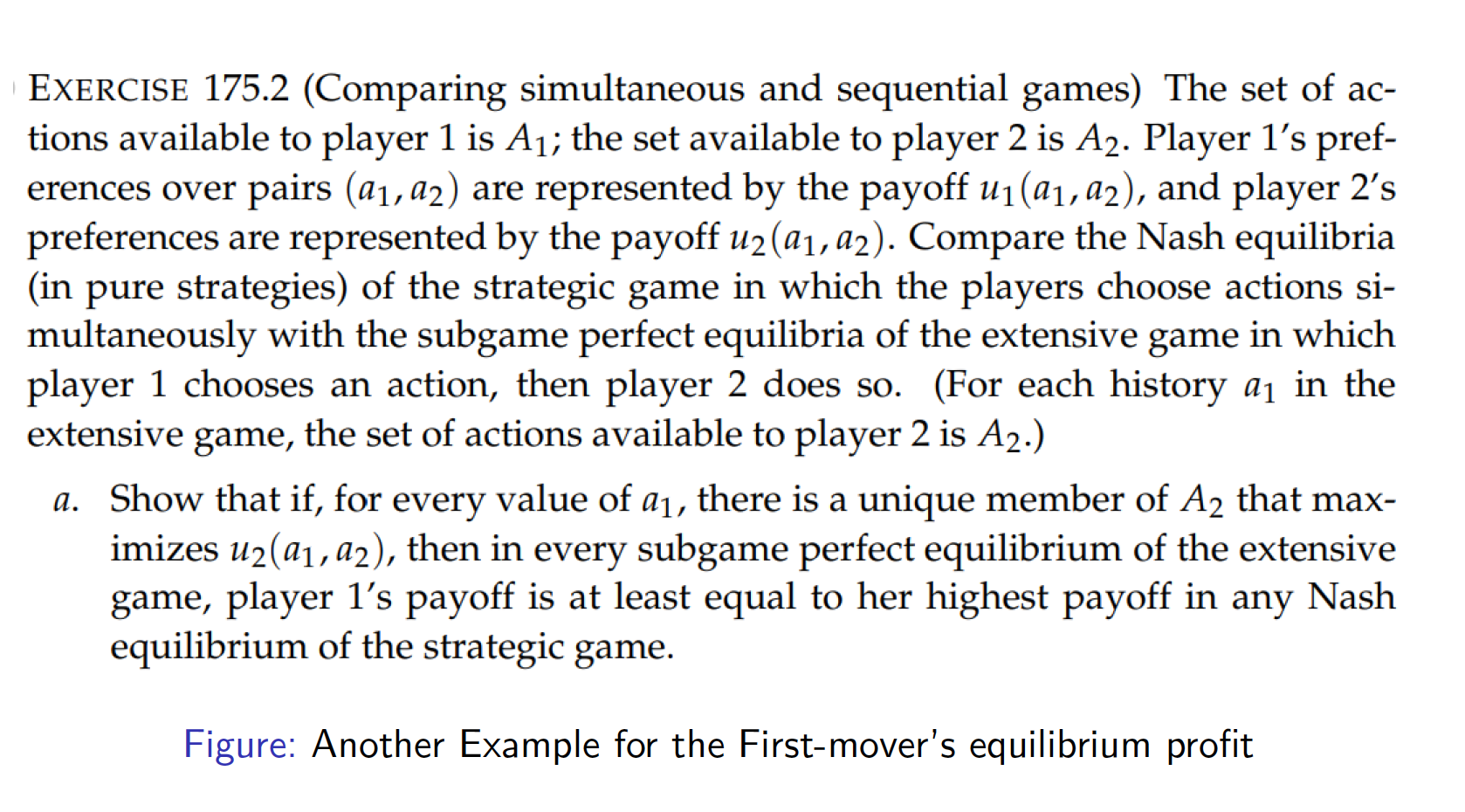
i EXERCISE 175.2 (Comparing simultaneous and sequential games) The set of ac- tions available to player 1 is A1; the set available to player 2 is A2. Player 1's pref- erences over pairs (a1, 512) are represented by the payoff u1(a1, a2), and player 2's preferences are represented by the payoff ug (a1, :12). Compare the Nash equilibria (in pure strategies) of the strategic game in which the players choose actions si- multaneously with the subgame perfect equilibria of the extensive game in which player 1 chooses an action, then player 2 does so. (For each history 111 in the extensive game, the set of actions available to player 2 is A2.) a. Show that if, for every value of all, there is a unique member of A2 that max- imizes u2(a1 , a2), then in every subgame perfect equilibrium of the extensive game, player 1's payoff is at least equal to her highest payoff in any Nash equilibrium of the strategic game. Figure: Another Example for the Firstmover's equilibrium profit
Step by Step Solution
There are 3 Steps involved in it

Get step-by-step solutions from verified subject matter experts