







Question: I FOUND THIS QUESTION AND ANSWER ON THIS WEBSITE BUT I DIDN'T UNDERSTAND THE SOLUTION. PLEASE SOMEONE EXPLAIN THE CONCEPT / SIMPLIFY FEW EXAMPLE POSTED
I FOUND THIS QUESTION AND ANSWER ON THIS WEBSITE BUT I DIDN'T UNDERSTAND THE SOLUTION. PLEASE SOMEONE EXPLAIN THE CONCEPT / SIMPLIFY FEW EXAMPLE POSTED HERE.
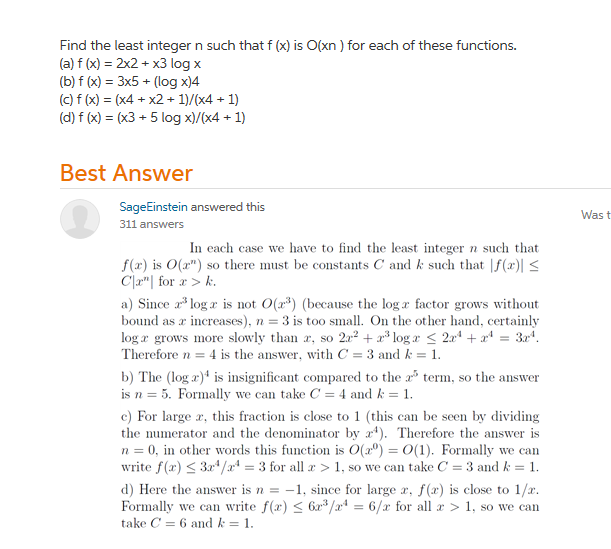
Find the least integer n such that f (x) is O(xn) for each of these functions. (a) f (x) = 2x2 + x3 log x (b) f (x) = 3x5 + (log x)4 (c) f (x)- (x4 +x21)/x4 1) (d) f (x) -(x3 5 log x)/(x41) Best Answer SageEinstein answered this 311 answers Was t In each case we have to find the least integer n such that f(r) is O(") so there must be constants C and k such that f(a)S C" for > a) Since log r is not O(a) (because the logr factor grows without bound asa, increases), n = 3 is too small. On the other hand, certainly logr grows more slowly than x, so 22,2 + 2,3 log r 22,4 + r4 = 3r4 Therefore n4 is the answer, with C3 and k 1 b) The (log ar) is insignificant compared to the term, so the answer is n = 5, Formally, we can take C = 4 and k = 1 e) For larger, this fraction is close to 1 (this can be seen by dividing the numerator and the denominator by Therefore the answer is n = 0. in other words this function s 0(2,0) = 0(1). Formally we can write f(x) 3 for all >1, so we can take C 3 and k 1 d) Here the answer is n =-1, since for large x, f(2) is close to 1/r Formally we can write f(66 for all>1, so we can take C6 and k1
Step by Step Solution
There are 3 Steps involved in it

Get step-by-step solutions from verified subject matter experts
 Study Help