





Question: I got this problem incorrect... Can you show your solution step-by step with the equilibrium graphs as well? I wrote both stable and unstable state
I got this problem incorrect... Can you show your solution step-by step with the equilibrium graphs as well? I wrote both stable and unstable state exist...
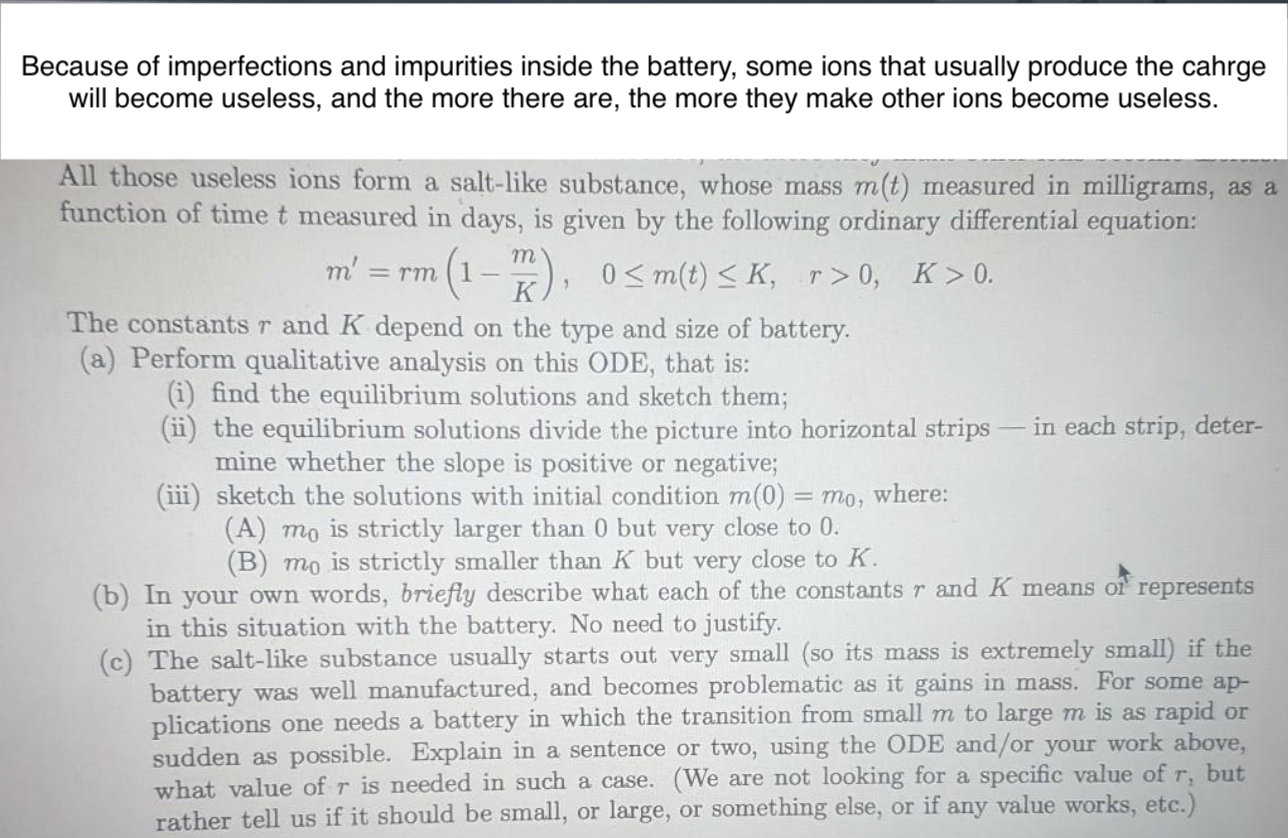
Because of imperfections and impurities inside the battery, some ions that usually produce the cahrge will become useless, and the more there are, the more they make other ions become useless. All those useless ions form a salt-like substance, whose mass m(t) measured in milligrams, as a function of time t measured in days, is given by the following ordinary differential equation: m = rm (1- * 1 0 5 m ( t ) 0 , K > 0. The constants r and K depend on the type and size of battery. (a) Perform qualitative analysis on this ODE, that is: (i) find the equilibrium solutions and sketch them; (ii) the equilibrium solutions divide the picture into horizontal strips - in each strip, deter- mine whether the slope is positive or negative; (iii) sketch the solutions with initial condition m(0) = mo, where: (A) mo is strictly larger than 0 but very close to 0. (B) mo is strictly smaller than K but very close to K. (b) In your own words, briefly describe what each of the constants r and K means or represents in this situation with the battery. No need to justify. (c) The salt-like substance usually starts out very small (so its mass is extremely small) if the battery was well manufactured, and becomes problematic as it gains in mass. For some ap- plications one needs a battery in which the transition from small m to large m is as rapid or sudden as possible. Explain in a sentence or two, using the ODE and/or your work above, what value of r is needed in such a case. (We are not looking for a specific value of r, but rather tell us if it should be small, or large, or something else, or if any value works, etc.)

