







Question: i have 20 multiple choice questions i need help with, need my today Multiple Choice - circle the most correct (3 points each) 1. Year
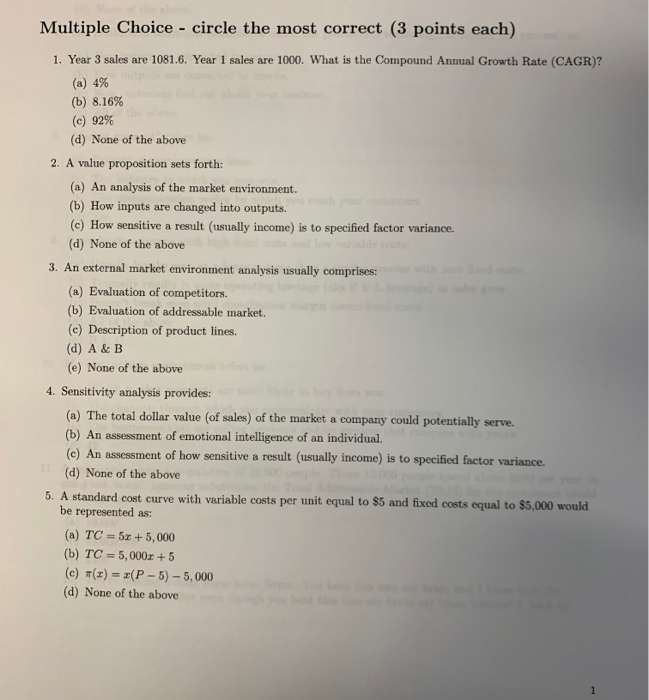
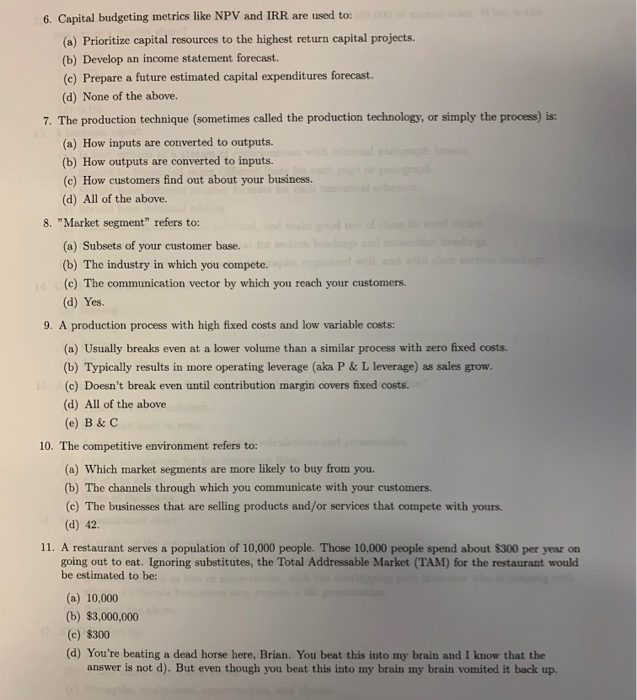
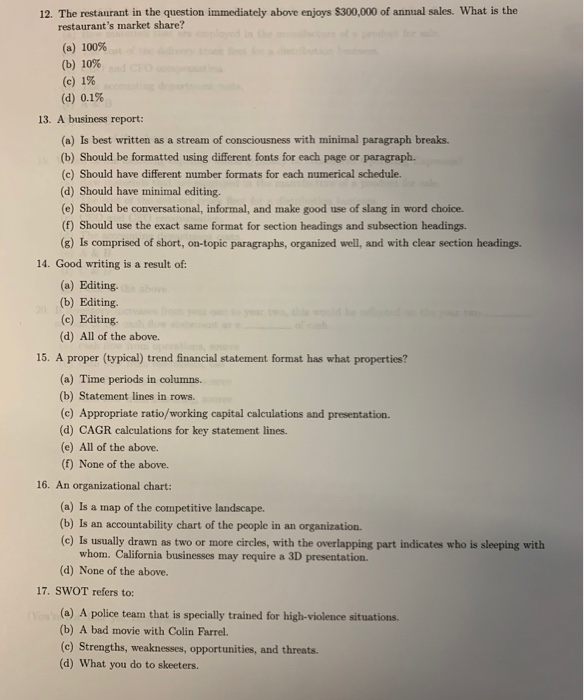
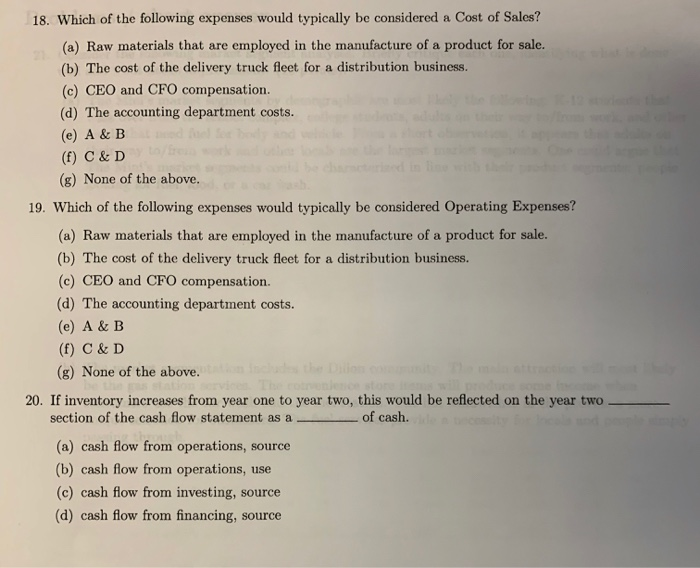
Multiple Choice - circle the most correct (3 points each) 1. Year 3 sales are 1081.6. Year 1 sales are 1000. What is the Compound Annual Growth Rate (CAGR)? (a) 4% (b) 8.16% (c) 92% (d) None of the above 2. A value proposition sets forth: (a) An analysis of the market environment. (b) How inputs are changed into outputs. (c) How sensitive a result (usually income) is to specified factor variance. (d) None of the above 3. An external market environment analysis usually comprises: (a) Evaluation of competitors. (b) Evaluation of addressable market. (c) Description of product lines. (d) A & B (e) None of the above 4. Sensitivity analysis provides: (a) The total dollar value of sales) of the market a company could potentially serve. (b) An assessment of emotional intelligence an individual. (c) An assessment of how sensitive a result (usually income) is to specified factor variance. (d) None of the above 5. A standard cost curve with variable costs per unit equal to $5 and fixed costs equal to $5,000 would be represented as: (a) TC = 5x +5,000 (b) TC = 5,000.x + 5 (c) (2) = x(P-5) - 5,000 (d) None of the above 6. Capital budgeting metrics like NPV and IRR are used to: (a) Prioritize capital resources to the highest return capital projects. (b) Develop an income statement forecast. (c) Prepare a future estimated capital expenditures forecast. (d) None of the above. 7. The production technique (sometimes called the production technology, or simply the process) is: (a) How inputs are converted to outputs. (b) How outputs are converted to inputs. (c) How customers find out about your business. (d) All of the above. 8. "Market segment refers to: (a) Subsets of your customer base. (b) The industry in which you compete. (e) The communication vector by which you reach your customers. (d) Yes 9. A production process with high fixed costs and low variable costs: (a) Usually breaks even at a lower volume than a similar process with zero fixed costs. (b) Typically results in more operating leverage (aka P & L leverage) as sales grow. (c) Doesn't break even until contribution margin covers fixed costs. (d) All of the above (e) B&C 10. The competitive environment refers to: (a) Which market segments are more likely to buy from you. (b) The channels through which you communicate with your customers. (c) The businesses that are selling products and/or services that compete with yours. (d) 42 11. A restaurant serves a population of 10,000 people. Those 10,000 people spend about $300 per year on going out to eat. Ignoring substitutes, the Total Addressable Market (TAM) for the restaurant would be estimated to be: (a) 10,000 (b) $3,000,000 (e) $300 (d) You're beating a dead horse here, Brian. You beat this into my brain and I know that the answer is not d). But even though you beat this into my brain my brain vomited it back up. 12. The restaurant in the question immediately above enjoys $300,000 of annual sales. What is the restaurant's market share? (8) 100% (b) 10% (c) 1% (d) 0.1% 13. A business report: (a) Is best written as a stream of consciousness with minimal paragraph breaks. (b) should be formatted using different fonts for each page or paragraph. (c) Should have different number formats for each numerical schedule. (d) Should have minimal editing. (e) Should be conversational, informal, and make good use of slang in word choice. (f) Should use the exact same format for section headings and subsection headings. (g) Is comprised of short, on-topic paragraphs, organized well, and with clear section headings. 14. Good writing is a result of: (a) Editing (b) Editing (c) Editing (d) All of the above. 15. A proper (typical) trend financial statement format has what properties? (a) Time periods in columns. (b) Statement lines in rows. (e) Appropriate ratio/working capital calculations and presentation (d) CAGR calculations for key statement lines. (e) All of the above. (f) None of the above. 16. An organizational chart: (a) Is a map of the competitive landscape. (b) is an accountability chart of the people in an organization. (e) is usually drawn as two or more circles, with the overlapping part indicates who is sleeping with whom. California businesses may require a 3D presentation. (d) None of the above. 17. SWOT refers to: (a) A police team that is specially trained for high-violence situations (b) A bad movie with Colin Farrel. (c) Strengths, weaknesses, opportunities, and threats. (d) What you do to skeeters. 18. Which of the following expenses would typically be considered a Cost of Sales? (a) Raw materials that are employed in the manufacture of a product for sale. (b) The cost of the delivery truck fleet for a distribution business. (c) CEO and CFO compensation. (d) The accounting department costs. (e) A & B (f) C & D (8) None of the above. 19. Which of the following expenses would typically be considered Operating Expenses? (a) Raw materials that are employed in the manufacture of a product for sale. (b) The cost of the delivery truck fleet for a distribution business. (c) CEO and CFO compensation. (d) The accounting department costs. (e) A & B (f) C & D (g) None of the above. 20. If inventory increases from year one to year two, this would be reflected on the year two section of the cash flow statement as a of cash. (a) cash flow from operations, source (b) cash flow from operations, use (c) cash flow from investing, source (d) cash flow from financing, source
Step by Step Solution
There are 3 Steps involved in it

Get step-by-step solutions from verified subject matter experts
 Study Help