







Question: I have 3 questions, based on the attachment below: Explain how the term underlined by BLUE is obtained Does the statement underlined by RED, refer
I have 3 questions, based on the attachment below:
- Explain how the term underlined by BLUE is obtained
- Does the statement underlined by RED, refer to the statement "but that these partials are not continuous at (0,0)". Please explain in more detail
- Please explain in detail, the GREEN box
Please explain clearly showing each step as thoroughly as possible.
If you are using hand-written notes, then please ensure they are tidy and legible as untidy written notes are difficult to interpret.
Alternatively use LaTeX.
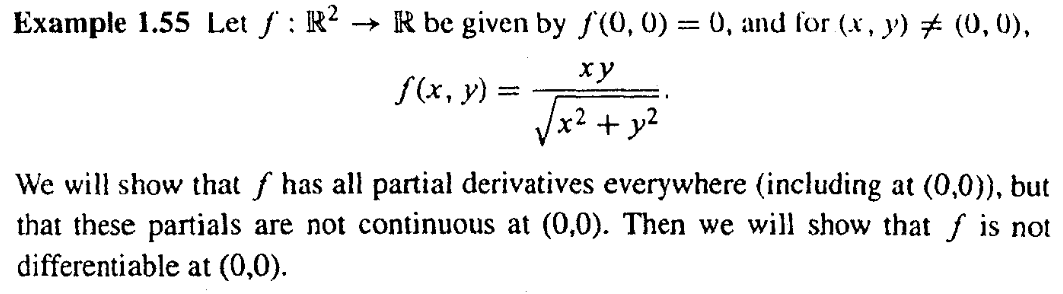
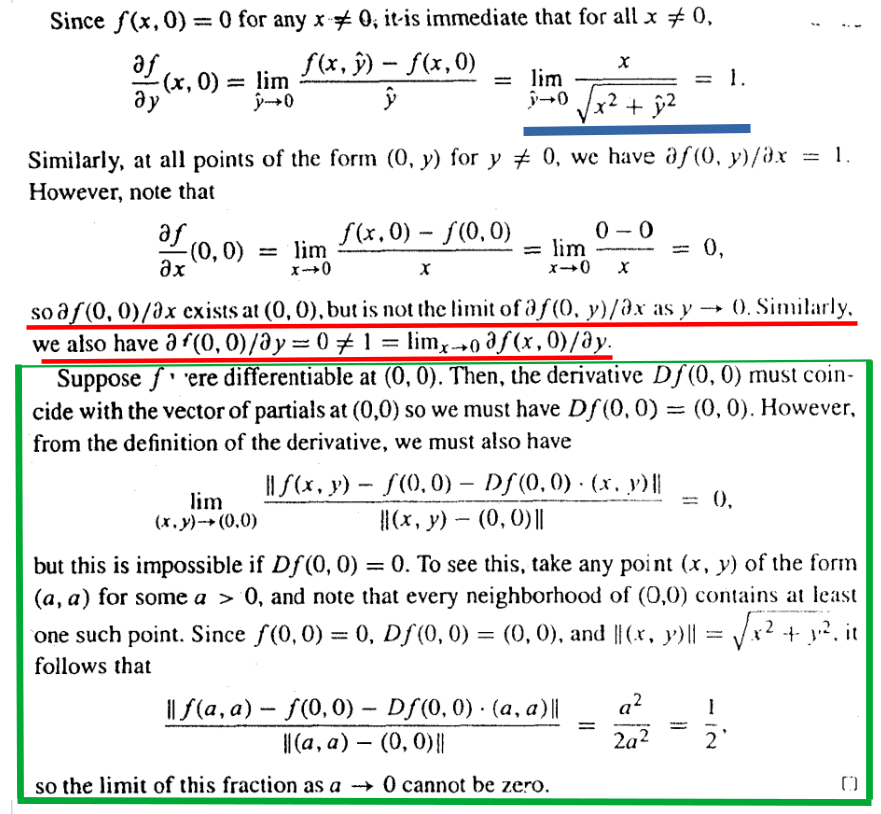
Example 1.55 Let f : Iz - R be given by f (0, 0) = 0, and for (x, y) # (0, 0), xy f (x, y) = Vx2 + 1/2 We will show that f has all partial derivatives everywhere (including at (0,0)), but that these partials are not continuous at (0,0). Then we will show that f is not differentiable at (0,0).Since f(x, 0) = 0 for any x / 0; it-is immediate that for all x # 0, - (x, 0) = lim J( x. y) - f(x, 0) X = lim = 1. x 2 + 12 Similarly, at all points of the form (0, y) for y # 0, we have af(0, y)/ax = 1. However, note that of (0, 0) = lim f(x. 0) - f(0, 0) 0-0 = lim == 0, ax * -+ 0 X x-+0 X so af (0, 0) /3x exists at (0, 0), but is not the limit of af (0, y) /ax as y - O. Similarly. we also have a f(0, 0) /ay = 0 # 1 = limx -.oaf (x, 0) /ay. Suppose f . ere differentiable at (0, 0). Then, the derivative Df (0, 0) must coin- cide with the vector of partials at (0,0) so we must have DS (0, 0) = (0, 0). However. from the definition of the derivative, we must also have lim II f (x. y) - f(0.0) - Df (0. 0) . (x. v)Il = 0. (x. y)- (0.0) I(x, y) - (0, 0) 11 but this is impossible if Df (0, 0) = 0. To see this, take any point (x, y) of the form (a, a) for some a > 0, and note that every neighborhood of (0,0) contains at least one such point. Since f(0, 0) = 0, Df(0, 0) = (0, 0), and II (x. y)ll = Vx2 + )2. it follows that ll f(a, a) - f(0, 0) - Df(0, 0) . (a, a)ll a2 = NI . Il (a, a) - (0, 0) 11 202 so the limit of this fraction as a - 0 cannot be zero
Step by Step Solution
There are 3 Steps involved in it

Get step-by-step solutions from verified subject matter experts
 Study Help