







Question: I have an assignment which is called An Executive Summary video where I will send you the link below please watch that video, which is
I have an assignment which is called An Executive Summary video where I will send you the link below please watch that video, which is called "Video review of executive summary from Victoria Business School." After watching the video, please complete the following question ? Link : https://youtu.be/KI1_Y3X56y4
1. Can you please post a draft of the executive summary for my final report using the guidelines provided in the video ?
I have attached you my final report in the picture below the topic is Impact of social media on Employee Productivity
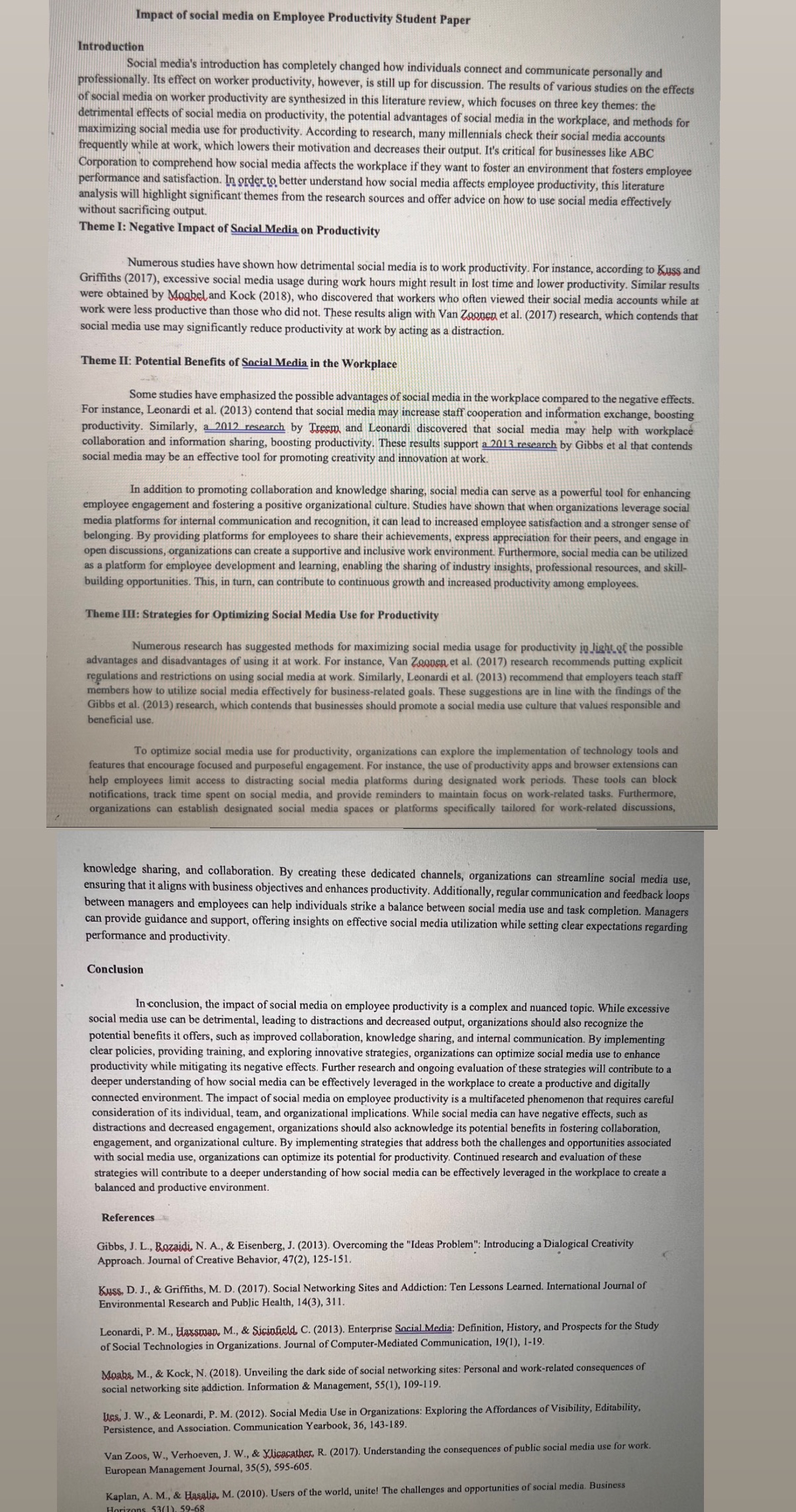 Impact of social media on Employee Productivity Student Paper Introduction Social media's introduction has completely changed how individuals connect and communicate personally and professionally. Its effect on worker productivity, however, is still up for discussion. The results of various studies on the effects of social media on worker productivity are synthesized in this literature review, which focuses on three key themes: the detrimental effects of social media on productivity, the potential advantages of social media in the workplace, and methods for maximizing social media use for productivity. According to research, many millennials check their social media accounts frequently while at work, which lowers their motivation and decreases their output. It's critical for businesses like ABC Corporation to comprehend how social media affects the workplace if they want to foster an environment that fosters employee performance and satisfaction. In order to better understand how social media affects employee productivity, this literature analysis will highlight significant themes from the research sources and offer advice on how to use social media effectively without sacrificing output. Theme I: Negative Impact of Social Media on Productivity Numerous studies have shown how detrimental social media is to work productivity. For instance, according to Kuss and Griffiths (2017), excessive social media usage during work hours might result in lost time and lower productivity. Similar results were obtained by Mogbel and Kock (2018), who discovered that workers who often viewed their social media accounts while at work were less productive than those who did not. These results align with Van Zoopen et al. (2017) research, which contends that social media use may significantly reduce productivity at work by acting as a distraction. Theme II: Potential Benefits of Social Media in the Workplace Some studies have emphasized the possible advantages of social media in the workplace compared to the negative effects. For instance, Leonardi et al. (2013) contend that social media may increase staff cooperation and information exchange, boosting productivity. Similarly, a 2012 research by Treem, and Leonardi discovered that social media may help with workplace collaboration and information sharing, boosting productivity. These results support a 2013 research by Gibbs et al that contends social media may be an effective tool for promoting creativity and innovation at work. In addition to promoting collaboration and knowledge sharing, social media can serve as a powerful tool for enhancing employee engagement and fostering a positive organizational culture. Studies have shown that when organizations leverage social media platforms for internal communication and recognition, it can lead to increased employee satisfaction and a stronger sense of belonging. By providing platforms for employees to share their achievements, express appreciation for their peers, and engage in open discussions, organizations can create a supportive and inclusive work environment. Furthermore, social media can be utilized as a platform for employee development and learning, enabling the sharing of industry insights, professional resources, and skill- building opportunities. This, in turn, can contribute to continuous growth and increased productivity among employees. Theme III: Strategies for Optimizing Social Media Use for Productivity Numerous research has suggested methods for maximizing social media usage for productivity in light of the possible advantages and disadvantages of using it at work. For instance, Van Zoonen et al. (2017) research recommends putting explicit regulations and restrictions on using social media at work. Similarly, Leonardi et al. (2013) recommend that employers teach staff members how to utilize social media effectively for business-related goals. These suggestions are in line with the findings of the Gibbs et al. (2013) research, which contends that businesses should promote a social media use culture that values responsible and beneficial use. To optimize social media use for productivity, organizations can explore the implementation of technology tools and features that encourage focused and purposeful engagement. For instance, the use of productivity apps and browser extensions can help employees limit access to distracting social media platforms during designated work periods. These tools can block notifications, track time spent on social media, and provide reminders to maintain focus on work-related tasks. Furthermore, organizations can establish designated social media spaces or platforms specifically tailored for work-related discussions, knowledge sharing, and collaboration. By creating these dedicated channels, organizations can streamline social media use, ensuring that it aligns with business objectives and enhances productivity. Additionally, regular communication and feedback loops between managers and employees can help individuals strike a balance between social media use and task completion. Managers can provide guidance and support, offering insights on effective social media utilization while setting clear expectations regarding performance and productivity. Conclusion In conclusion, the impact of social media on employee productivity is a complex and nuanced topic. While excessive social media use can be detrimental, leading to distractions and decreased output, organizations should also recognize the potential benefits it offers, such as improved collaboration, knowledge sharing, and internal communication. By implementing clear policies, providing training, and exploring innovative strategies, organizations can optimize social media use to enhance productivity while mitigating its negative effects. Further research and ongoing evaluation of these strategies will contribute to a deeper understanding of how social media can be effectively leveraged in the workplace to create a productive and digitally connected environment. The impact of social media on employee productivity is a multifaceted phenomenon that requires careful consideration of its individual, team, and organizational implications. While social media can have negative effects, such as distractions and decreased engagement, organizations should also acknowledge its potential benefits in fostering collaboration, engagement, and organizational culture. By implementing strategies that address both the challenges and opportunities associated with social media use, organizations can optimize its potential for productivity. Continued research and evaluation of these strategies will contribute to a deeper understanding of how social media can be effectively leveraged in the workplace to create a balanced and productive environment. References Gibbs, J. L., Rozaidi N. A., & Eisenberg, J. (2013). Overcoming the "Ideas Problem": Introducing a Dialogical Creativity Approach. Journal of Creative Behavior, 47(2), 125-151. Kuss, D. J., & Griffiths, M. D. (2017). Social Networking Sites and Addiction: Ten Lessons Learned. International Journal of Environmental Research and Public Health, 14(3), 311. Leonardi, P. M., Haxswan, M., & Sicinfield C. (2013). Enterprise Social Media: Definition, History, and Prospects for the Study of Social Technologies in Organizations. Journal of Computer-Mediated Communication, 19(1), 1-19. Moaks M., & Kock, N. (2018). Unveiling the dark side of social networking sites: Personal and work-related consequences of social networking site addiction. Information & Management, 55(1), 109-119. Utes, J. W., & Leonardi, P. M. (2012). Social Media Use in Organizations: Exploring the Affordances of Visibility, Editability, Persistence, and Association. Communication Yearbook, 36, 143-189. Van Zoos, W., Verhoeven, J. W., & Xlicacather, R. (2017). Understanding the consequences of public social media use for work. European Management Journal, 35(5), 595-605. Kaplan, A. M., & Hasalia, M. (2010). Users of the world, unite! The challenges and opportunities of social media. Business
Step by Step Solution
There are 3 Steps involved in it
1 Expert Approved Answer
Step: 1 Unlock

Question Has Been Solved by an Expert!
Get step-by-step solutions from verified subject matter experts
Step: 2 Unlock
Step: 3 Unlock
 Study Help