



Question: I have attached all the correct answers to all problems. Please show all of your work for all problems. . a = 10 m/s 2.
I have attached all the correct answers to all problems. Please show all of your work for all problems.
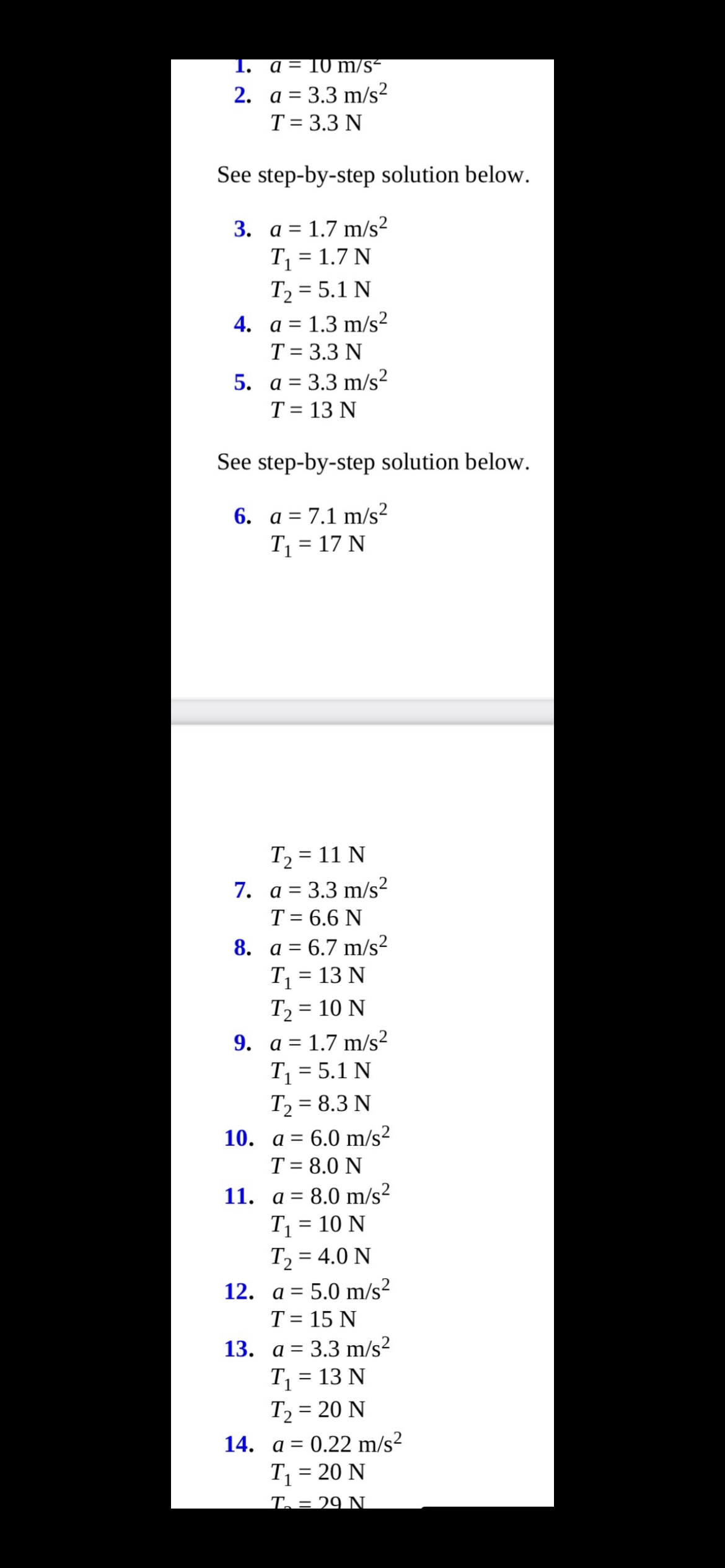
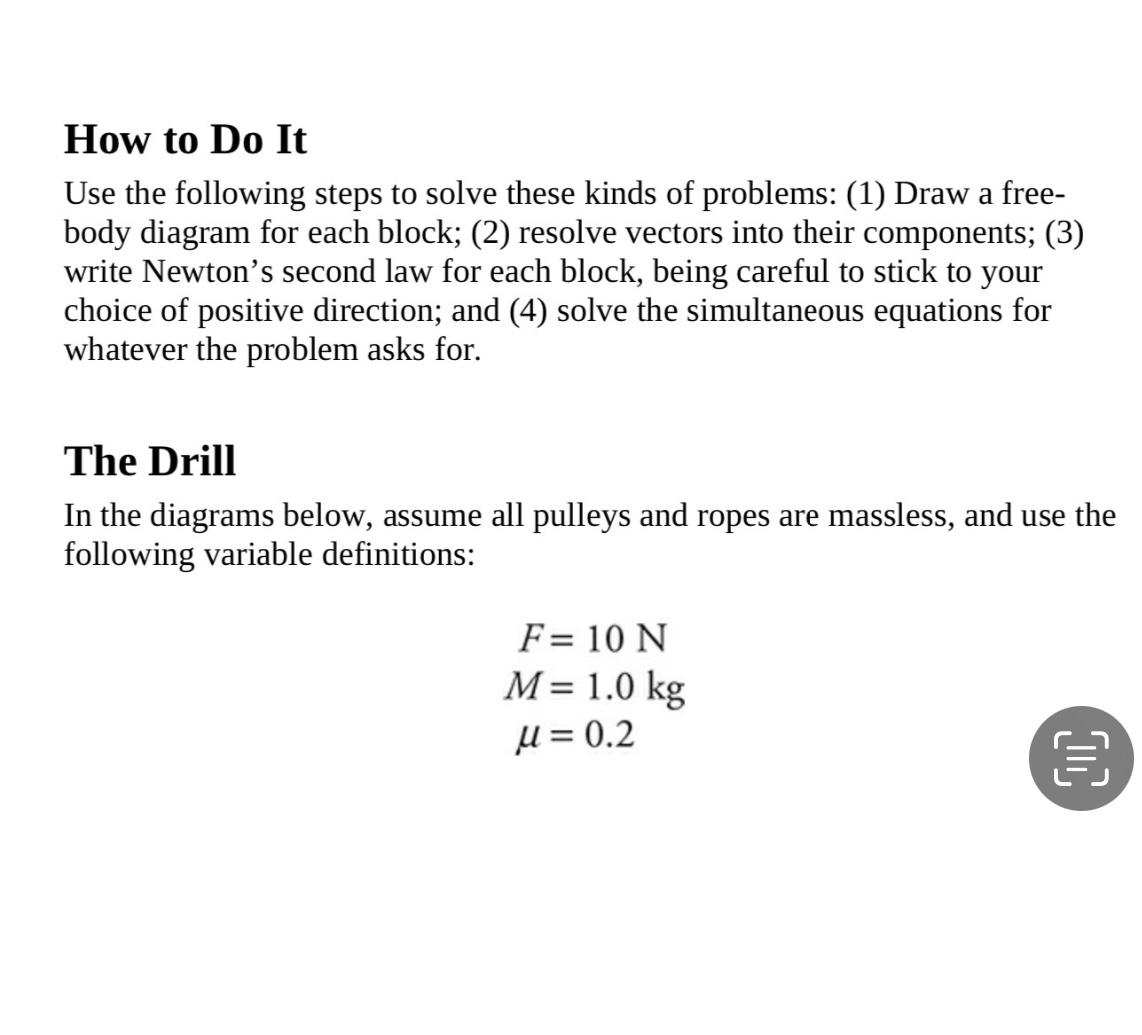
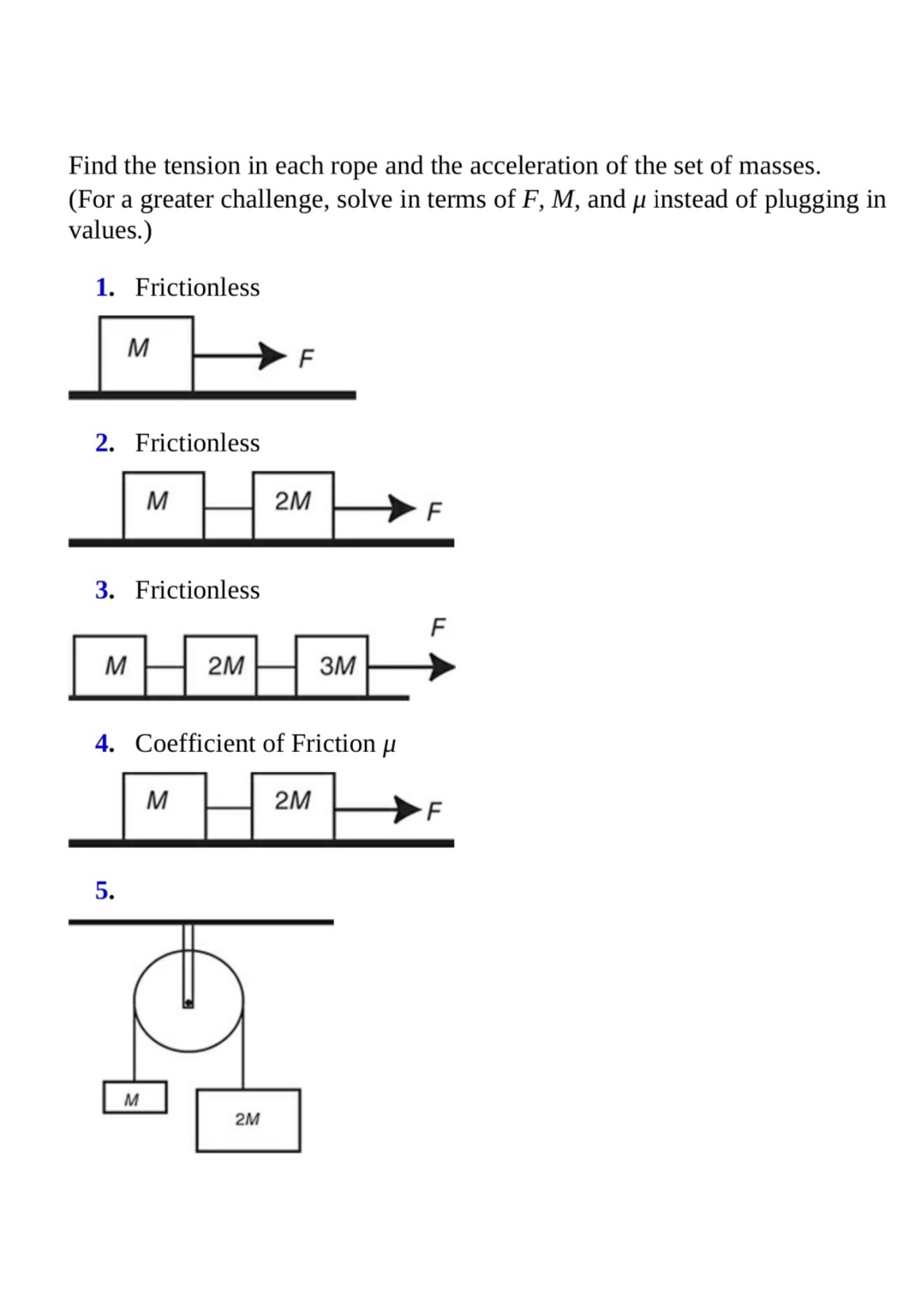
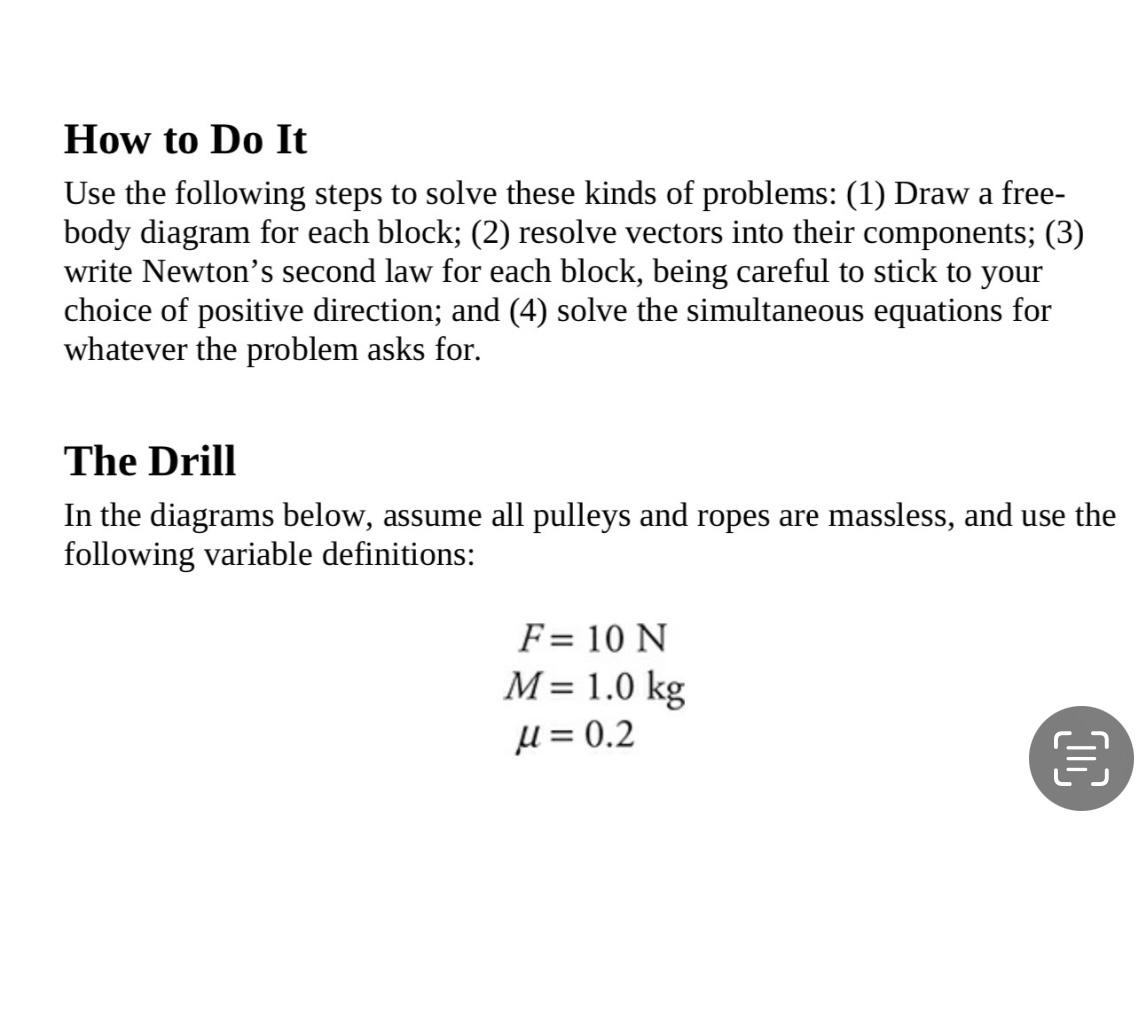
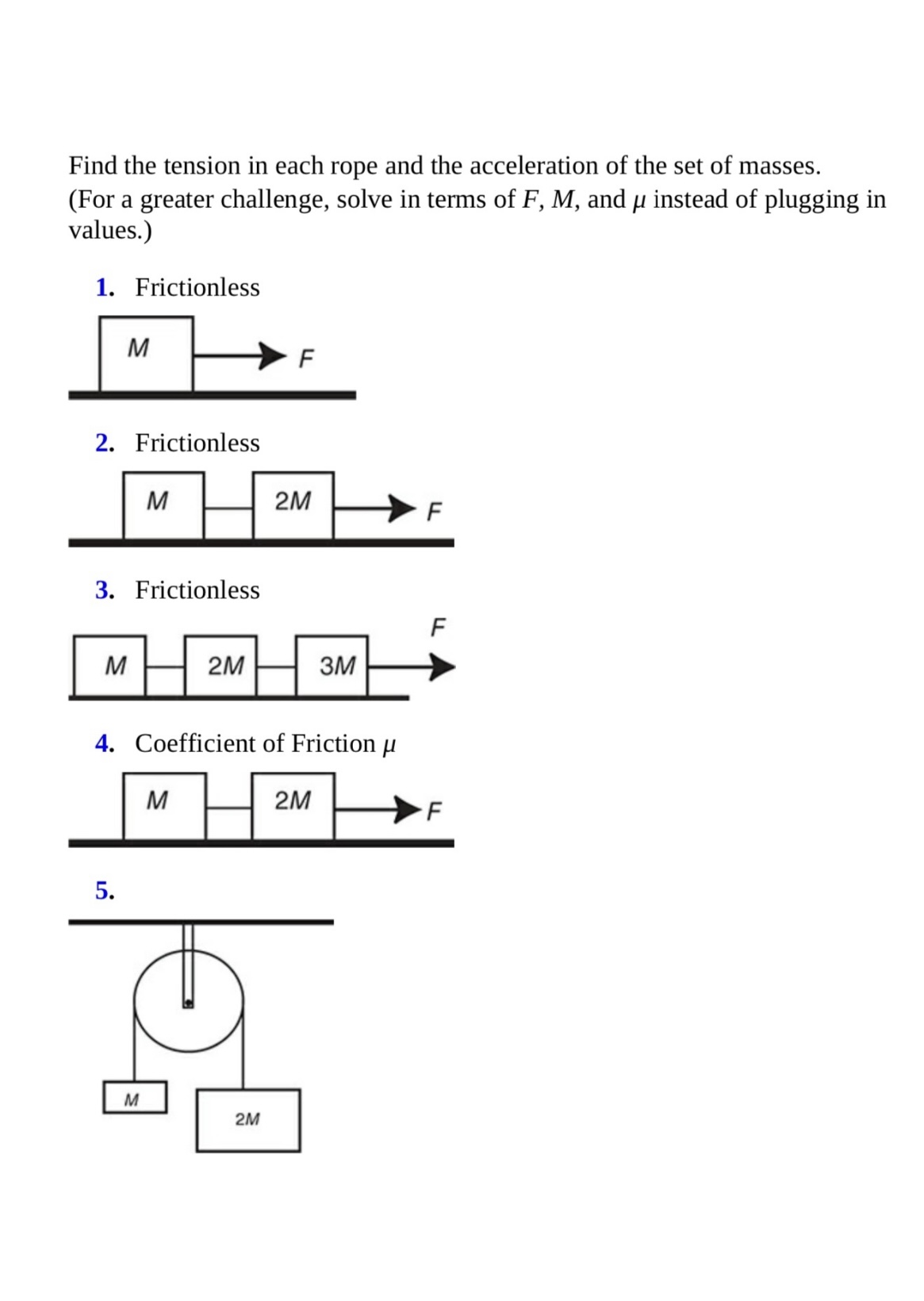
. a = 10 m/s 2. a = 3.3 m/s2 T = 3.3 N See step-by-step solution below. 3. a = 1.7 m/s2 T1 = 1.7 N T, = 5.1 N 4. a = 1.3 m/s2 T = 3.3 N 5. a = 3.3 m/s2 T = 13 N See step-by-step solution below. 6. a = 7.1 m/s2 T1 = 17 N T, = 11 N 7. a = 3.3 m/s2 T = 6.6 N 8. a = 6.7 m/s2 T1 = 13 N T2 = 10 N 9. a = 1.7 m/s2 T1 = 5.1 N T, = 8.3 N 10. a = 6.0 m/s2 T = 8.0 N 11. a = 8.0 m/s2 T1 = 10 N T, = 4.0 N 12. a = 5.0 m/s2 T = 15 N 13. a = 3.3 m/s2 T = 13 N T, = 20 N 14. a = 0.22 m/s2 T1 = 20 N T. = 29 NHow to Do It Use the following steps to solve these kinds of problems: (1) Draw a free- body diagram for each block; (2) resolve vectors into their components; (3) write Newton's second law for each block, being careful to stick to your choice of positive direction; and (4) solve the simultaneous equations for whatever the problem asks for. The Drill In the diagrams below, assume all pulleys and ropes are massless, and use the following variable definitions: F=10N M=1.0kg e Find the tension in each rope and the acceleration of the set of masses. (For a greater challenge, solve in terms of F, M, and p instead of plugging in values.) 1. Frictionless F 2. Frictionless M -- F 3. Frictionless F l.. 4. Coefficient of Friction p
Step by Step Solution
There are 3 Steps involved in it

Get step-by-step solutions from verified subject matter experts