







Question: I have attached my problem questions with my code. My question is: Does the code for the quasi random and monte carlo methods look correct?
I have attached my problem questions with my code. My question is: Does the code for the quasi random and monte carlo methods look correct? If I changed the skip or leap sizes in the haltonset calculation then the quasi random results can change dramatically which makes me think something is wrong. I have attached the questions of the project but I want to see if my code is correct.
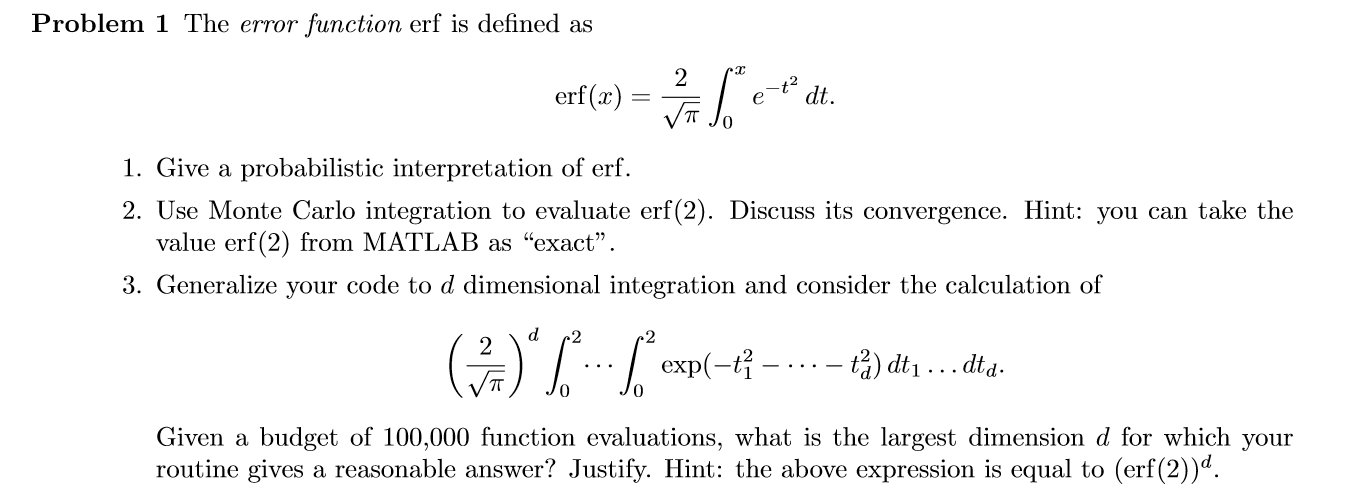

And here is the code I am using
%%Matlab code for Monte Carlo simulation for finding value of pi clear all close all
NN = [10^3 10^4 10^5]; %sets different evaluations to see the changes in the integration and difference values.
for ii=1:length(NN) N=NN(ii); %Reads the NN values for the evaluation ax =0;bx =2; %project gave integration from 0->2 ay =0;by =2; x = ax + (bx-ax).*rand(N,1); y = ay + (by-ay).*rand(N,1); hits=0; for i=1:N if y(i)
for ii=1:length(NN) N=NN(ii); %Reads the NN values for the evaluation ax =0;bx =2; %project gave integration from 0->2 ay =0;by =2;
p = haltonset(2,'Skip',100,'Leap',68); p = scramble(p,'RR2'); rar=net(p,N); rary=net(p,N); x = ax + (bx-ax).*rar; y = ay + (by-ay).*rary; hits=0; for i=1:N if y(i)
I think that my code is right best I can tell and if it is I was going to conclude that the psuedorandom generator of the Monte Carlo method is more accurate to the error function however the quasi random generator has a more consistent solution across the different size evaluation matrices.
Any help is greatly appreciated.
Problem 1 The error function erf is defined as 2 _+2 erf(x) = El e-t dt. 1. Give a probabilistic interpretation of erf. 2. Use Monte Carlo integration to evaluate erf(2). Discuss its convergence. Hint: you can take the value erf(2) from MATLAB as exact. 3. Generalize your code to d dimensional integration and consider the calculation of / 2 d 2 2 | .. exp(-t - ... - t) dt ... dtd. JO Given a budget of 100,000 function evaluations, what is the largest dimension d for which your routine gives a reasonable answer? Justify. Hint: the above expression is equal to (erf(2))d. Problem 3 1. Choose either the Halton or the Sobol sequence of quasi-random numbers. Briefly describe how they are constructed. 2. Illustrate graphically the difference between pseudo-random numbers and quasi-random numbers. 3. Repeat step 2 of Problem 1 with quasi-random numbers. Comment. Problem 1 The error function erf is defined as 2 _+2 erf(x) = El e-t dt. 1. Give a probabilistic interpretation of erf. 2. Use Monte Carlo integration to evaluate erf(2). Discuss its convergence. Hint: you can take the value erf(2) from MATLAB as exact. 3. Generalize your code to d dimensional integration and consider the calculation of / 2 d 2 2 | .. exp(-t - ... - t) dt ... dtd. JO Given a budget of 100,000 function evaluations, what is the largest dimension d for which your routine gives a reasonable answer? Justify. Hint: the above expression is equal to (erf(2))d. Problem 3 1. Choose either the Halton or the Sobol sequence of quasi-random numbers. Briefly describe how they are constructed. 2. Illustrate graphically the difference between pseudo-random numbers and quasi-random numbers. 3. Repeat step 2 of Problem 1 with quasi-random numbers. Comment
Step by Step Solution
There are 3 Steps involved in it

Get step-by-step solutions from verified subject matter experts
 Study Help