







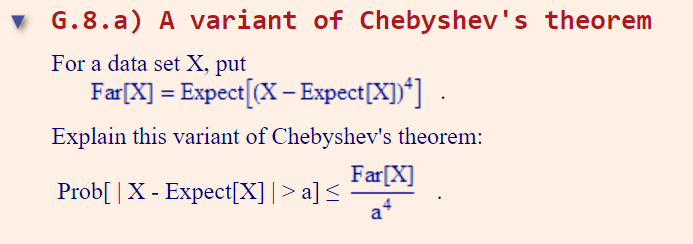
Question: I have been doing a unit in my probability theory and statistics course on Markov's inequality and Chebyshev's theorem. This below question is stumping me,
I have been doing a unit in my probability theory and statistics course on Markov's inequality and Chebyshev's theorem. This below question is stumping me, I'm not quite sure where to start. The only hint I have gotten is this: The key to explaining this is using Markov's inequality. Markov's inequality tells usk * Prob[Y > k]
If we carefully choose our k and Y we can solve the above problem. You setY =(X - Expect[X])^2 , but it may be easier to choose a Y such that Expect[Y] = Far[X].
Could I have some advice on how to tackle this problem? Thank you!
\f
Step by Step Solution
There are 3 Steps involved in it
1 Expert Approved Answer
Step: 1 Unlock

Question Has Been Solved by an Expert!
Get step-by-step solutions from verified subject matter experts
Step: 2 Unlock
Step: 3 Unlock
 Study Help