







Question: I have provided the sources chapter 9, please give me the neated written solutions to Question 1, thank you! 5. (a) Without expanding, by transforming
I have provided the sources chapter 9, please give me the neated written solutions to Question 1, thank you!
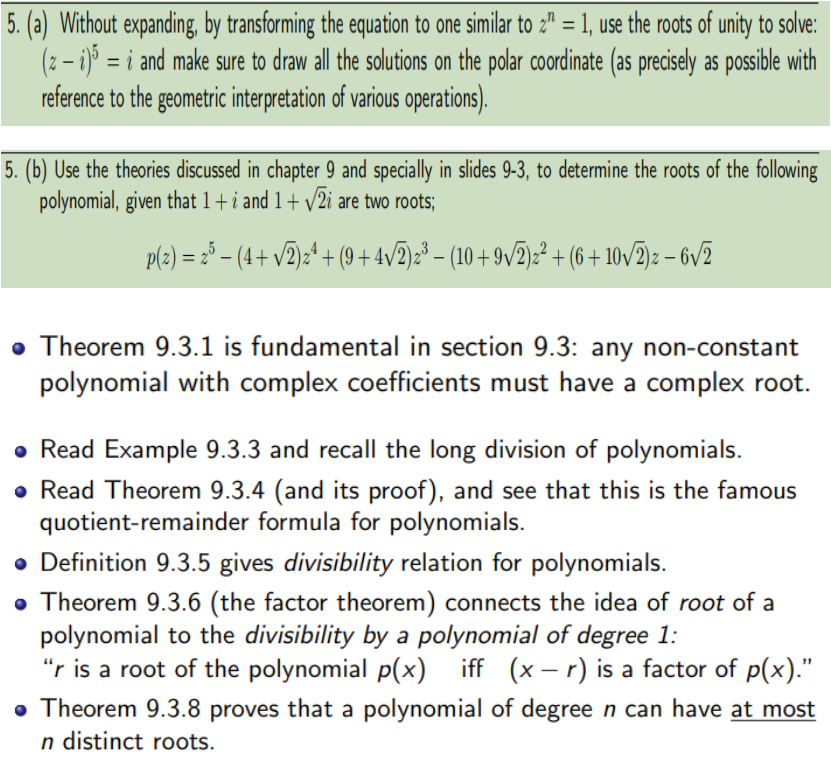
5. (a) Without expanding, by transforming the equation to one similar to z" = 1, use the roots of unity to solve: (z - i)* = i and make sure to draw all the solutions on the polar coordinate (as precisely as possible with reference to the geometric interpretation of various operations). 5. (b) Use the theories discussed in chapter 9 and specially in slides 9-3, to determine the roots of the following polynomial, given that 1 +i and 1 + V2i are two roots; p(z) = 26 (4+ v2)24 + (9+4/2)23 (10 +972)z2 + (6 + 1072)2 672 Theorem 9.3.1 is fundamental in section 9.3: any non-constant polynomial with complex coefficients must have a complex root. . Read Example 9.3.3 and recall the long division of polynomials. Read Theorem 9.3.4 (and its proof), and see that this is the famous quotient-remainder formula for polynomials. Definition 9.3.5 gives divisibility relation for polynomials. . Theorem 9.3.6 (the factor theorem) connects the idea of root of a polynomial to the divisibility by a polynomial of degree 1: "r is a root of the polynomial p(x) iff (x r) is a factor of p(x). . Theorem 9.3.8 proves that a polynomial of degree n can have at most n distinct roots. 5. (a) Without expanding, by transforming the equation to one similar to z" = 1, use the roots of unity to solve: (z - i)* = i and make sure to draw all the solutions on the polar coordinate (as precisely as possible with reference to the geometric interpretation of various operations). 5. (b) Use the theories discussed in chapter 9 and specially in slides 9-3, to determine the roots of the following polynomial, given that 1 +i and 1 + V2i are two roots; p(z) = 26 (4+ v2)24 + (9+4/2)23 (10 +972)z2 + (6 + 1072)2 672 Theorem 9.3.1 is fundamental in section 9.3: any non-constant polynomial with complex coefficients must have a complex root. . Read Example 9.3.3 and recall the long division of polynomials. Read Theorem 9.3.4 (and its proof), and see that this is the famous quotient-remainder formula for polynomials. Definition 9.3.5 gives divisibility relation for polynomials. . Theorem 9.3.6 (the factor theorem) connects the idea of root of a polynomial to the divisibility by a polynomial of degree 1: "r is a root of the polynomial p(x) iff (x r) is a factor of p(x). . Theorem 9.3.8 proves that a polynomial of degree n can have at most n distinct roots
Step by Step Solution
There are 3 Steps involved in it

Get step-by-step solutions from verified subject matter experts
 Study Help