







Question: I have solved this problem and I have solved it in matlab and I have solved some sub questions through using quad I need to
I have solved this problem and I have solved it in matlab and I have solved some sub questions through using "quad" I need to use Trapezoidal rule in the code and not quad and get the same answer. can someone replace the quad with Trapezoidal rule and explain each step how you thought and how it works because I've tried and didn't get that far 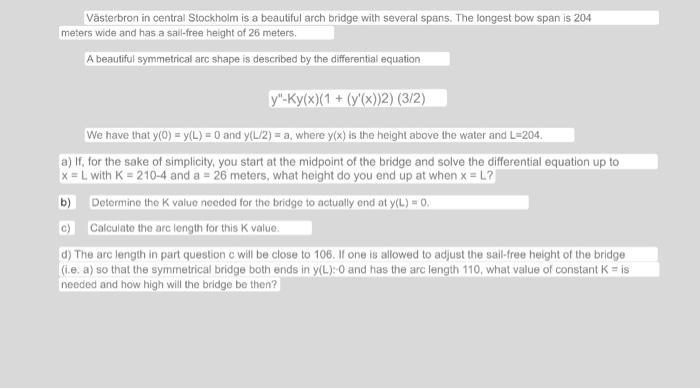
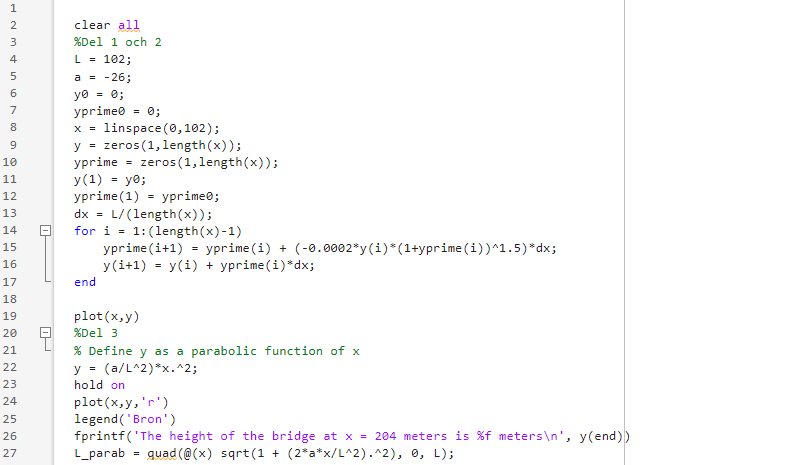
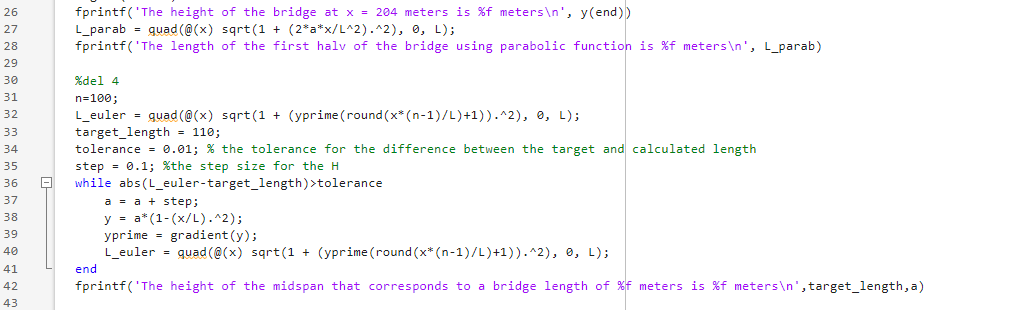
Here is my code
yKy(x)(1+(y(x))2)(3/2) We have that y(0)=y(L)=0 and y(L/2)=a, where y(x) is the height above the water and a) If, for the sake of simplicity, you start at the midpoint of the bridge and solve the differential equation up to x=L with K=2104 and a=26 meters, what height do you end up at when x=L ? b) Determine the K value needed for the bridge to actually end at y(L)=0. c) d) The are length in part question c will be close to 106. If one is allowed to adjust the sail-free height of the bridge (i.e. a) so that the symmetrical bridge both ends in y(L):0 and has the arc length 110 , what value of constant K= is needed and how high will the bridge be then
Step by Step Solution
There are 3 Steps involved in it

Get step-by-step solutions from verified subject matter experts
 Study Help