







Question: I have the basic purpose of this study below; however, I am having trouble analyzing the results or interpreting it as I am new to
I have the basic purpose of this study below; however, I am having trouble analyzing the results or interpreting it as I am new to statistics. And I don't know what degree of freedom means.
The present experiment is trying to determine both if non-words were made to look like real word primes people to recognize real words and if this is affected by delay time. Therefore, the hypothesis would be that "non-words that look moresimilar to real words have a stronger priming effect" and "longer delays reduce the effectiveness of the priming effect." The null hypothesis then would be that there be no effect between non-words that look more similar to real words on priming effect.
Word relationship (related/unrelated)
p value = 0.390 - degree of freedom 1
Interstimulus interval -
p value = 0.400 - Degree of freedom 2
Interaction world relationship and interstimulus interval - p value = 0.372
Degree of freedom 2
N=52
Related Word_300 (millisecond) interval
MEAN = 0.7744423
SD= 0 .63487315
Related Word_600 (millisecond) interval
MEAN = 4.6985958
STANDARD DEVIATION = 28.56566364
Related Word_900 (millisecond) interval
MEAN = 0.7903242
SD= 0 .67325493
Unrelated Word_300 interval
MEAN = 1.4075585
SD= 5.14511338
Unrelated Word_600 interval
MEAN = 0 .8915963
SD = 0 .96415566
Unrelated Word_900 interval
MEAN = 1.2306671
SD = 1.8968128
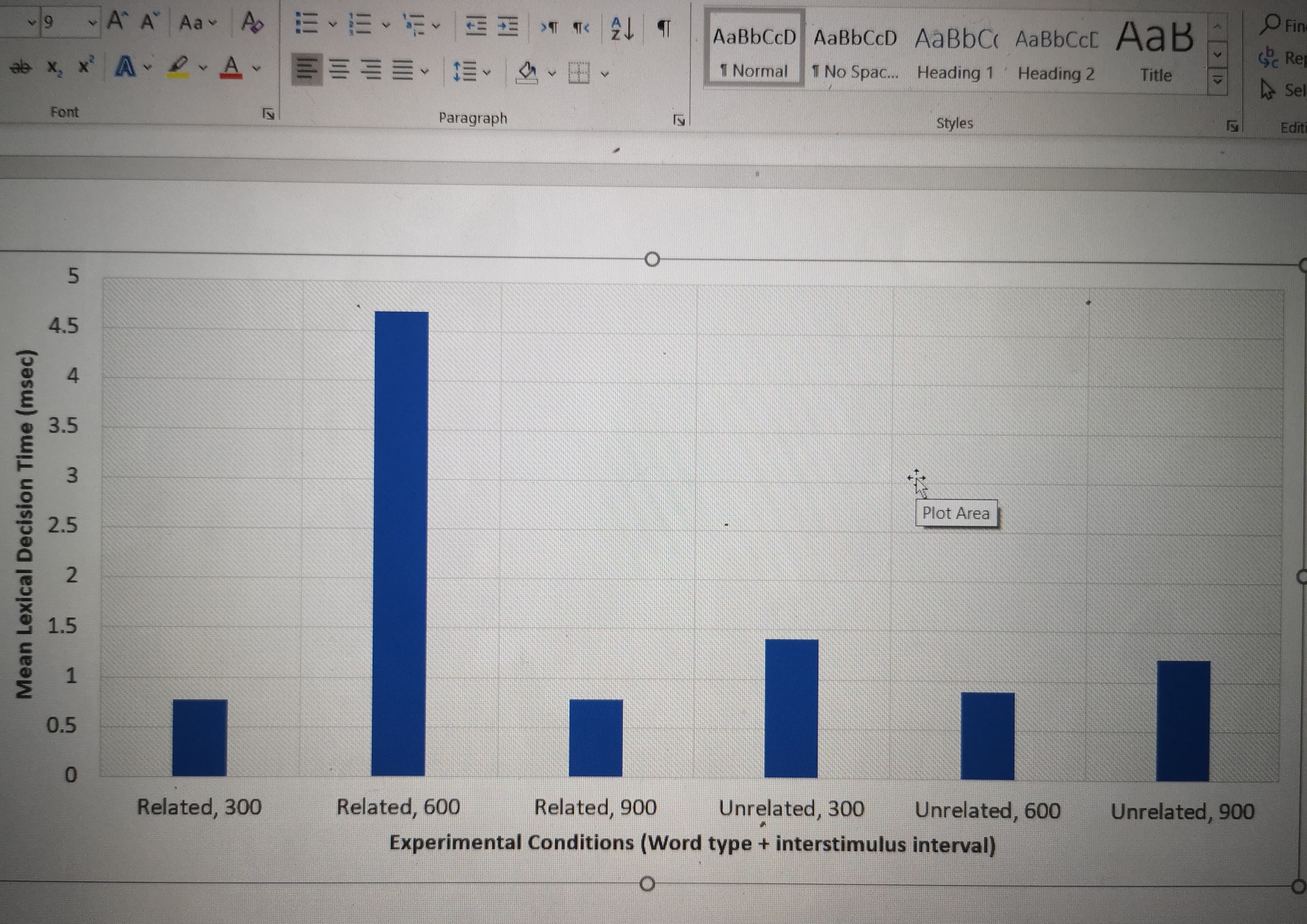
9 A A Aa A AL AaBbCCD AaBbCcD AaBbCc AaBbCct AaB OFin ab x, x A A 1 Normal 1 No Spac... Heading 1 . Heading 2 Title Sec Re Se Font Paragraph Styles Edi UT O 4.5 Mean Lexical Decision Time (msec) 3.5 2.5 Plot Area N 1.5 0.5 0 I I Related, 300 Related, 600 Related, 900 Unrelated, 300 Unrelated, 600 Unrelated, 900 Experimental Conditions (Word type + interstimulus interval)
Step by Step Solution
There are 3 Steps involved in it

Get step-by-step solutions from verified subject matter experts
 Study Help