







Question: I have to design a cost-minimizing optimal assignment plan for the example which is given in Chapter 5.2c, Problem 1Q Pratical Managment Science. First I
I have to design a cost-minimizing optimal assignment plan for the example which is given in Chapter 5.2c, Problem 1Q Pratical Managment Science. First I have to provide an algebraic formulation of the problem (which I already did) and then I have to do a visual representation of this problem. I need help constructing the network diagram. Could you tell me step by step how to formulate it and maybe provide an example so I can understand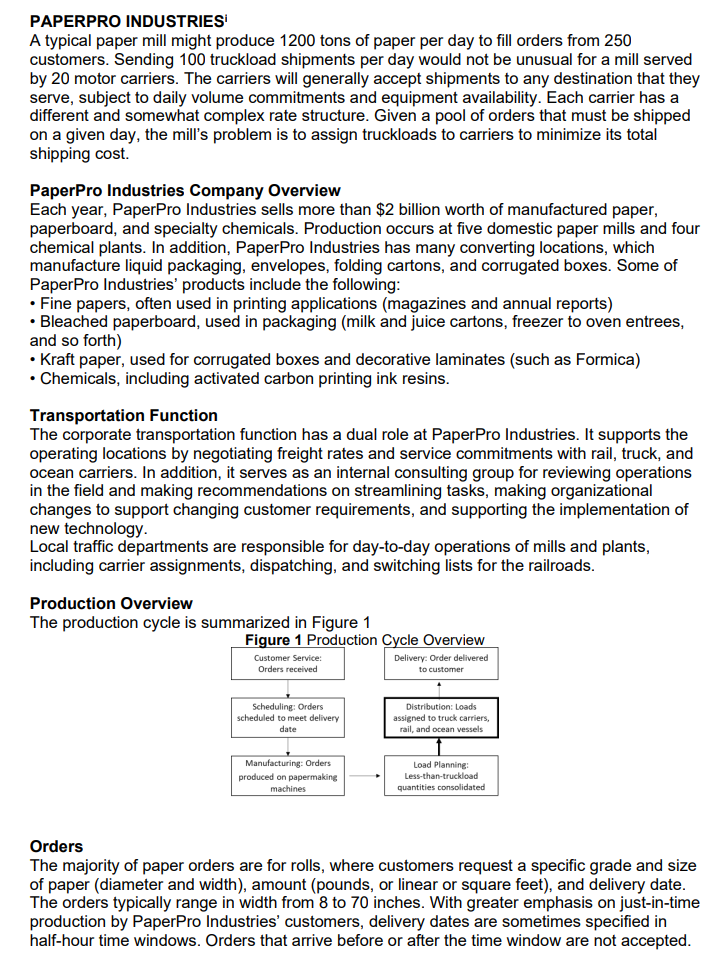
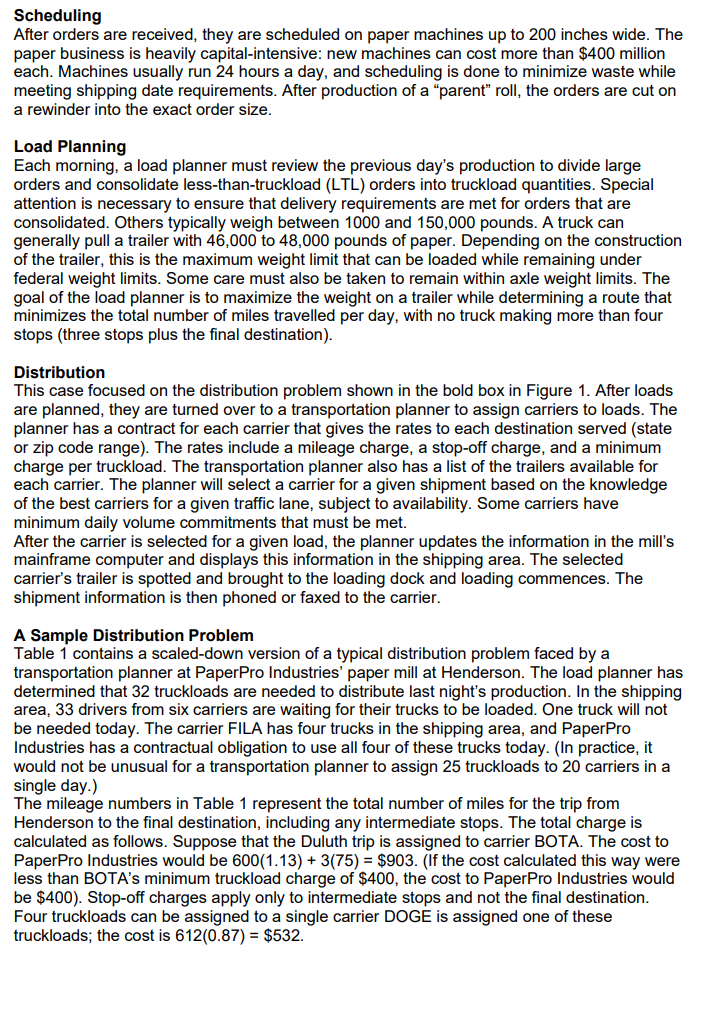
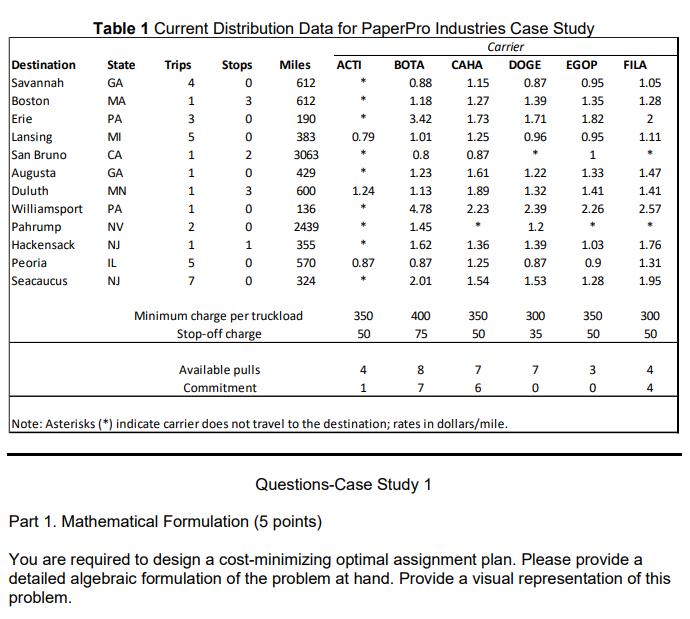
PAPERPRO INDUSTRIES' A typical paper mill might produce 1200 tons of paper per day to fill orders from 250 customers. Sending 100 truckload shipments per day would not be unusual for a mill served by 20 motor carriers. The carriers will generally accept shipments to any destination that they serve, subject to daily volume commitments and equipment availability. Each carrier has a different and somewhat complex rate structure. Given a pool of orders that must be shipped on a given day, the mill's problem is to assign truckloads to carriers to minimize its total shipping cost. PaperPro Industries Company Overview Each year, PaperPro Industries sells more than $2 billion worth of manufactured paper, paperboard, and specialty chemicals. Production occurs at five domestic paper mills and four chemical plants. In addition, PaperPro Industries has many converting locations, which manufacture liquid packaging, envelopes, folding cartons, and corrugated boxes. Some of PaperPro Industries' products include the following: - Fine papers, often used in printing applications (magazines and annual reports) - Bleached paperboard, used in packaging (milk and juice cartons, freezer to oven entrees, and so forth) - Kraft paper, used for corrugated boxes and decorative laminates (such as Formica) - Chemicals, including activated carbon printing ink resins. Transportation Function The corporate transportation function has a dual role at PaperPro Industries. It supports the operating locations by negotiating freight rates and service commitments with rail, truck, and ocean carriers. In addition, it serves as an internal consulting group for reviewing operations in the field and making recommendations on streamlining tasks, making organizational changes to support changing customer requirements, and supporting the implementation of new technology. Local traffic departments are responsible for day-to-day operations of mills and plants, including carrier assignments, dispatching, and switching lists for the railroads. Production Overview The production cycle is summarized in Figure 1 Orders The majority of paper orders are for rolls, where customers request a specific grade and size of paper (diameter and width), amount (pounds, or linear or square feet), and delivery date. The orders typically range in width from 8 to 70 inches. With greater emphasis on just-in-time production by PaperPro Industries' customers, delivery dates are sometimes specified in half-hour time windows. Orders that arrive before or after the time window are not accepted. Scheduling After orders are received, they are scheduled on paper machines up to 200 inches wide. The paper business is heavily capital-intensive: new machines can cost more than $400 million each. Machines usually run 24 hours a day, and scheduling is done to minimize waste while meeting shipping date requirements. After production of a "parent" roll, the orders are cut on a rewinder into the exact order size. Load Planning Each morning, a load planner must review the previous day's production to divide large orders and consolidate less-than-truckload (LTL) orders into truckload quantities. Special attention is necessary to ensure that delivery requirements are met for orders that are consolidated. Others typically weigh between 1000 and 150,000 pounds. A truck can generally pull a trailer with 46,000 to 48,000 pounds of paper. Depending on the construction of the trailer, this is the maximum weight limit that can be loaded while remaining under federal weight limits. Some care must also be taken to remain within axle weight limits. The goal of the load planner is to maximize the weight on a trailer while determining a route that minimizes the total number of miles travelled per day, with no truck making more than four stops (three stops plus the final destination). Distribution This case focused on the distribution problem shown in the bold box in Figure 1. After loads are planned, they are turned over to a transportation planner to assign carriers to loads. The planner has a contract for each carrier that gives the rates to each destination served (state or zip code range). The rates include a mileage charge, a stop-off charge, and a minimum charge per truckload. The transportation planner also has a list of the trailers available for each carrier. The planner will select a carrier for a given shipment based on the knowledge of the best carriers for a given traffic lane, subject to availability. Some carriers have minimum daily volume commitments that must be met. After the carrier is selected for a given load, the planner updates the information in the mill's mainframe computer and displays this information in the shipping area. The selected carrier's trailer is spotted and brought to the loading dock and loading commences. The shipment information is then phoned or faxed to the carrier. A Sample Distribution Problem Table 1 contains a scaled-down version of a typical distribution problem faced by a transportation planner at PaperPro Industries' paper mill at Henderson. The load planner has determined that 32 truckloads are needed to distribute last night's production. In the shipping area, 33 drivers from six carriers are waiting for their trucks to be loaded. One truck will not be needed today. The carrier FILA has four trucks in the shipping area, and PaperPro Industries has a contractual obligation to use all four of these trucks today. (In practice, it would not be unusual for a transportation planner to assign 25 truckloads to 20 carriers in a single day.) The mileage numbers in Table 1 represent the total number of miles for the trip from Henderson to the final destination, including any intermediate stops. The total charge is calculated as follows. Suppose that the Duluth trip is assigned to carrier BOTA. The cost to PaperPro Industries would be 600(1.13)+3(75)=$903. (If the cost calculated this way were less than BOTA's minimum truckload charge of $400, the cost to PaperPro Industries would be $400 ). Stop-off charges apply only to intermediate stops and not the final destination. Four truckloads can be assigned to a single carrier DOGE is assigned one of these truckloads; the cost is 612(0.87)=$532. Part 1. Mathematical Formulation (5 points) You are required to design a cost-minimizing optimal assignment plan. Please provide a detailed algebraic formulation of the problem at hand. Provide a visual representation of this
Step by Step Solution
There are 3 Steps involved in it

Get step-by-step solutions from verified subject matter experts
 Study Help