







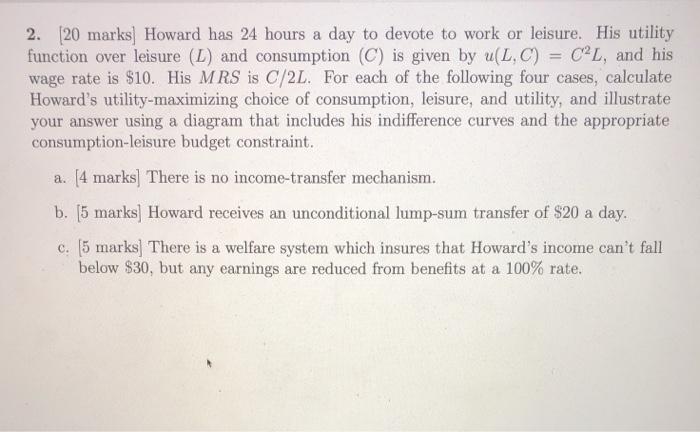
Question: I hope these notes help you get some idea what this question is about. 2. (20 marks) Howard has 24 hours a day to devote




![a day. c. (5 marks] There is a welfare system which insures](https://dsd5zvtm8ll6.cloudfront.net/si.experts.images/questions/2024/10/671412bee873b_766671412be68052.jpg)
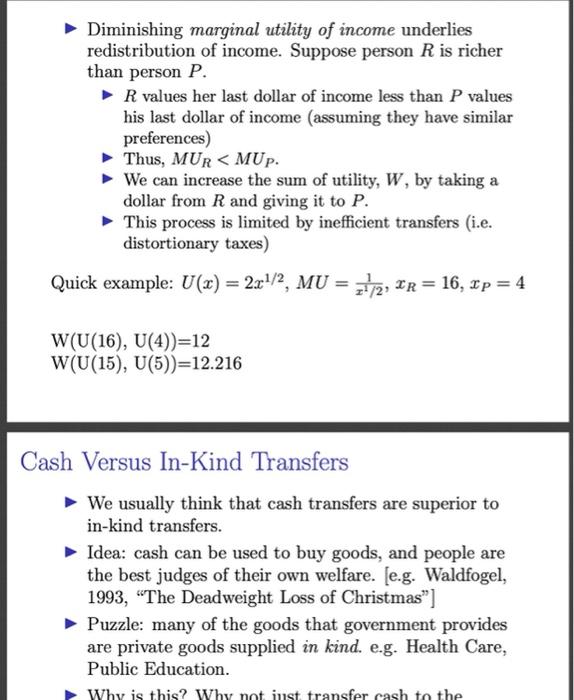
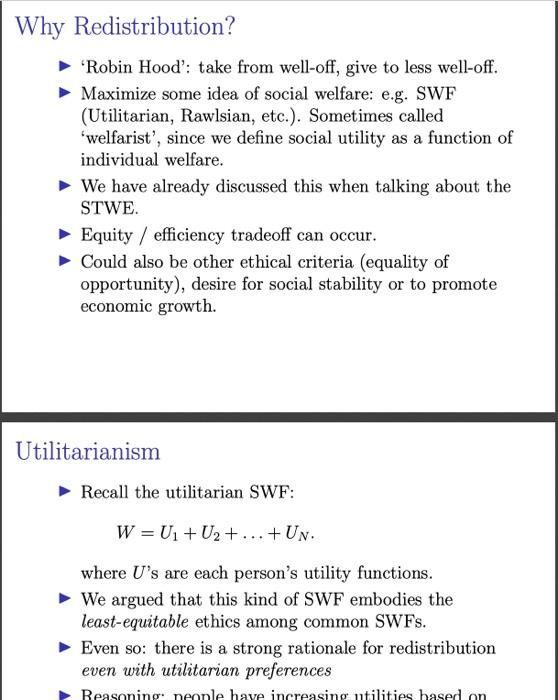
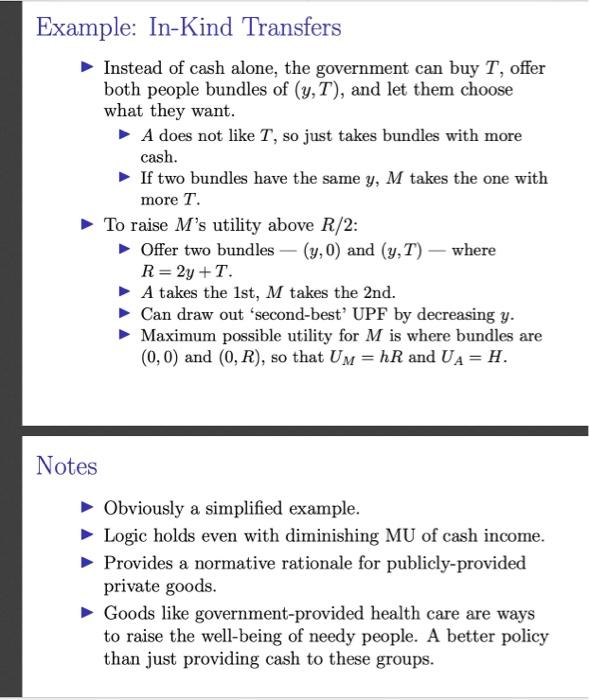
2. (20 marks) Howard has 24 hours a day to devote to work or leisure. His utility function over leisure (L) and consumption (C) is given by u(L,C) = CL, and his wage rate is $10. His MRS is C/2L. For each of the following four cases, calculate Howard's utility-maximizing choice of consumption, leisure, and utility, and illustrate your answer using a diagram that includes his indifference curves and the appropriate consumption-leisure budget constraint. a. [4 marks) There is no income-transfer mechanism. b. [5 marks) Howard receives an unconditional lump-sum transfer of $20 a day. c. (5 marks] There is a welfare system which insures that Howard's income can't fall below $30, but any earnings are reduced from benefits at a 100% rate. d. (6 marks) There is a negative income tax system which provides guaranteed benefits of $18 a day with an income tax of rate 20% (t = 0.2). (Assume that there is no tax once all of Howard's benefits have been clawed-back.) Utilitarianism Recall the utilitarian SWF: W = U. +U2+...+Un. where U's are each person's utility functions. We argued that this kind of SWF embodies the least-equitable ethics among common SWFs. Even so: there is a strong rationale for redistribution even with utilitarian preferences Reasoning: people have increasing utilities based on their income / consumption, but these utilities increase at a decreasing rate. Thus, diminishing marginal utility of income. Diminishing marginal utility of income underlies redistribution of income. Suppose person R is richer than person P. R values her last dollar of income less than P values his last dollar of income (assuming they have similar preferences) Thus, MUR 0 and 0.5
Step by Step Solution
There are 3 Steps involved in it

Get step-by-step solutions from verified subject matter experts
 Study Help